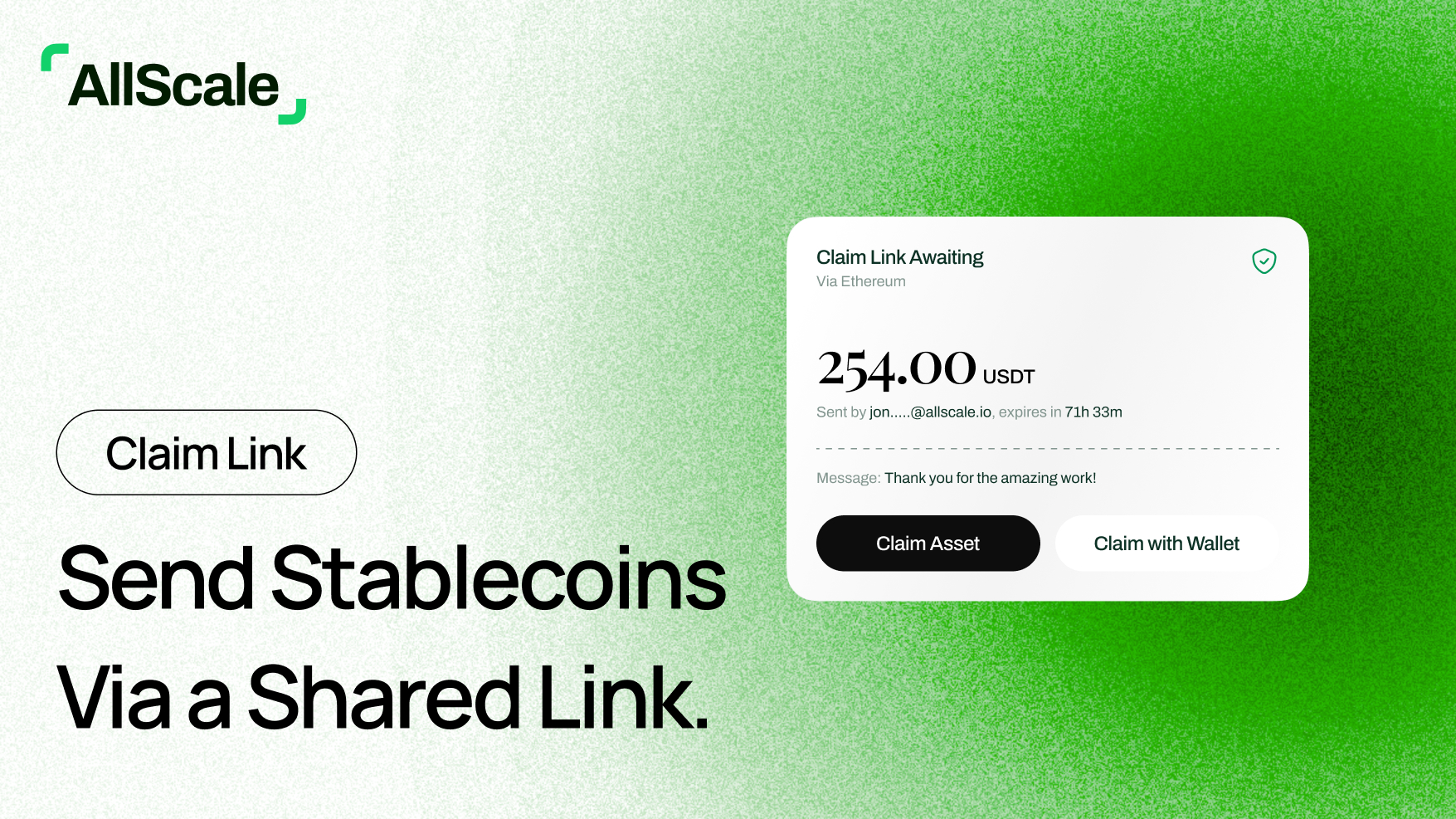
A complete business guide to stablecoins and digital dollars. Learn how stablecoins work, how they are used for payments, treasury, and cross-border transactions, and why they are becoming essential for modern businesses.

Stablecoins are cryptocurrencies engineered to hold a steady value by linking their price to a reserve asset — typically a fiat currency or commodity. That peg reduces the price swings you see with Bitcoin or Ethereum, making stablecoins a more reliable medium of exchange and store of value for day-to-day business transactions. This financial stability forms the core foundation of our AllScale Pay introduction and operational architecture.
Stablecoins are cryptocurrencies engineered to hold a steady value by linking their price to a reserve asset — typically a fiat currency or commodity. That peg reduces the price swings you see with Bitcoin or Ethereum, making stablecoins a more reliable medium of exchange and store of value for day-to-day business transactions.
There are a few common ways stablecoins keep a steady price. Many are collateralized: each token is backed by reserves such as cash, bonds, or other crypto assets. Fiat-backed stablecoins, for example, keep a dollar reserve for every token they issue so holders can redeem tokens at a fixed rate. Other stablecoins use algorithmic rules to expand or contract supply based on demand, aiming to hold the peg programmatically.
Below are concise comparisons of those approaches and how they work in practice.
Businesses typically encounter three broad stablecoin types, each suited to different use cases:
Over the past year, using stablecoins for business has transitioned from a niche tech experiment to a mainstream corporate liquidity strategy. Stablecoins can make business payments faster and cheaper. They settle quickly, cut intermediaries and fees, and make cross-border transfers simpler. Integrating stablecoins into payments can smooth cash flow and reduce the friction of global commerce. Research into digital commerce supports these practical benefits and also points to key adoption hurdles.
Stablecoin payments offer clear advantages for smaller businesses and early-stage companies:allscale-pay-introduction
AllScale provides a plug-and-play platform that makes it straightforward to accept stablecoin payments. This comprehensive approach to industry mapping and merchant infrastructure handles the tricky parts — integration, compliance automation, and operational plumbing — so teams can adopt stablecoins without deep blockchain expertise.
Using stablecoins for invoicing and payroll can reduce admin work, speed up payments, and lower costs. By serving as a reliable framework for global settlement, they eliminate the friction of traditional cross-border banking. They’re especially useful where fast settlement, minimal intermediaries, and predictable value are priorities.
Stablecoin invoicing brings several practical benefits:
Tokenized invoicing and DeFi‑backed receivables are emerging examples of how stablecoins can reshape working capital.
For distributed workforces and freelancers, stablecoin payrolls offer tangible improvements:
Doing business and checking out online are often slow, exposed, and complicated. At Allscale, we make things incredibly easy. Introducing Allscale Checkout. Finally, when you are placing an order online, you can pay with Allscale, and it is Web3 wallet friendly. You can enjoy instant settlement, zero knowledge privacy, and auto KYT. You can connect and manage your store in Allscale Checkout through an intuitive user interface with built-in protection for sensitive business information. Auto yield on stablecoins makes your assets grow effortlessly. 1.5 million registered Allscale wallets help bootstrap your business. Direct to your customers. True self-custody.
Growing use of stablecoins brings regulatory and security responsibilities. Businesses must understand local rules and adopt strong operational controls to use stablecoins safely and compliantly.
Key compliance steps include:
To protect funds and reputation, follow these practices:
Stablecoin adoption is poised to grow as businesses and consumers look for faster, lower-cost payment options. Expect more integrations, clearer regulation, and broader use in cross-border and platform-native payments.
Recent data show that stablecoin transaction volumes as a whole are growing quickly, with an increasing share used for business payments. This trend reflects broader acceptance where fast, predictable value transfers are important, especially in sectors with frequent cross-border activity.
SMEs and startups increasingly use stablecoins to make instant global payments, cut transaction costs, and better manage cash flow. These benefits help smaller companies operate more competitively on a global scale.
Stablecoins bring benefits but also risks. The regulatory environment is still evolving, which can create uncertainty. A stablecoin’s peg depends on the quality and management of its backing reserves — poor reserve practices can break the peg. Security risks such as hacks and fraud are also real, so firms should pair adoption with strong operational controls.
Unlike volatile cryptocurrencies such as Bitcoin or Ethereum, stablecoins are designed to hold a steady value through backing or algorithmic design. That makes them better suited for payments and business use, while traditional cryptocurrencies are more often used for investment or speculative purposes.
Yes. Stablecoins can speed up and lower the cost of cross-border payments by removing repeated currency conversions and reducing banking intermediaries. That efficiency is particularly helpful for companies with international suppliers or remote teams.
Stablecoins are a foundational element of DeFi. They act as a stable medium of exchange and accounting unit, enabling lending, borrowing, trading, and liquidity provisioning without the volatility of other crypto assets.
Start with practical training: workshops, webinars, and targeted sessions led by experts. Share case studies, internal playbooks, and curated resources so teams understand real-world use cases, risks, and operational steps. Encouraging open discussion helps teams make informed decisions about adoption.
Watch for clearer regulation, improved technical interoperability, and growing integration with mainstream payments. Advances in security and settlement speed will matter, and central bank digital currencies (CBDCs) could reshape partnerships and competition in the stablecoin space.