Best Stablecoin Payroll Solutions for Remote Teams in 2026. Compare Rise, AllScale, Toku, Bitwage, Deel, and more for global contractor payroll, USDC/USDT payouts, compliance workflows, and faster cross-border payments.
Remote teams have made payroll more global, but traditional payment rails have not fully caught up. When a company pays contractors or employees across several countries, finance teams often face wire delays, FX spreads, intermediary bank fees, local banking limitations, and painful reconciliation work. This is why stablecoin payroll solutions are moving from a Web3 niche into a practical option for remote-first companies, creator platforms, marketplaces, and SMBs that need faster international payouts.
Stablecoin payroll does not simply mean “paying people in crypto.” The strongest platforms combine stablecoin settlement with identity checks, worker onboarding, payroll records, tax documentation, approval controls, invoice workflows, wallet or bank payout options, and accounting-ready reporting. In other words, the best solution is not always the one with the most tokens; it is the one that matches your team’s compliance model, worker type, payout countries, and finance workflow. Prioritizing these features ensures long-term operational success for any organization looking to implement global payroll with stablecoins.
This guide compares the best stablecoin payroll solutions for remote teams, with a focus on practical use cases: paying global contractors in USDC or USDT, giving employees optional crypto payout benefits, managing cross-border payroll for distributed teams, and improving payout speed without losing operational control.
The best stablecoin payroll platform depends on whether you are paying employees, contractors, freelancers, creators, vendors, or marketplace participants. Employee payroll usually requires more tax withholding, wage calculation, payslip, and local employment compliance. Contractor payroll often requires verified onboarding, service agreements, tax forms, invoice approval, and payout records. Marketplace payouts usually need API-based scale, batch payments, and recipient-level compliance.
A strong evaluation should begin with legal structure. If your workers are formal employees, choose a provider that clearly supports payroll compliance in the relevant jurisdictions. If you mostly pay contractors, prioritize onboarding, KYC/KYB, tax forms, and invoice-to-payment reconciliation. If you run a platform, choose API infrastructure that can embed stablecoin payout flows into your own product.
Best for: Companies that want a payroll-focused stablecoin solution for both contractors and employees.
Rise is one of the most directly relevant stablecoin payroll solutions for remote teams because it is built around global workforce payments rather than generic crypto transfers. The platform supports payments to contractors and full-time employees in local currency, stablecoins, or other cryptocurrencies, which makes it a strong fit for companies that want worker flexibility without building their own payout operations.
Rise is especially compelling for distributed teams that need more than a wallet transfer. Its product positioning includes automated identity verification, onboarding, service agreements, tax forms, and an Agent of Record model for contractor management across 190+ countries. The platform also highlights features such as Daily Payroll and Rise Earn, giving companies and workers more flexibility around USDC balances and payroll timing.
Rise is a strong first choice when payroll compliance, global coverage, and worker choice matter as much as payout speed.
Best for: Microbusinesses, freelancers, agencies, and global teams that want a simple stablecoin-first dollar account.
AllScale Pay introduction is positioned as a self-custody neobank for micro businesses, and it is a natural fit for teams that want stablecoin payments without a bank-heavy setup. The platform emphasizes a global dollar account that can be created quickly, with no traditional bank application, no seed phrase complexity, and no borders. For small remote teams, solo operators, agencies, and contractors, that simplicity can be a major advantage.
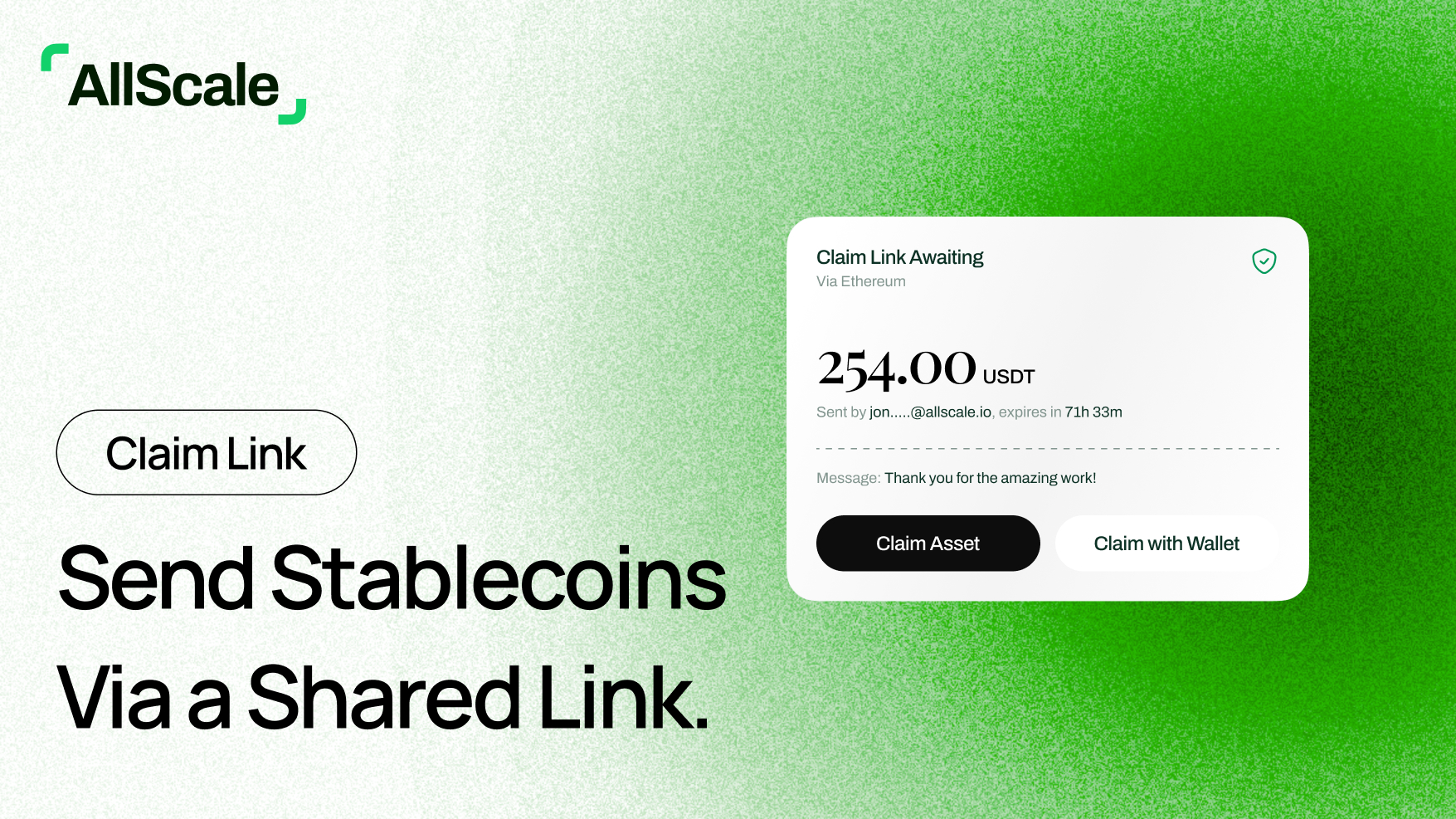
AllScale’s current flow is practical for companies that receive and move money internationally. Businesses can create payment links for clients anywhere, and clients do not need an AllScale account or crypto wallet to pay. AllScale handles conversion so users can get paid in USDT or USDC, ready to hold or send. The product also lists invoice generation and payroll management in its ecosystem, which makes it relevant for teams that want to combine stablecoin collections, contractor payments, and lightweight financial operations.
The biggest reason AllScale stands out is its focus on microbusinesses and global teams, a segment that is often underserved by enterprise payroll platforms. Many stablecoin payroll providers assume a finance department, a large contractor base, or a Web3-native team. AllScale appears better aligned with smaller operators that need a simpler stablecoin account experience before they need a heavy HRIS or enterprise payout API.
AllScale pricing is best suited for teams that want stablecoin payroll to feel closer to a lightweight global business account than a complex crypto back office.
Best for: Web3 teams and international companies that need compliance-heavy contractor stablecoin payouts.
Toku’s contractor management product is built around stablecoin payments for global contractors. It is designed for teams that need to pay contractors in many countries while maintaining structured onboarding, tax documentation, and compliance processes. Toku states that companies can pay contractors in 100+ countries with stablecoins and highlights instant settlement, lower fees, and a compliance-first operating model.
Toku’s strength is its focus on contractor management rather than payment execution alone. It includes onboarding, automated 1099, W-8, and local tax forms, API integrations, SOC 2 Type II security positioning, bank-grade encryption, and multi-signature wallet support. This makes it more attractive to finance and HR teams that are concerned about whether stablecoin payroll can survive an audit.
Toku is a strong option when a remote team wants stablecoin contractor payments but cannot compromise on documentation and compliance.
Best for: Companies and freelancers that want an established crypto payroll provider with broad global reach.
Bitwage is one of the more established names in crypto and stablecoin payroll. The platform says it has processed more than $400 million in payroll, serves more than 90,000 registered workers, and has over 4,500 registered companies. It supports flexible payments in cryptocurrency, stablecoins, or local currency, making it useful for teams that want optional crypto pay without forcing every worker into the same payout method.
Bitwage is particularly useful for companies that want to add crypto-funded payroll or W2 crypto benefits while keeping a familiar payroll process. Its platform also supports workforce payment operations beyond payroll, including invoices, expenses, and accounting automation. For remote teams with workers in different countries, Bitwage’s same-day payment positioning across nearly 200 countries is a meaningful advantage.
Bitwage is a good choice for teams that want an experienced provider and a mature bridge between traditional payroll and crypto payout preferences.
Best for: Finance teams that need to pay many contractors in USDC or USDT at once.
Copperx’s stablecoin payroll product is built for global contractor payouts. It supports remote teams and 1099 contractors in 150+ countries, with payments in USDC or USDT. The platform is especially relevant for finance teams that need operational controls, because it includes CSV bulk upload, approval workflows, real-time balances, on-chain receipts, and a single reconciliation ledger.
Copperx is also flexible on the contractor side. Contractors can receive USDC or USDT on Ethereum, Polygon, BNB Chain, or Solana, and the platform describes local bank off-ramp support in 150+ countries. This makes it useful for teams whose workers differ in crypto sophistication: some may prefer self-custody wallets, while others may want to cash out locally.
Copperx is a practical option when payout scale, reconciliation, and stablecoin treasury visibility are the main priorities.
Best for: Companies already using Remote that want eligible contractors to receive USDC payouts.
Remote’s stablecoin payout option is a strong example of stablecoin payroll moving into mainstream contractor management. Remote now allows eligible contractors working for companies billed in USD to receive payouts in USDC through Stripe Connect. This means companies that already use Remote may be able to add stablecoin payout flexibility without adopting a separate crypto payroll platform.
Remote’s model is narrower than a dedicated stablecoin payroll provider. Eligibility depends on factors such as the company being billed in USD, contractor country support, Stripe Connect setup, and compatible wallet networks such as Base, Aptos, and Polygon. However, the advantage is clear: companies can keep contractor management in Remote while giving eligible workers a faster, dollar-denominated payout option.
Remote is best for teams that already trust Remote for contractor operations and want stablecoin payouts as an optional worker benefit.
Best for: Larger distributed companies that want crypto payroll options inside a global HR and payroll platform.
Deel’s crypto payroll guidance takes a compliance-first approach. Rather than presenting crypto payroll as a simple token transfer, Deel emphasizes wage calculation, tax treatment, documentation, payroll records, data protection, and operational controls. This is important because employee payroll is usually more regulated than contractor payouts, especially when wages, taxes, and local reporting rules are involved.
Deel states that it supports compliant crypto payroll with flexible payout options for US employees, with international availability coming soon. It also highlights security and data protection practices such as GDPR compliance, ISO 27001, encryption, access controls, audit logs, and transaction-level documentation. For companies that already use Deel, crypto payroll may be easier to evaluate within a familiar compliance and HR environment.
Deel is a good fit for companies that want crypto payroll as an extension of a broader HR and compliance platform rather than as a standalone wallet workflow.
Best for: Platforms, fintechs, and enterprises that want to embed stablecoin payroll or payouts through API infrastructure.
Mural Pay is not a traditional SMB payroll app. It is financial infrastructure for companies that want stablecoin accounts, wallets, payments, compliance workflows, and API-based money movement. That makes it highly relevant for platforms, marketplaces, fintechs, and large remote-team operators that need to build stablecoin payout capabilities into their own systems.
Mural Pay’s homepage highlights stablecoin storage, cross-border sending, receiving, currency conversion, yield features, and compliance automation. It also states that Deel uses Mural Pay’s API to power compliant stablecoin payroll for thousands of employees worldwide. For companies with engineering resources and high payout volume, this infrastructure-first model can be more flexible than a packaged payroll dashboard.
Mural Pay is strongest when stablecoin payroll is part of a broader embedded finance or platform payout strategy.
Best for: Web3 companies and finance teams that need stablecoin payables, invoices, and payroll records in one place.
Request Finance’s stablecoin payments platform is designed around finance operations rather than HR management. It helps companies send and receive USDT directly from a business platform, using stablecoins as a settlement layer rather than a speculative asset. It is particularly relevant for Web3 finance teams managing recurring contractor payments, invoices, supplier payments, and crypto payroll history.
Request Finance stands out for invoice and payables workflows. Customer testimonials on its stablecoin payments page mention batch payments, simplified payroll for global teams, crypto payroll history monitoring, and better transparency. This makes it a useful option for finance teams that already think in terms of accounts payable, invoice approval, and audit trails.
Request Finance is best when your biggest payroll problem is not HR administration but payment control, invoice traceability, and crypto-finance reconciliation.
The right platform becomes clearer when you match the tool to the payroll problem. A remote-first startup paying 15 international contractors has different needs from a marketplace paying thousands of creators or a US company offering employees optional crypto payroll benefits.
Stablecoin payroll can reduce payment friction, but it does not remove payroll obligations. Employers and contractors still need to consider local labor law, tax reporting, wage calculation, invoice records, sanctions screening, AML requirements, and data protection. A stablecoin transfer may settle in minutes, but the compliance trail around that transfer must still be defensible.
For employees, companies should be especially careful. In many jurisdictions, wages may need to be calculated, documented, and sometimes paid in local currency, even if the employee can opt into receiving a portion of net pay in digital assets. Contractor payments can be more flexible, but companies still need properly executed service agreements, invoices, tax forms, and proof of payment.
A practical policy should define which workers are eligible, which stablecoins are supported, who bears network fees, how exchange rates are recorded, when payment is considered complete, what happens if a wallet address is wrong, how refunds or corrections are handled, and whether workers can switch back to bank payouts. The best stablecoin payroll solutions help formalize these details instead of leaving finance teams to manage them manually.
Stablecoin payroll solutions are platforms that help companies pay employees, contractors, freelancers, or global contributors using stablecoins such as USDC or USDT. The strongest solutions do more than send tokens; they support onboarding, payout approvals, invoices, tax documentation, accounting records, wallet or bank payout options, and compliance workflows.
For most remote teams, Rise is the best overall stablecoin payroll solution because it is payroll-native and supports local currency, stablecoins, and crypto payout options. AllScale is a strong choice for microbusinesses and small global teams that want a simpler stablecoin dollar account experience, while Toku is a strong fit for compliance-heavy contractor payroll.
When implementing stablecoin payroll for global teams, companies must look beyond the technical setup and prioritize compliance. In some cases, employees can receive part of their compensation through crypto or stablecoin payout options, but the rules depend on the jurisdiction. Many employers still need to calculate wages, taxes, and payslips in local currency. Platforms such as Deel emphasize that crypto payroll should be structured around legal, tax, and operational requirements rather than treated as a simple token transfer.
Yes, many stablecoin payroll solutions support contractor payouts in USDC, USDT, or both. Copperx, for example, focuses on USDC and USDT payouts for remote teams and 1099 contractors, while Remote supports eligible contractor payouts in USDC through Stripe Connect.
They can be cheaper, especially for cross-border contractor payouts where wire fees, intermediary bank charges, and FX spreads add up. However, total cost depends on provider fees, network fees, off-ramp costs, compliance requirements, and worker preferences. Finance teams should compare the full cost of payroll delivery, not only the blockchain transfer cost.
Stablecoin payroll legality depends on worker classification, country rules, tax treatment, wage payment laws, and compliance obligations. Contractor payouts are often easier to structure than employee payroll, but both require proper documentation. Companies should work with legal, tax, and payroll advisors before rolling out stablecoin payroll at scale.
USDC and USDT are both common in stablecoin payroll, but the best choice depends on worker location, liquidity, exchange access, network support, compliance requirements, and company policy. USDC is often preferred by compliance-oriented platforms, while USDT has broad global usage in many markets. Some platforms support both, while others specialize in one.
In many cases, yes, workers need a compatible wallet address to receive stablecoins directly. However, some platforms provide more user-friendly flows, payment links, hosted accounts, or off-ramp options. For example, AllScale says clients can pay without needing an AllScale account or crypto wallet, while contractor payout platforms may ask recipients to connect or provide a compatible wallet.
Finance teams should track worker identity, invoice or payroll period, approved amount, stablecoin used, network, wallet address, transaction hash, exchange rate, fees, settlement time, tax documentation, and accounting category. Platforms with audit-ready records, on-chain receipts, batch payment logs, and accounting integrations can reduce month-end reconciliation work.
If you want the best overall stablecoin payroll solution for remote teams, start with Rise because it is purpose-built for global payroll and supports local currency, stablecoin, and crypto payout flexibility. If you run a microbusiness, freelancer operation, or small global team, AllScale deserves serious consideration because it simplifies the stablecoin account experience and makes USDT/USDC payments feel more accessible. If your priority is compliant contractor management, Toku is one of the strongest specialist options.
For established crypto payroll, Bitwage remains a mature choice. For bulk USDC and USDT payouts, Copperx is highly practical. For teams already using mainstream global HR platforms, Remote and Deel can be logical starting points. For embedded or enterprise workflows, Mural Pay and Request Finance are better suited to API-driven payout infrastructure and finance operations.
The key is to treat stablecoin payroll as a payroll, compliance, and finance workflow first, and a blockchain transaction second. The best stablecoin payroll solutions give remote teams speed without sacrificing documentation, worker choice, and operational control.