
The best stablecoin payment gateway is not necessarily the one that accepts the most coins. It is the one that lets your customers pay with assets they already have, settles into an asset your finance team can use, and does not create more work in refunds, compliance, or reconciliation than it removes.
That distinction matters because “accept crypto” can describe very different products. One gateway may accept USDC and pay the merchant in dollars. Another may accept hundreds of tokens but deposit funds into a custodial platform balance. A third may swap the customer’s token and send USDT or USDC directly to a wallet controlled by the merchant.
We reviewed nine stablecoin payment gateways across the same eight criteria: customer payment options, merchant settlement currency, custody, fees, settlement timing, integrations, payment operations, and compliance controls. The result is not a universal ranking. Each platform below is the best fit for a particular operating model.
Disclosure: AllScale publishes this guide and offers one of the products reviewed. We apply the same criteria to every provider, link to public pricing and documentation, and include AllScale’s current limitations. Product availability and pricing were checked on August 14, 2026.
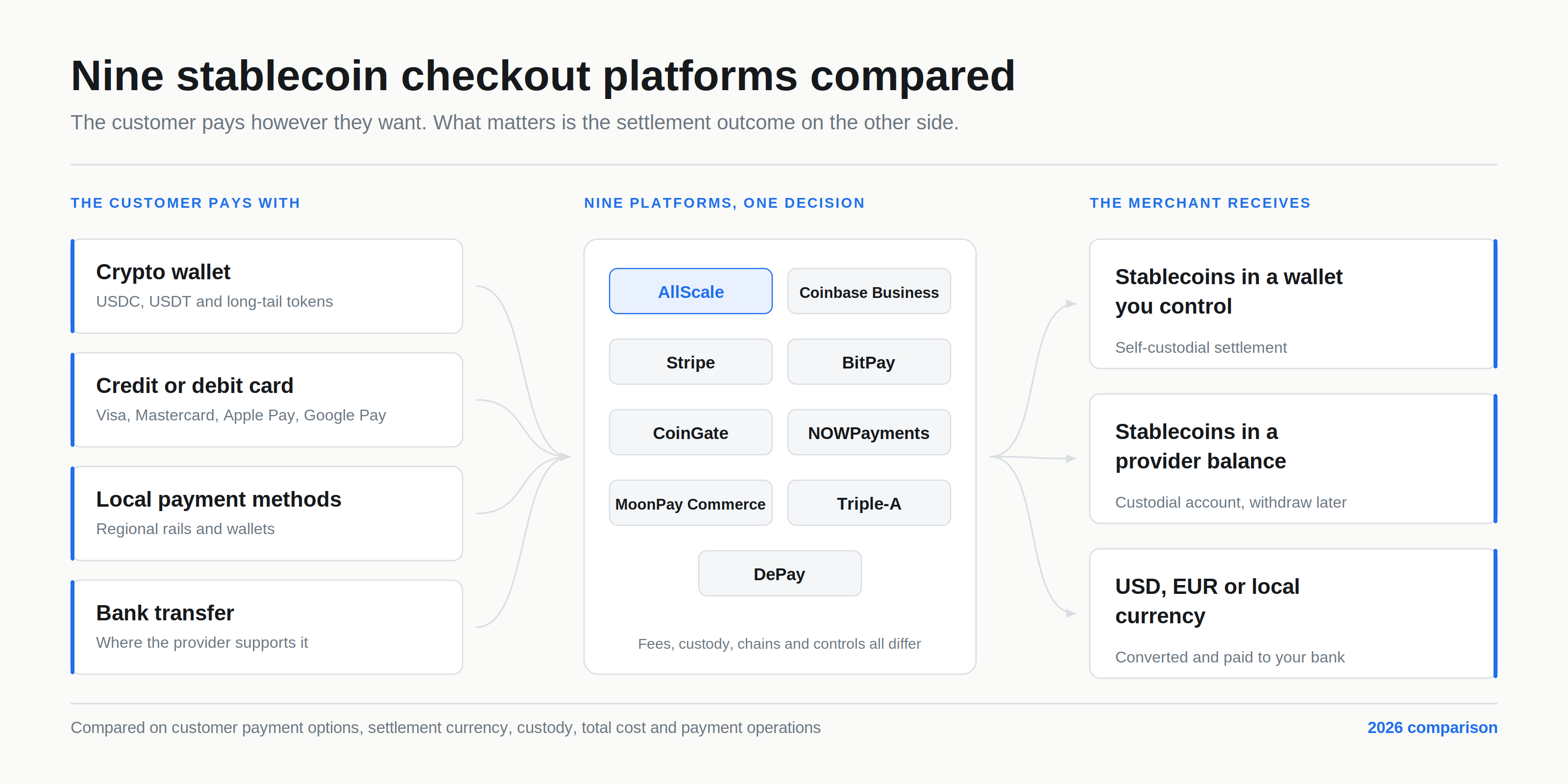
TL;DR: The Best Stablecoin Payment Gateways by Use Case
AllScale: Best for merchants that want customers to pay by card, local payment method, bank transfer, or crypto while the merchant receives USDT/USDC in a self-custody wallet.
Coinbase Business: Best for US and Singapore businesses that want a custodial USDC operating account with payments, trading, and bank off-ramps.
Stripe: Best for existing US Stripe merchants that want to add stablecoin acceptance but continue settling and reporting in USD.
BitPay: Best for established businesses that want a mature processor and a configurable mix of fiat and crypto settlement.
CoinGate: Best for ecommerce merchants that want common plugins, fiat or crypto settlement, and simple published pricing.
NOWPayments: Best for businesses that prioritize the widest possible token coverage and automatic conversion.
MoonPay Commerce: Best for Web3 apps, Shopify stores, gaming deposits, and recurring crypto subscriptions.
Triple-A: Best for regulated, sales-led enterprise deployments with local-currency settlement.
DePay: Best for merchants that want decentralized, wallet-to-wallet settlement and any-token-to-selected-token conversion.
Quick Comparison Table
*Headline fees are not an all-in cost. Network fees, swap spreads, card/on-ramp fees, off-ramp fees, refunds, FX, minimums, and enterprise pricing can materially change the result. Always run a quote using your actual order distribution.
Why You Can Trust This Review
AllScale publishes this review and is one of the products included. To reduce that conflict, we used the same public-source checklist for every platform, linked claims to official product documentation or pricing pages, and included concrete limitations for AllScale as well as its competitors. Product availability and pricing were last fact-checked on August 14, 2026.
This is a documentation-based comparison, not a claim that we opened and production-tested merchant accounts with all nine providers. Before choosing a gateway, merchants should run their own test orders and verify current pricing, country eligibility, asset support, and contract terms.
We evaluated each platform using the following criteria.
We used the following questions because they map to the work a merchant must perform after the integration—not just to what looks good on a product page.
1. What can the customer use to pay?
Count the useful payment options, not only the number of token symbols. A customer holding BNB on BNB Chain does not benefit from a checkout that accepts USDC only unless the payment flow can swap or bridge the asset. A non-crypto customer needs a card, bank, or local-payment on-ramp rather than a longer list of wallets.
2. What does the merchant receive?
“Crypto accepted” does not tell a finance team whether it will receive USD in a processor balance, USDC in a custodial account, the original volatile token, or a merchant-selected stablecoin in its own wallet. This is usually the most important difference between providers.
3. Who controls the funds?
With custodial settlement, the provider holds funds until withdrawal or bank payout. That can make refunds, accounting, and fiat conversion easier. With non-custodial settlement, funds move to a wallet controlled by the merchant, reducing counterparty and withdrawal risk but making the merchant responsible for wallet security, refunds, and treasury operations.
4. What is the actual cost?
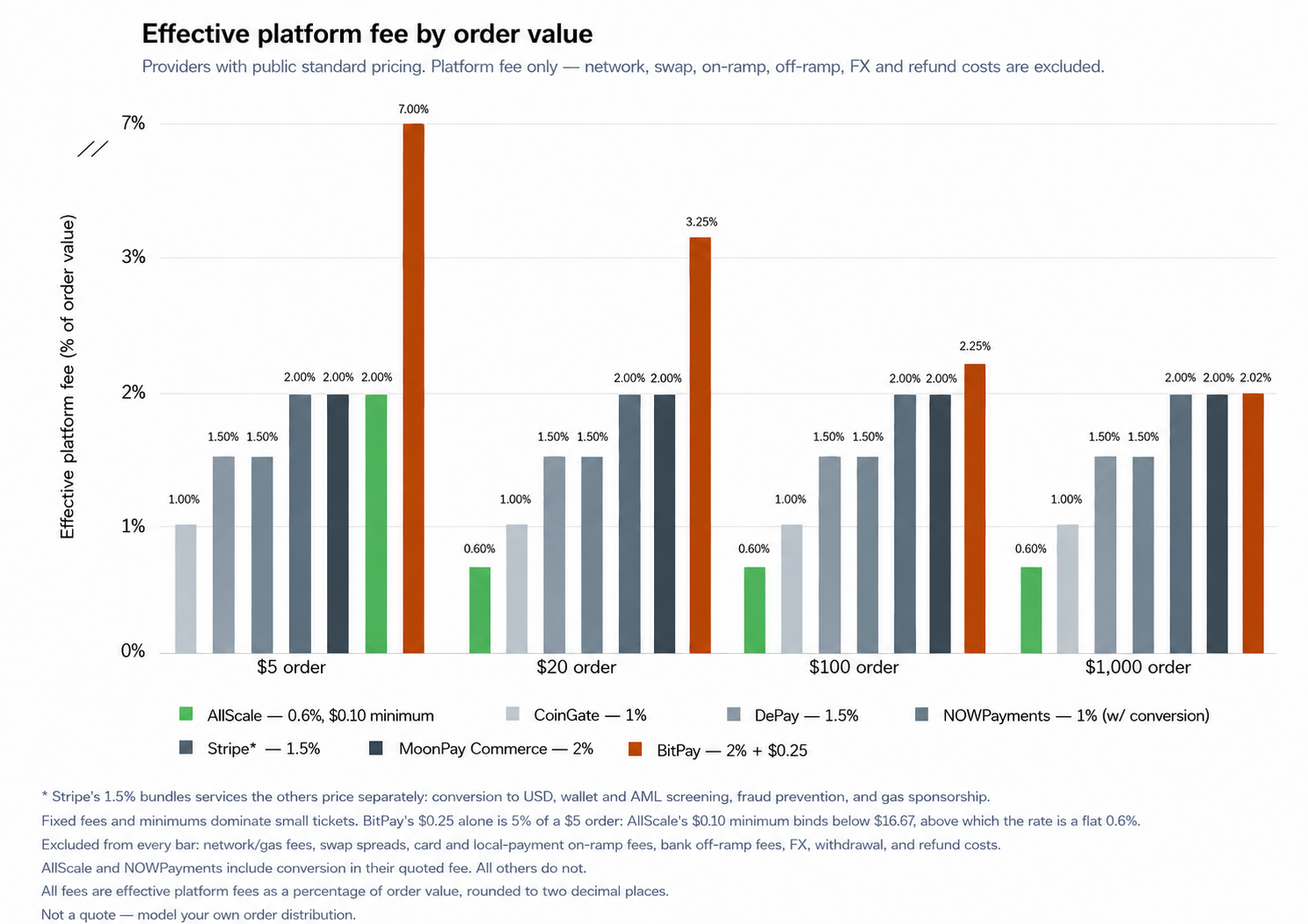
We looked beyond the processing percentage to fixed fees, minimums, gas, token conversion, card on-ramp, bank off-ramp, FX, and withdrawal costs. A 0.6% headline price can behave like 2% on a $5 transaction if there is a $0.10 minimum. A 1.5% price that includes gas and conversion may be cheaper than a 1% price with two network transfers and a swap.
5. Can the payment be operated like a real payment system?
The checkout must handle expiring quotes, underpayments, overpayments, webhook retries, refunds, order IDs, transaction hashes, duplicate callbacks, and reporting. These details determine how many support tickets and reconciliation exceptions a gateway creates.
How to Choose a Stablecoin Payment Gateway
Start with the payment outcome rather than the provider’s coin count. A useful buying process should answer four questions in order: what customers already have, what the merchant wants to receive, who should control the funds, and what the complete operational cost will be.
Match customer payment inputs to merchant settlement output
A cross-border software seller may serve three very different buyers: one holds BNB on BNB Chain, one holds USDC on Base, and one has only a local bank account or Visa card. Requiring all three to acquire the same token before checkout creates avoidable abandonment.
Gateways with swap, bridge, or on-ramp capabilities can separate the customer’s payment method from the merchant’s settlement asset. When comparing them, request the exact matrix of input token, input chain, output token, and output chain. “Supports 300 cryptocurrencies” does not guarantee that every input can be converted into the stablecoin and network your treasury team selected.
Choose custody deliberately
Custodial settlement can simplify bank payouts, role controls, refunds, and accounting. Non-custodial settlement gives the merchant immediate wallet control and reduces provider withdrawal risk, but also makes the merchant responsible for wallet security, treasury movements, and often refunds.
Neither model is automatically better. Document who controls the funds at payment confirmation, during compliance screening, before withdrawal, and during a refund.
Model total cost using actual order sizes
Do not compare headline percentages in isolation. Include platform fees, fixed charges, minimums, gas, swaps, card on-ramps, bank off-ramps, FX, withdrawal, and refund costs. Calculate the effective rate at the 10th, 50th, and 90th percentile order values—not just average monthly GMV.
For example, a $0.10 minimum equals 2% of a $5 order, while a $0.25 fixed fee equals 5% before any percentage charge. Fixed and minimum fees become almost irrelevant on a $5,000 order.
Test payment operations before launch
At minimum, test a successful payment, expired quote, late payment, underpayment, overpayment, wrong network, compliance rejection, duplicate webhook, delayed webhook, browser closed before redirect, and refund. Store the provider transaction ID, merchant order ID, chain, token, gross amount, fee, net amount, wallet, and transaction hash.
Fulfillment must be idempotent: receiving the same webhook twice must never ship an order twice. Complete a mock weekly or monthly accounting close before enabling the gateway for all customers.
Consider where stablecoin checkout fits best
Stablecoin checkout is particularly useful for cross-border digital goods, SaaS, services, travel, high-value retail, crypto-native buyers, and merchants that can reuse stablecoin revenue for suppliers or contractors.
It may be a poor primary payment method when most customers lack wallets or low-friction on-ramps, order values are too small for minimum and network fees, the business depends on card-style consumer dispute rights, or the finance team is not prepared to manage wallets and on-chain reconciliation.
A practical rollout is to add stablecoins alongside cards, then measure payment-method selection, completion rate, support contacts, average order value, net processing cost, refunds, and time to usable funds.
Use three test cases to expose meaningful differences
Customer has BNB; merchant wants USDC. A stablecoin-only gateway may force the buyer to leave, swap, and return. A routing gateway can convert a supported input, but the merchant should compare the quote, spread, network transfers, gas payer, and final net USDC.
Customer has no wallet; merchant wants USDC. A card-funded on-ramp can close the access gap. It does not eliminate the card rail: the provider may require identity verification and charge a separate on-ramp fee. Do not assume the wallet-funded fee or finality model applies.
A $5,000 order needs finality and a refund policy. An authenticated wallet payment avoids a card-network dispute that automatically debits the merchant, but a legitimate customer can still be owed a refund. Compare dashboard/API refunds with manual wallet refunds, destination verification, exchange-rate handling, and accounting updates.
Run this implementation checklist
- List the five most important customer countries, wallets, assets, networks, and non-crypto payment methods.
- Choose the merchant settlement asset and chain before requesting provider quotes.
- Confirm exactly who pays platform, network, conversion, on-ramp, off-ramp, and refund costs.
- Complete merchant KYB and review restricted jurisdictions and industries.
- Distinguish provider KYT screening from the merchant’s own KYC, sanctions, tax, and recordkeeping obligations.
- Use a dedicated settlement wallet with appropriate multisig or role controls.
- Restrict and rotate API keys; keep secrets outside source code.
- Write a refund SOP and train support on pending, confirmed, failed, screened, underpaid, and refunded states.
1. AllScale — Best for flexible customer payments with self-custody stablecoin settlement
Overview
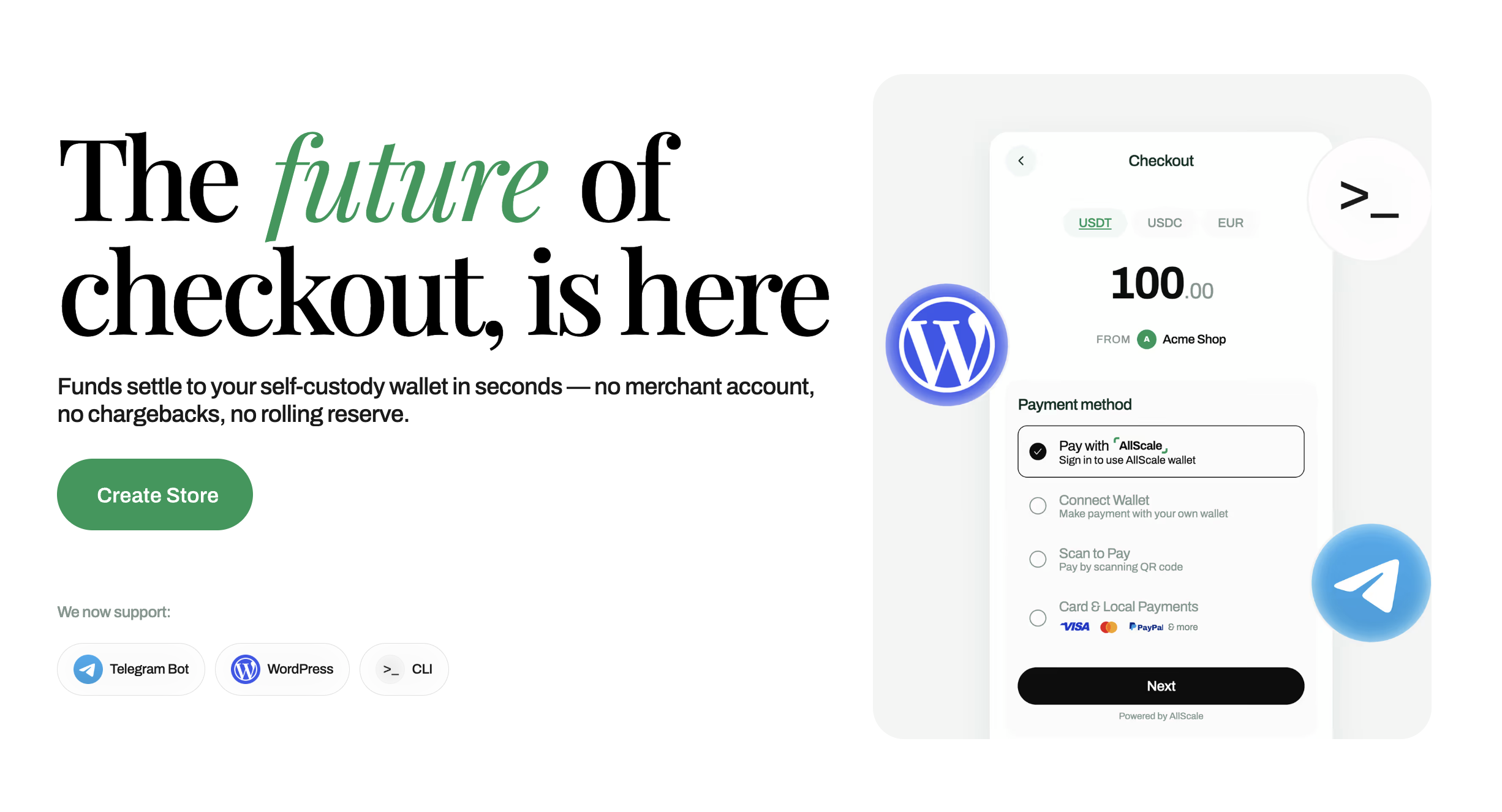
AllScale Checkout separates how the customer pays from what the merchant receives. A customer can use crypto from an AllScale or third-party wallet, while card and local payment options support Visa, Mastercard, Apple Pay, Google Pay, and region-dependent local methods. AllScale’s public documentation also describes bank-transfer and auto-bridge/swap flows. The merchant chooses stablecoin settlement rather than inheriting the customer’s asset exposure.
This architecture is useful when a merchant wants one treasury asset but serves several types of buyers. A crypto-native customer might pay with a token already in a wallet. A mainstream customer might use a card in local currency. The merchant can still receive USDT or USDC in a self-custody wallet on a supported chain.
AllScale’s documented WooCommerce crypto checkout price is 0.6% per transaction with a $0.10 minimum. The WordPress plugin records the AllScale transaction ID, order ID, chain, transaction hash, paid amount, fee, and net amount. Webhooks use HMAC-SHA256 signatures, timestamps, and nonces, which gives developers the primitives needed to prevent tampering and replay.
Incoming crypto transactions are screened with Auto-KYT before routing to the merchant. AllScale’s policy states that a failed screening is returned to the originating wallet. This is useful transaction-risk infrastructure, but merchants must still determine whether their own jurisdiction or business model requires customer KYC, sanctions controls, licensing, or additional recordkeeping.
There is early real-world distribution, although not yet the operating history of a BitPay or Stripe. A partnership with Bravo Rewards connects AllScale checkout functionality with a network of more than 450 Vancouver restaurants and a reported 45,000 registered Bravo users.
Best For
Cross-border ecommerce, digital goods, creators, and merchants that want to standardize diverse customer payment methods into self-custodied USDT/USDC.
Key Features
- Crypto-wallet, card, local-payment, and documented bank-transfer routes.
- Merchant-selected USDT/USDC settlement on supported chains.
- Non-custodial merchant wallet, Auto-KYT screening, and signed webhooks.
- WooCommerce plugin plus hosted/API-oriented commerce tooling.
Pros
- Card/local-payment and crypto-wallet paths can feed stablecoin settlement.
- Merchant retains control of the settlement wallet.
- Auto-swap/bridge reduces the need for a buyer to hold the exact settlement token.
- 0.6% documented crypto-checkout fee is competitive for medium and high order values.
- Auto-KYT and signed webhooks address two common gaps in direct-wallet payment flows.
Cons
- Automatic refunds are not currently available in the documented WooCommerce flow; the merchant sends funds back and updates the order status.
- The public WooCommerce plugin is new and has a smaller install base than plugins from longer-established processors.
- Card and local-payment transactions use third-party on-ramp providers. A first-time buyer may need identity verification, and the provider shows its own final amount and fees before confirmation.
- The $0.10 minimum makes the effective platform fee 2% on a $5 order before any network or conversion cost.
- Merchants should confirm the current token-by-chain matrix and whether a specific customer payment route settles in USDT or USDC before launch.
Pricing
The documented WooCommerce crypto-checkout fee is 0.6% per transaction with a $0.10 minimum. Card, local-payment, swap, network, and provider-specific costs must be confirmed separately for the chosen route.
Why We Picked It
AllScale is included for its unusually clear separation between customer input and merchant output: several payment methods can feed a merchant-selected stablecoin in a wallet the merchant controls. We did not treat it as the universal winner because its refund automation and plugin ecosystem remain less mature than those of longer-established processors.
2. Coinbase Business — Best custodial stablecoin operating account for US and Singapore businesses
Overview
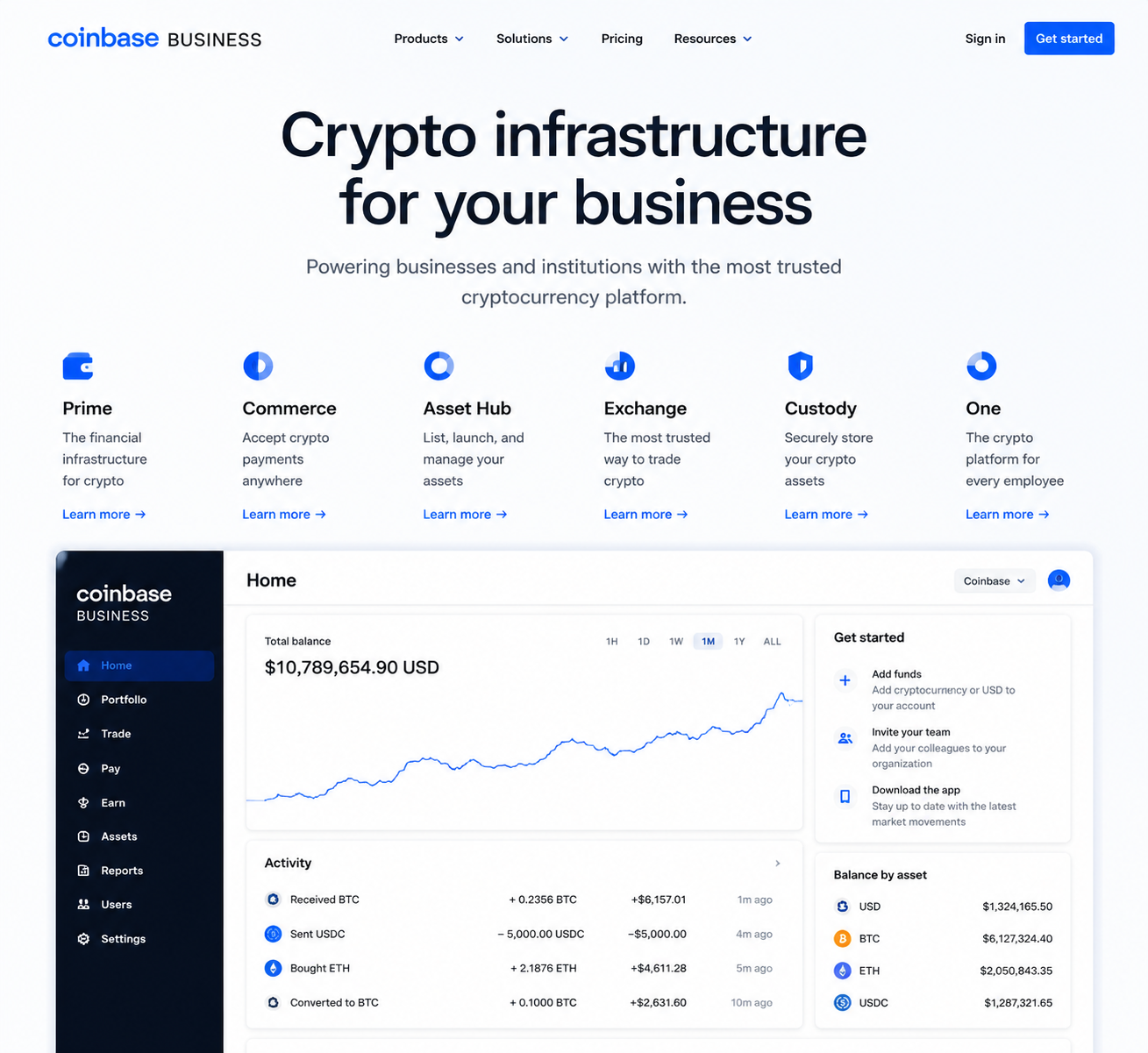
Coinbase Business replaced the former Coinbase Commerce product in 2026. The change is operationally important: Coinbase Commerce was associated with broad, self-custodial crypto acceptance, while Coinbase Business is a custodial, stablecoin-first business account.
Customers can pay in USDC across Ethereum, Base, Polygon, Optimism, and Arbitrum. Funds arrive in the merchant’s Coinbase Business account in USDC, and the merchant can enable conversion to USD or withdraw to a connected bank. Coinbase also offers payment links, invoices, checkout APIs, webhooks, trading, payouts, and accounting integrations in the same account.
That consolidation can be attractive to a US startup that wants fewer vendors and does not want to manage private keys. It is less attractive to a merchant whose primary requirement is immediate settlement to a self-custody wallet.
Best For
US and Singapore businesses that want stablecoin acceptance, treasury, trading, off-ramp, and accounting tools inside one regulated custodial account.
Key Features
- USDC checkout on Ethereum, Base, Polygon, Optimism, and Arbitrum.
- Payment links, invoices, checkout APIs, and webhooks.
- Trading, payouts, accounting integrations, and connected-bank withdrawals.
- Transaction monitoring and sanctions screening.
Pros
- USDC settlement in seconds inside Coinbase Business.
- Payment links, invoices, APIs, webhooks, and bank connectivity.
- Built-in transaction monitoring and sanctions screening.
Cons
- Coinbase Business is currently available only in the United States and Singapore, with other markets planned.
- The payments suite is stablecoin-first rather than a broad any-token checkout.
- Funds settle into Coinbase custody, not directly to a merchant-controlled wallet.
- Payment and USDC-to-USD conversion fees are visible after login rather than on a public rate card, which makes pre-sales cost comparison harder.
Pricing
Coinbase states that it charges a fee on completed payments and that another fee can apply to automatic USDC-to-USD conversion. Current rates are shown inside the merchant account rather than on a public pricing page.
Why We Picked It
Coinbase Business is a strong reference point for merchants that prefer an integrated custodial operating account over self-custody. Its geographic limitation and private rate card prevent it from being a broad default recommendation.
3. Stripe — Best for existing US Stripe merchants that want USD settlement
Overview
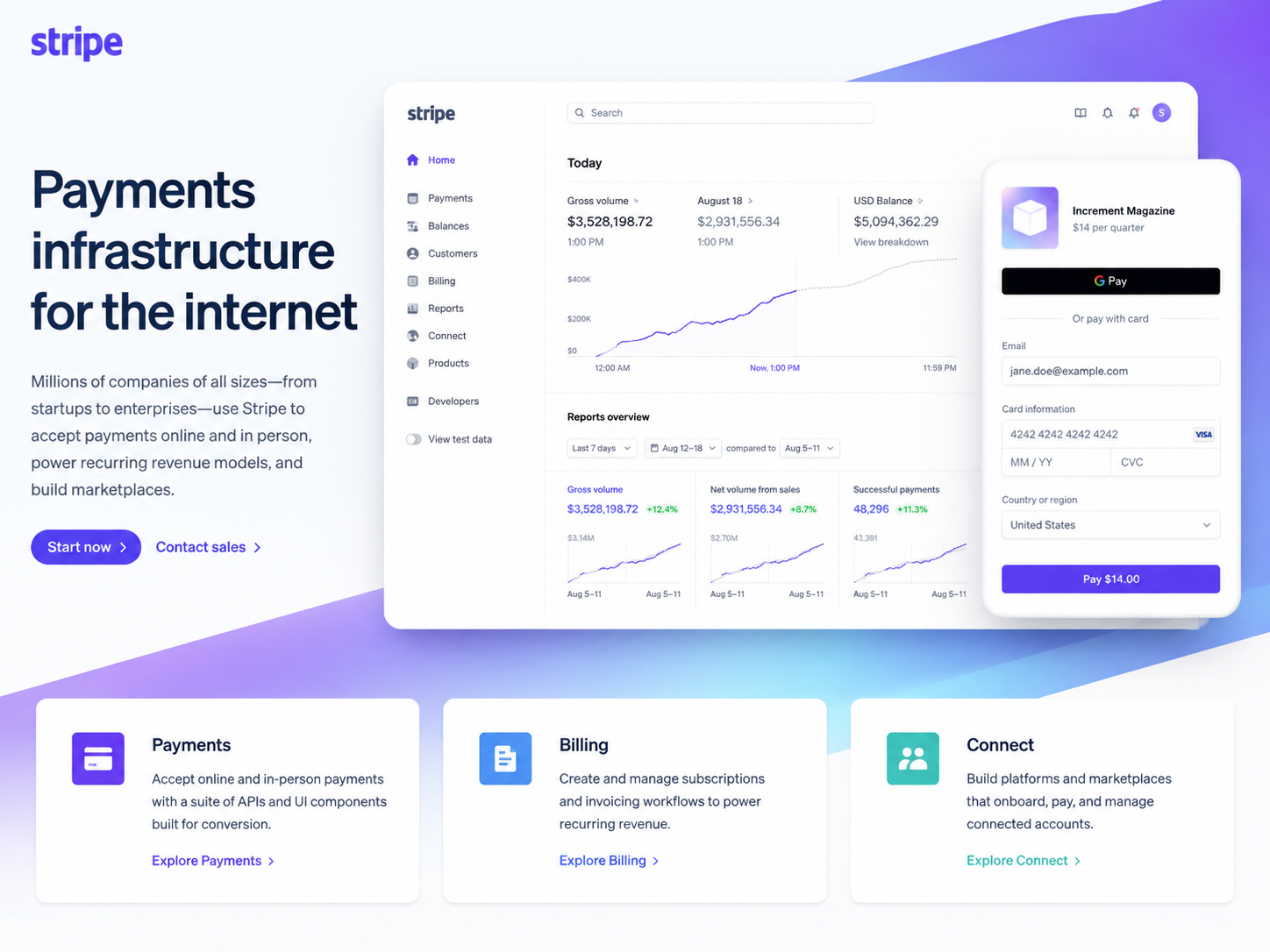
Stripe stablecoin payments are designed to make crypto look like another payment method inside an existing Stripe integration. Customers pay with supported stablecoins from a wallet, but the merchant receives USD in its Stripe balance. Stripe handles conversion, wallet and AML screening, fraud prevention, and gas sponsorship for a published 1.5% fee.
The operational advantage is consistency. Stablecoin payments work with Stripe Checkout, Elements, Payment Links, Invoicing, Billing, and Connect. Stripe supports full and partial refunds, and its subscription product supports recurring stablecoin payments.
The trade-off is that this is not stablecoin settlement for the merchant. It is stablecoin acceptance followed by fiat settlement. It is therefore a strong option for businesses that want to add crypto demand without changing treasury or accounting, but the wrong fit for a business that specifically wants USDT or USDC in its own wallet.
Best For
Existing US Stripe users that want a low-lift stablecoin payment option while keeping USD reporting and payouts.
Key Features
- Stablecoin support through Checkout, Elements, Payment Links, Invoicing, and Billing.
- USD settlement into the existing Stripe balance.
- Full and partial refunds plus recurring stablecoin payments.
- Gas sponsorship, wallet/AML screening, and fraud prevention included in the fee.
Pros
- One dashboard and integration alongside cards and other Stripe payment methods.
- 1.5% includes fiat conversion, screening, fraud prevention, and gas sponsorship.
- Full and partial refunds, subscriptions, Invoicing, Payment Links, and Connect support.
- No crypto chargeback process after a customer-authenticated wallet payment.
Cons
- Only US businesses can currently accept stablecoin payments.
- All payments settle in USD to the Stripe balance, not in stablecoins to the merchant’s wallet.
- Supported payment assets are limited to USDC, USDP, and USDG on specified networks.
- Stripe documents a limit of $10,000 per transaction and $100,000 per month.
Pricing
Stripe publishes a 1.5% fee on the USD transaction amount. The price includes conversion to fiat, wallet and AML screening, fraud prevention, and gas sponsorship.
Why We Picked It
Stripe is the clearest choice for an existing US Stripe merchant that wants stablecoin demand without changing its fiat treasury workflow. It is not a stablecoin-settlement recommendation because the merchant receives USD rather than USDC or USDT.
4. BitPay — Best mature processor for split fiat and crypto settlement
Overview
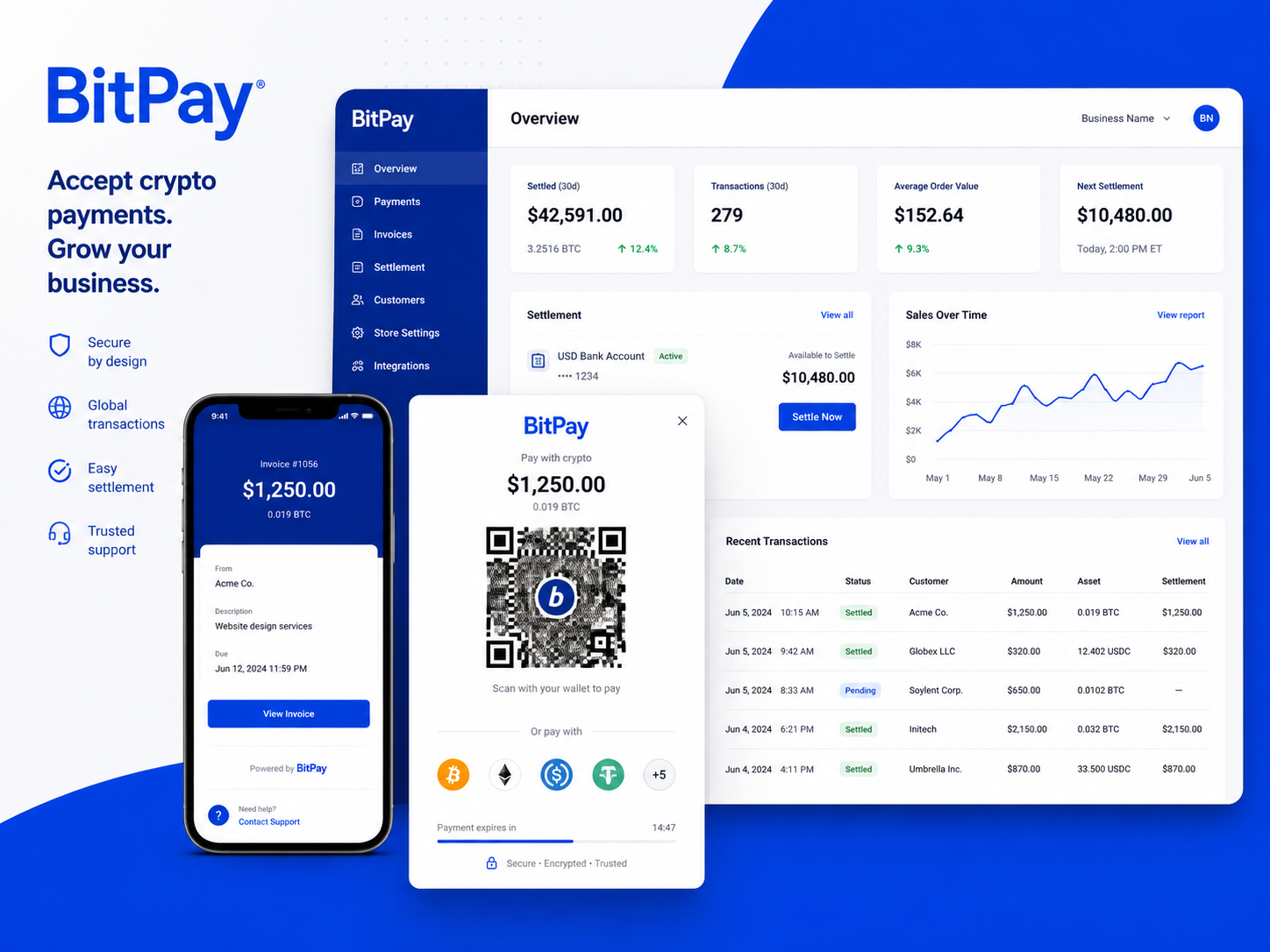
BitPay has processed crypto payments since 2011 and offers online checkout, ecommerce plugins, invoices, in-store POS, and B2B payment tools. Customers can pay with major cryptocurrencies and stablecoins from more than 100 supported wallets. Merchants can settle in local currency, crypto, or a percentage split between the two.
BitPay behaves more like a traditional processor than a direct-wallet checkout. It generates an invoice, locks an exchange rate, receives the customer’s payment, and settles according to the merchant’s settings. Fiat settlement is initiated the next business day; crypto settlements are processed daily and have asset-specific minimums.
The platform is most compelling when maturity, compliance, fiat settlement, and omnichannel support matter more than the lowest possible fee. BitPay’s own 2025 data says stablecoins represent 40% of its transaction volume and have average transaction values three to four times those of volatile cryptocurrencies. That is provider-reported data, but it is a useful signal that stablecoin acceptance is no longer limited to small experimental purchases.
Best For
Established online or physical merchants that need a long-running processor and configurable fiat/crypto settlement.
Key Features
- Online checkout, ecommerce plugins, invoices, in-store POS, and B2B tools.
- Local-currency, crypto, or percentage-split settlement.
- Locked exchange-rate invoices and support for 100+ wallets.
- Daily settlement and an established merchant compliance program.
Pros
- Online, invoice, POS, payout, and common ecommerce integrations.
- Fiat, crypto, or split settlement.
- Locked exchange-rate checkout and established compliance program.
- Long operating history and broad wallet support.
Cons
- Standard pricing below 500,000 in monthly volume is 2% + $0.25, higher than several crypto-native alternatives.
- Settlement is batched daily rather than sent directly to the merchant at the moment of purchase.
- Crypto settlement minimums apply; BitPay currently lists a 200-unit minimum for USDC and USDT settlement.
Pricing
BitPay charges 2% + $$0.25 per transaction below$$500,000 in monthly volume, 1.5% + $$0.25 from$$500,000 to $$999,999, and 1% +$$0.25 at $1 million or more. Higher rates can apply to high-risk industries.
Why We Picked It
BitPay represents the mature, processor-led end of the market and is useful when omnichannel acceptance and split settlement matter more than direct wallet settlement or the lowest entry-tier fee.
5. CoinGate — Best for ecommerce plugins with straightforward pricing
Overview
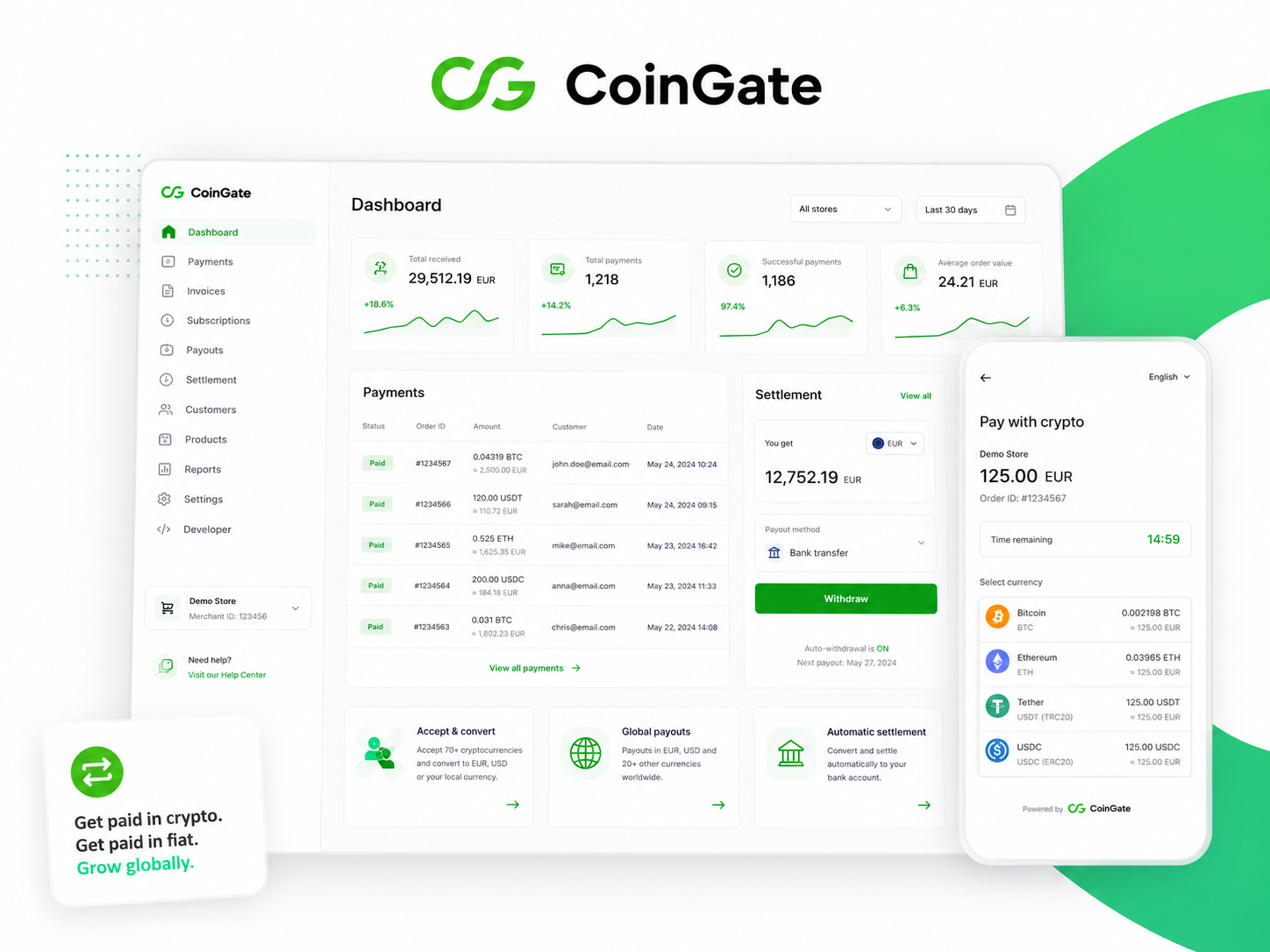
CoinGate offers hosted checkout, billing, APIs, and plugins for WooCommerce, PrestaShop, WHMCS, and other ecommerce systems. A shopper pays in crypto, while the merchant can configure settlement in EUR, GBP, USD, or crypto.
Its standard plan publishes a simple 1% processing fee with no monthly charge. Automatic checkout conversion is included, while manual currency conversion is listed separately at 1%. Standard automatic settlements are weekly, and enterprise merchants can negotiate volume pricing and on-request settlement.
CoinGate is a practical middle ground: more conventional settlement and refund tooling than a raw wallet integration, without BitPay’s 2% entry-tier rate. It does not offer the same long-tail asset count as NOWPayments or the direct any-token model of DePay.
Best For
Ecommerce businesses that want established plugins, fiat settlement options, and a public 1% price.
Key Features
- Hosted checkout, billing, API, and common ecommerce plugins.
- EUR, GBP, USD, or crypto settlement.
- Automatic checkout conversion and locked-rate payment handling.
- Managed refunds, reporting, and enterprise settlement options.
Pros
- Common ecommerce plugins plus API and billing tools.
- Settlement in fiat or crypto.
- Published 1% standard processing fee and no monthly fee.
- Built-in refunds and reporting.
Cons
- Standard automatic settlement is weekly, which may be too slow for businesses choosing stablecoins primarily for immediate liquidity.
- Manual conversion, payouts, and SWIFT settlement can add fees.
- The standard plan advertises 10+ payment cryptocurrencies, less breadth than asset-coverage specialists.
Pricing
The Standard plan charges 1% per transaction with no monthly fee. Manual currency exchange is 1%; crypto payouts, converted payouts, and SWIFT withdrawals have separate fees. Enterprise rates are negotiated.
Why We Picked It
CoinGate offers a useful middle ground between self-managed wallet checkout and a higher-priced full processor: recognizable ecommerce integrations, fiat or crypto settlement, refund tools, and a public standard price.
6. NOWPayments — Best for broad token coverage and automatic conversion
Overview
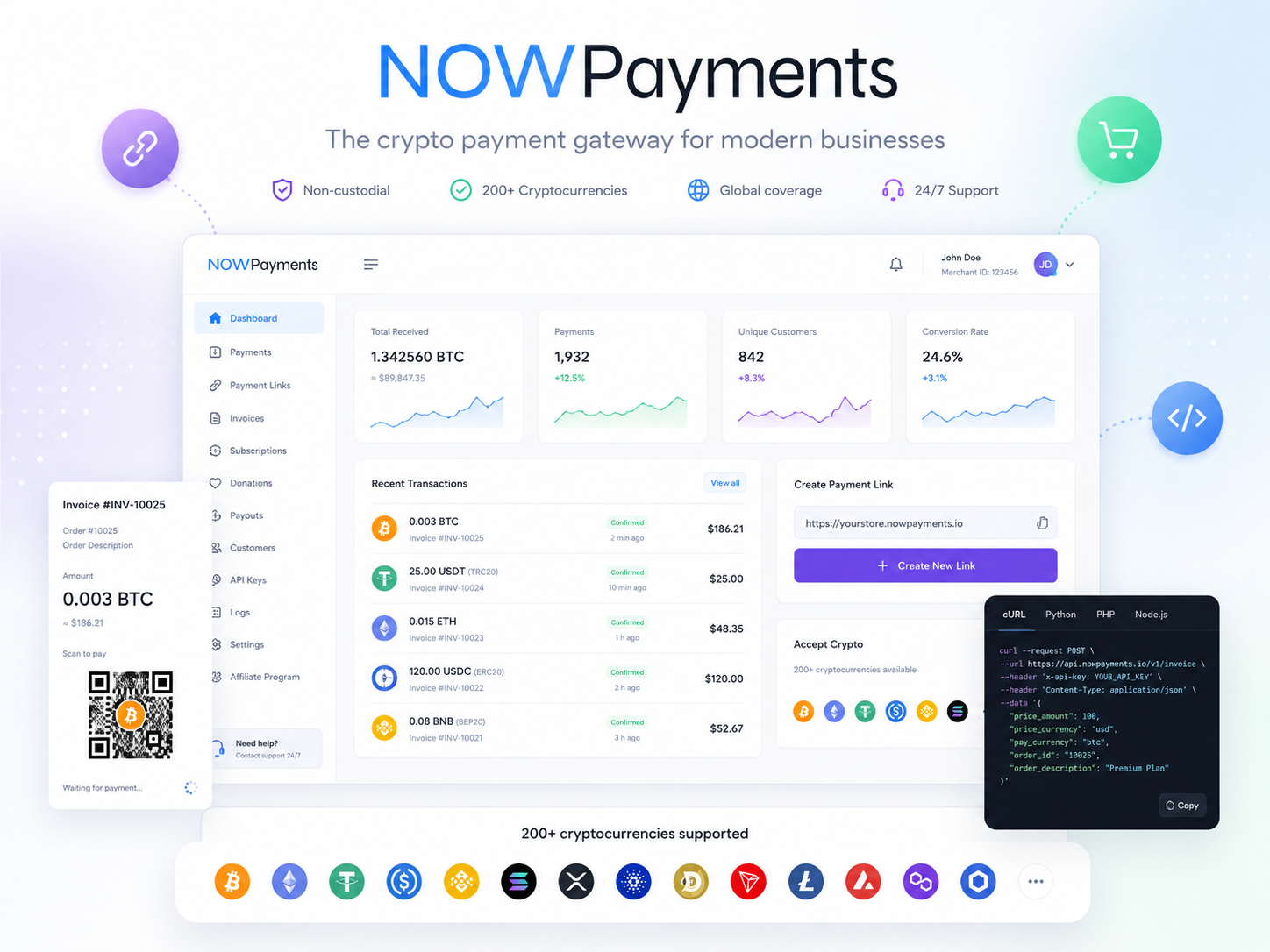
NOWPayments supports more than 300 cryptocurrencies, multiple payment links and plugins, payment APIs, subscriptions, POS links, and mass payouts. The customer can pay with one supported asset while the merchant receives another; the platform’s own example is a customer paying BTC while the merchant receives USDT.
The pricing distinction matters. Payments without an exchange are 0.5%, while multi-currency payments, fixed-rate payments, and “fee paid by user” flows are 1%. Network fees also apply. In a non-custodial route, the buyer pays a network fee to send the deposit, and a second network transfer can be required when NOWPayments sends funds to the merchant’s wallet.
NOWPayments now enables custody balances by default for new accounts to reduce network costs and onboarding friction, but merchants can add a payout wallet and switch back to non-custodial processing. Buyers and finance teams should verify this setting rather than assuming the older non-custodial default still applies.
Best For
Exchanges, gaming products, Web3 services, and ecommerce stores whose customers hold a wide variety of tokens.
Key Features
- More than 300 supported cryptocurrencies across multiple chains.
- Automatic conversion into a merchant-selected asset.
- APIs, payment links, plugins, subscriptions, POS, and mass payouts.
- Custodial balances or configurable external-wallet settlement.
Pros
- 300+ supported cryptocurrencies and cross-chain conversion.
- Competitive 0.5% no-exchange and 1% conversion pricing.
- APIs, payment links, plugins, subscriptions, payouts, and fiat partners.
- Choice of custody balance or external-wallet settlement.
Cons
- Network fees and the extra payout transaction can be meaningful on small orders or expensive chains.
- The headline 0.5% does not apply when the customer’s asset must be converted to the merchant’s preferred stablecoin.
- New merchant accounts are custodial by default, so teams seeking direct-wallet settlement must change the configuration.
Pricing
NOWPayments charges 0.5% for payments without exchange and 1% for multi-currency, fixed-rate, and “fee paid by user” payments. Network fees are additional and can include a second transfer in non-custodial mode.
Why We Picked It
NOWPayments is the asset-coverage benchmark in this comparison. It is most attractive when buyer token breadth matters, provided the merchant models conversion and network costs and verifies the custody setting.
7. MoonPay Commerce — Best for Web3 apps, deposits, Shopify, and subscriptions
Overview
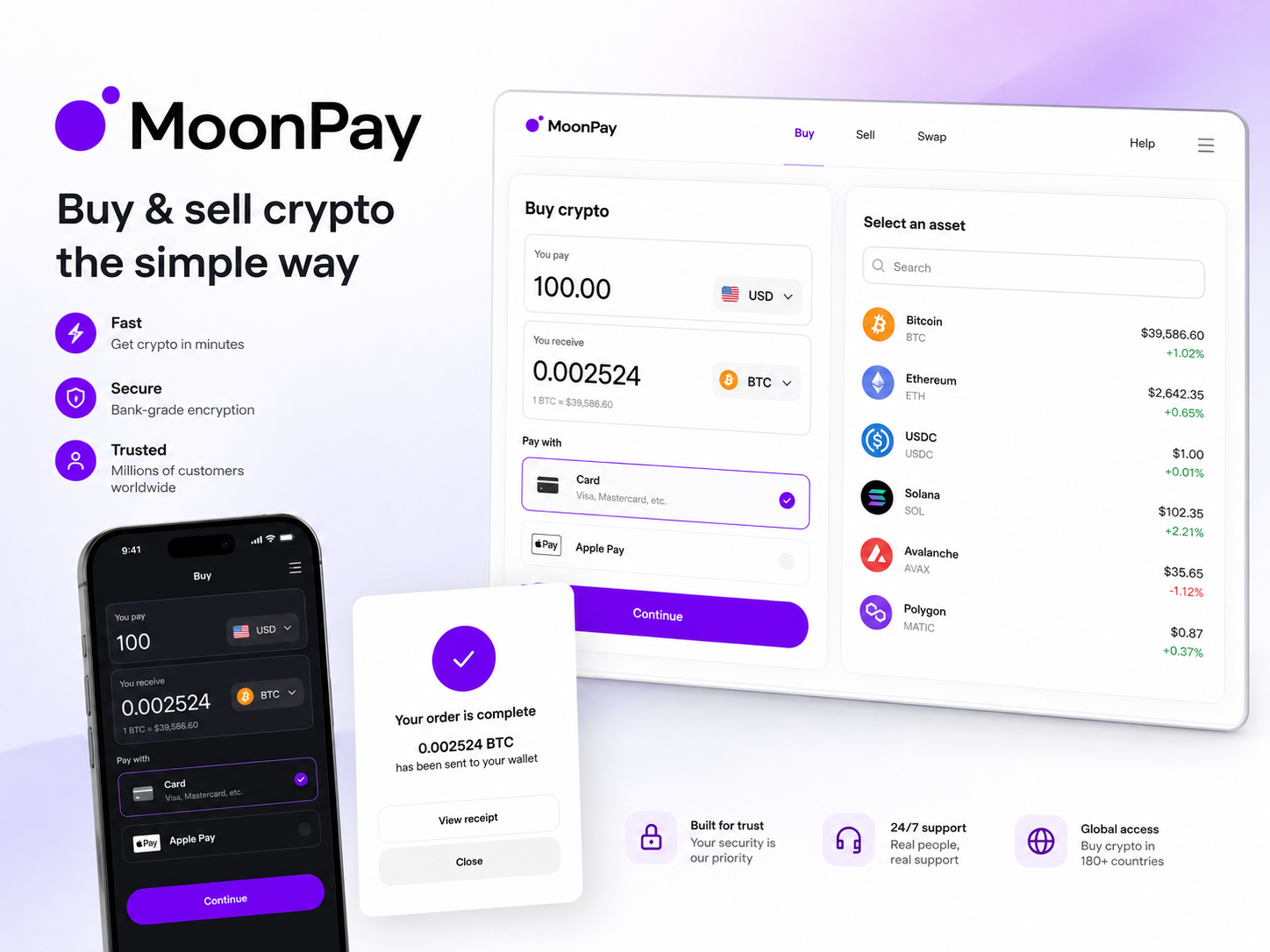
MoonPay Commerce—formerly Helio—offers pay links, an embeddable checkout widget, subscriptions, deposits, Solana Pay for Shopify, and developer APIs. The checkout can accept USDC, more than 100 digital currencies, and card payments through a fiat on-ramp. Merchants can receive a chosen crypto asset, use automated swaps, or auto-off-ramp to fiat.
Its product depth is particularly useful for gaming balances, trading apps, and recurring Web3 products. A deposit flow can let users connect a wallet, transfer manually, or add money by card without the merchant building each rail separately.
Standard pricing is 2% per transaction. The company lists an additional 0.25% for swaps and 0.50% for auto-off-ramp; high-volume merchants can request custom rates. This is not the lowest-cost option, but it packages a wide range of commerce and Web3-specific flows.
Best For
Web3 apps and merchants that need deposits, pay links, subscriptions, a Shopify path, and both crypto and card-funded checkout.
Key Features
- Pay links, embedded checkout, subscriptions, deposits, and Shopify support.
- More than 100 digital currencies plus card-funded on-ramp.
- Automated swaps/bridging and optional fiat off-ramp.
- Test environments and APIs for custom commerce flows.
Pros
- 100+ assets, automated swaps/bridging, card on-ramp, and fiat off-ramp.
- Strong no-code and developer options.
- Subscription and deposit products, not only one-time ecommerce checkout.
- Test environments on Solana Devnet, Polygon, Base, and Ethereum Sepolia.
Cons
- The 2% standard rate is relatively high, and swaps/off-ramp add separate fees.
- Card payment requires an on-ramp flow and its associated eligibility and verification steps.
- Merchants should model one-time token-account creation and network-specific costs in addition to the platform price.
Pricing
MoonPay Commerce lists a 2% standard transaction fee. Swaps add 0.25% and auto-off-ramp adds 0.50%. HelioX Pass holders receive a 1% transaction rate, and high-volume merchants can request custom pricing.
Why We Picked It
MoonPay Commerce stands out for product breadth beyond one-time checkout, particularly deposits, recurring payments, embedded Web3 experiences, and Shopify. Its higher standard fee is the principal trade-off.
8. Triple-A — Best for regulated enterprise stablecoin acceptance
Overview
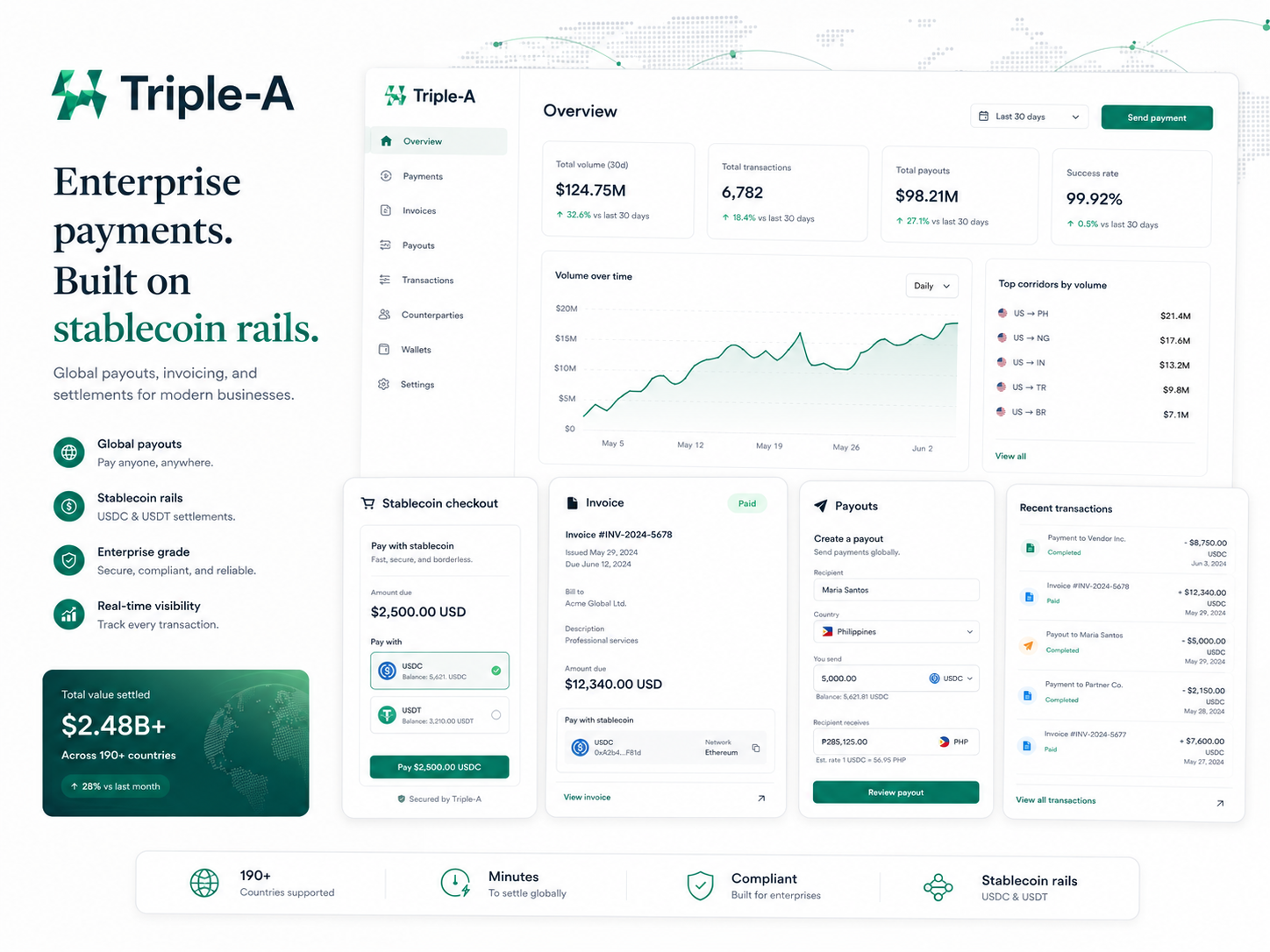
Triple-A is a licensed payment institution in the United States, Europe, and Singapore. Its Stablecoin Payment API lets customers pay in stablecoins while merchants settle in USD, EUR, GBP, or more than 30 other local currencies. The company also supports stablecoin payouts and local-currency payouts funded by stablecoins.
Triple-A is built for a different buyer from a self-serve WordPress plugin. Integration is account-managed: talk to the team, create a sandbox, integrate, then request production access. The value is regulated infrastructure, currency conversion, and enterprise deployment rather than permissionless setup.
Triple-A reports more than 1,000 enterprise customers, including brands such as Razer, Farfetch, Alternative Airlines, and Grab. In a 2026 retail deployment with LuxLexicon, the product converted stablecoin payments into local currency at a locked rate with next-day bank settlement.
Best For
Airlines, luxury retail, marketplaces, gaming companies, and other enterprises that want customers to pay in stablecoins without holding crypto on the merchant balance sheet.
Key Features
- Stablecoin acceptance with settlement in more than 30 local currencies.
- Stablecoin and local-currency payout APIs.
- Licensed operations in the United States, Europe, and Singapore.
- Account-managed onboarding, sandbox access, conversion, and compliance tooling.
Pros
- Licensed footprint across major markets.
- Stablecoin acceptance with settlement in 30+ local currencies.
- Enterprise compliance, conversion, custody, and account management.
- Sandbox and APIs for payments and payouts.
Cons
- Pricing is custom rather than publicly self-serve.
- Sales-led onboarding is heavier than a plugin or payment link.
- Local-currency settlement means this is not the best fit when the merchant specifically wants immediate USDT/USDC in a self-custody wallet.
Pricing
Triple-A does not publish a self-serve standard rate. Pricing and commercial terms require a sales quote based on the merchant’s markets, volumes, settlement currencies, and use case.
Why We Picked It
Triple-A is the regulated enterprise option in this list. It is relevant to larger merchants that want stablecoin acceptance without holding crypto, even though it is less accessible to teams seeking instant self-serve deployment.
9. DePay — Best decentralized any-token checkout
Overview
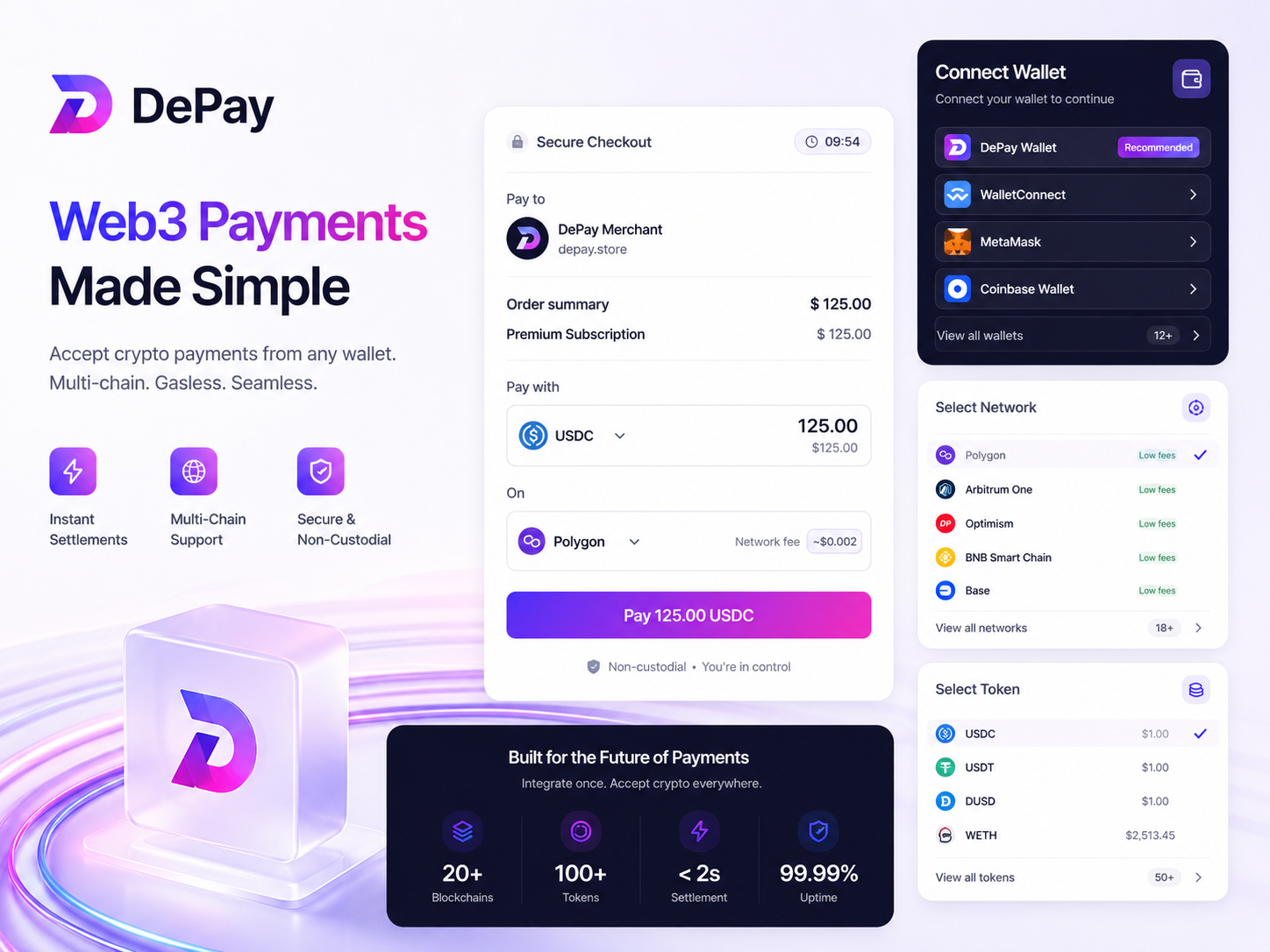
DePay uses decentralized exchanges to let customers pay with thousands of tokens while the merchant receives only the token it configured. Payments are peer-to-peer, so DePay does not take custody of merchant funds. It supports payment links, JavaScript/React/Next integrations, Shopify, WooCommerce, and WordPress.
This is one of the closest conceptual matches to the “customer pays with what they have; merchant receives what they want” model. The main difference is its Web3-first scope: it is designed around wallet payments and decentralized conversion, not a unified card, bank, and local-payment checkout.
The standard managed platform price is 1.5%. DePay also offers open-source basics with 0% platform fees, while enterprise rates are advertised as low as 0.5%.
Best For
Crypto-native brands and developers that want direct wallet-to-wallet settlement and on-chain token conversion.
Key Features
- More than 1,000 tokens, 100+ wallets, and 10+ blockchains.
- Decentralized any-token-to-selected-token conversion.
- Peer-to-peer, non-custodial settlement.
- Payment links, JavaScript frameworks, Shopify, WooCommerce, and WordPress.
Pros
- 1,000+ tokens, 100+ wallets, and 10+ blockchains.
- Merchant receives a selected asset despite the buyer paying another token.
- Non-custodial, peer-to-peer settlement.
- Open-source route for teams prepared to own more of the implementation.
Cons
- Standard managed pricing is 1.5%, above several processor alternatives.
- A wallet-first flow does not solve payment access for customers who only have cards or bank accounts.
- The merchant retains more responsibility for wallet security, refund operations, accounting, and compliance policy.
Pricing
DePay’s managed Standard plan charges 1.5% per transaction. Open-source basics have no platform transaction fee, while enterprise pricing is advertised as low as 0.5%.
Why We Picked It
DePay is included because it demonstrates the decentralized version of customer-payment flexibility: the buyer can use a long-tail token while the merchant receives a configured asset without a custodial intermediary.
Feature Comparison Matrix
“Yes” does not mean every asset, chain, country, or merchant category is supported. Verify the exact route and contract terms during a pilot.
Pricing Comparison: What $100,000 in Monthly Sales Could Cost
Consider a merchant processing 1,000 wallet-funded orders per month at an average order value of $100, for 100,000 in monthly GMV. The following is an illustrative platform-fee comparison using published standard rates.
This table is useful, but it is not a quote. Stripe’s 1.5% includes gas sponsorship, screening, and conversion to fiat. AllScale’s 0.6% public figure comes from its WooCommerce crypto-checkout documentation; a card or local-payment provider can charge a separate fee. NOWPayments can incur a second network transaction in non-custodial mode. Off-ramping stablecoins to a bank also has a cost.
Order size changes the answer. On a $5 order, AllScale’s 0.10 minimum is an effective 2% platform fee. BitPay’s $0.25 fixed component adds another 5% before its percentage fee. For micropayments, use actual ticket-size percentiles—not average GMV—to model cost.
Which Tool Should You Choose? A Decision Tree
- Choose AllScale when customers need several ways to pay but the merchant wants standardized USDT/USDC in a self-custody wallet.
- Choose Coinbase Business when a US or Singapore company wants payments, custody, conversion, trading, and bank connectivity in one stablecoin operating account.
- Choose Stripe when stablecoin acceptance should behave like another Stripe payment method and the merchant wants USD, managed refunds, and subscriptions.
- Choose BitPay when operating history, fiat/crypto split settlement, POS, and enterprise payment operations outweigh a higher entry-tier fee.
- Choose CoinGate when common ecommerce plugins, fiat settlement, and a clear 1% standard rate are the priority.
- Choose NOWPayments when token coverage is the deciding factor and the team is willing to model conversion and network costs carefully.
- Choose MoonPay Commerce for Web3 deposits, subscriptions, Shopify, embedded widgets, and card-funded on-ramp flows.
- Choose Triple-A when a regulated enterprise provider and local-currency settlement are more important than self-serve onboarding.
- Choose DePay when the checkout should remain decentralized and wallet-to-wallet while accepting a long tail of tokens.
The most reliable selection method is a two-provider pilot using the same ten test orders and the same accounting close. A feature table tells you what a platform claims to support; a pilot tells you what your customers and finance team can actually operate.
FAQ
What is a stablecoin payment gateway?
A stablecoin payment gateway connects a merchant checkout to blockchain payment rails. It creates a payment request, shows the customer supported wallet/token/network options, monitors the transaction, and notifies the merchant when payment is confirmed. Some gateways also convert the customer’s asset, screen wallet risk, provide refunds, or settle funds into fiat.
Can a customer pay with any crypto while I receive USDC or USDT?
Some gateways can do this, but “any” always means any asset and chain for which the provider has an integration and enough liquidity. AllScale, NOWPayments, MoonPay Commerce, and DePay each support forms of asset conversion or routing. Ask for the exact input-token, input-chain, output-stablecoin, and output-chain matrix.
Can customers pay by credit card while the merchant receives USDC?
Yes, through a card-to-crypto on-ramp. AllScale Checkout’s card/local-payment route and MoonPay Commerce support this type of flow. The on-ramp provider may charge an additional fee and require buyer identity verification. Availability depends on country, card, transaction size, and provider policy.
Are stablecoin payments chargeback-free?
A completed wallet-to-wallet blockchain transfer is generally irreversible and does not have the card-network chargeback mechanism. However, card-funded on-ramps still touch card rails, and merchants still owe legitimate refunds under their policy and applicable law. “No chargebacks” should never be presented as “no customer remedies.”
Is non-custodial always better?
No. Non-custodial settlement gives the merchant immediate control and removes provider withdrawal risk, but it also moves wallet security, refunds, treasury, and some compliance operations to the merchant. Custodial providers can make fiat conversion, role controls, and automated refunds easier. The better model depends on the business.
Which stablecoin payment gateway has the lowest fees?
There is no reliable answer without an order distribution and settlement route. AllScale publishes 0.6% with a $0.10 minimum for its documented WooCommerce crypto checkout. NOWPayments lists 0.5% without asset exchange and 1% with conversion. CoinGate lists 1%. Network, conversion, on-ramp, off-ramp, fixed, minimum, and refund costs can reverse the ranking.
Do I still need KYC or AML controls if a gateway provides KYT?
Possibly. KYT screens the history and risk signals associated with an on-chain transaction or wallet. It does not automatically satisfy every merchant KYC, sanctions, licensing, tax, or recordkeeping obligation. Requirements vary by jurisdiction and industry; obtain qualified advice for your specific flow.
What stablecoin should a merchant receive?
USDC and USDT have the broadest payment-gateway support, but the right choice depends on the chains your customers use, your suppliers and off-ramps, local rules, liquidity, issuer risk policy, and accounting treatment. A gateway should let the merchant choose intentionally rather than accept an arbitrary default.
Conclusion: Choose the Settlement Outcome, Then Test the Checkout
Start with the settlement outcome, not the coin count.
If your finance team wants USD inside an existing payment stack, Stripe or Triple-A may be the cleanest choice. If you want a custodial stablecoin business account, Coinbase Business is a strong fit in its supported markets. If broad token coverage matters most, test NOWPayments or DePay. If you need mature fiat/crypto processing, compare BitPay and CoinGate. If your product needs Web3 deposits or subscriptions, evaluate MoonPay Commerce.
If the requirement is broader on the customer side—card, local payment, bank transfer, or crypto—but narrower on the merchant side—receive USDT/USDC in a wallet you control—AllScale Checkout is designed around that specific mismatch.
Whichever provider you shortlist, do not launch from a pricing page. Run real test transactions, test a refund and failed screening, reconcile the net amount to an order, and confirm who controls the funds at every step.
Create an AllScale store
API docs: https://docs.allscale.io/allscale-checkout/getting-started
Live Demo: https://x.com/allscaleio/status/2057129328723320920?s=46
WordPress plugin: https://wordpress.org/plugins/allscale-checkout/
Card/local-payment explainer: https://x.com/allscaleio/status/1974342029422326096?s=46
This article is for general informational purposes and is not legal, tax, accounting, financial, or compliance advice. Product availability, fees, supported assets, and regulations change. Verify current terms with each provider and consult qualified advisers for your business and jurisdictions.