
A cash-advance app that promises not to chase repayment sounds broken — but that waiver is the product. This piece breaks down how cash-advance and earned-wage apps rebuild the payday loan as software: the growth loop, who funds the advances, underwriting without a credit check, and where it legally becomes a loan.
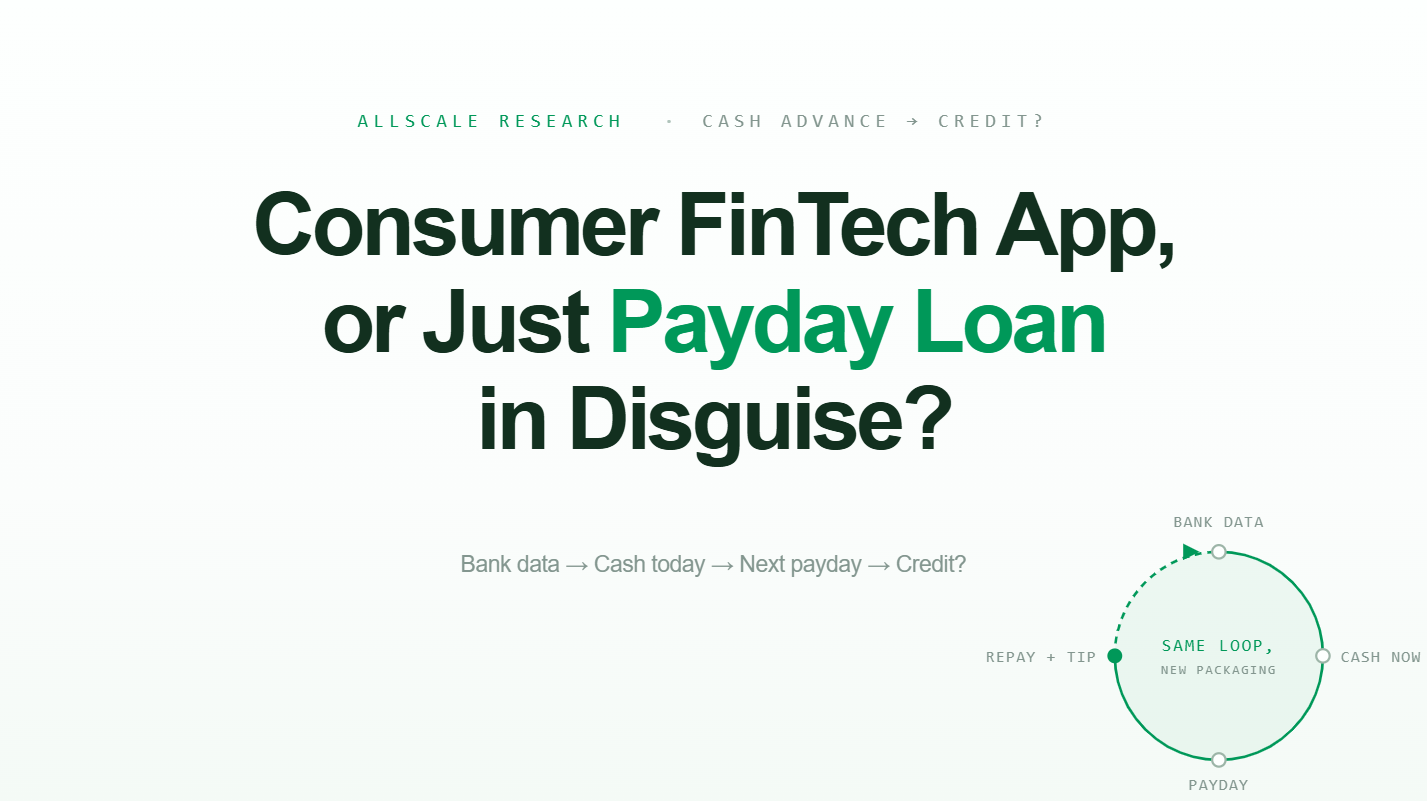
How cash-advance apps turned the gap between work and payday into a growth machine by building around one very useful question: what actually counts as credit?

We found the weirdest sentence in Bree's terms.
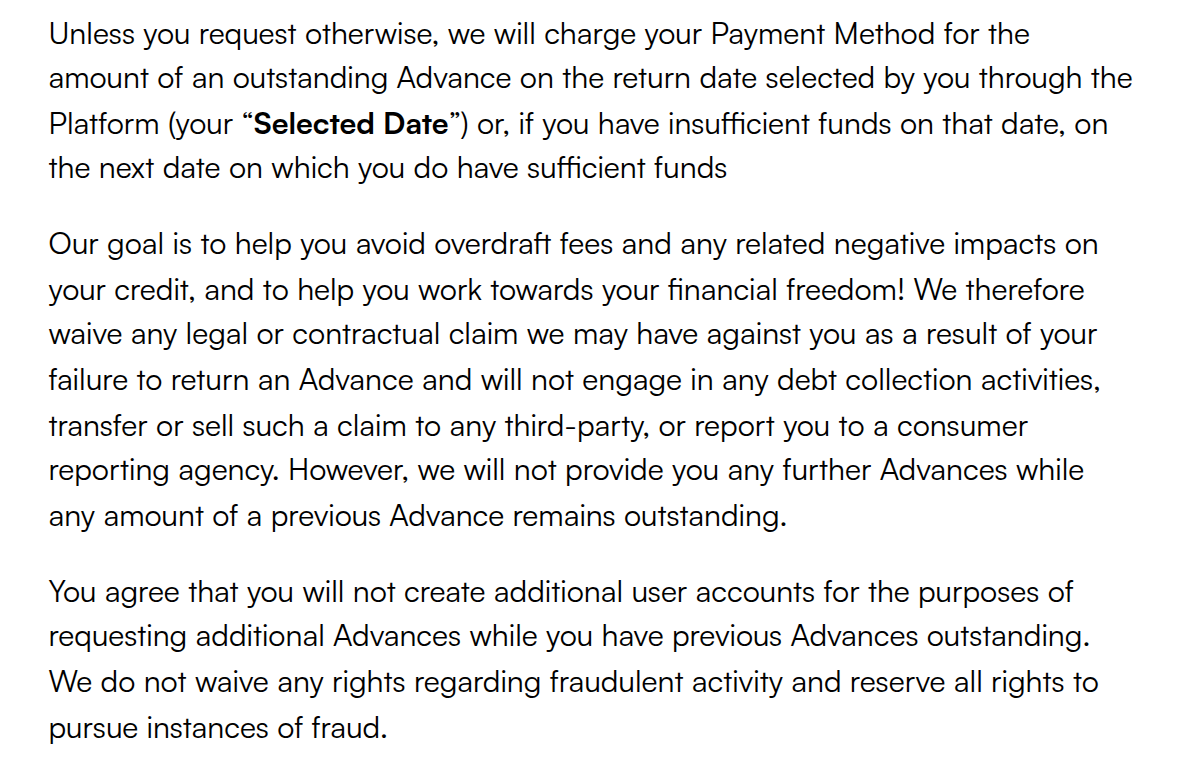
It is not the promise of 0% interest. It is this: if a customer fails to return an advance, Bree says it will waive any legal or contractual claim against them.
Instead of selling the claim to debt collectors and putting this on credit bureau reports, they simply does allow customers take another advance while money remains outstanding.
Read that again. A finance app hands out cash and promises not to use ordinary debt-collection tools when people do not return it.
Sounds like a terrible business.
It isn't. That promise is part of the product.
Bree uses bank-account data to decide who gets an advance and how much. It starts cautiously, automatically attempts repayment and cuts off customers who do not return the money. Expected losses become a cost of doing business. At the same time, the absence of interest, mandatory fees and ordinary recourse makes the product different from a conventional payday loan. Economically, though, the customer still receives a small amount of money and is expected to return it after the next deposit.
Here is the broader playbook: take the job once performed by a payday loan, break it into software components, then rebuild those components around a more favourable regulatory category.
Revenue that a conventional lender might earn as interest is replaced by express-delivery fees, tips, subscriptions or interchange. A credit check becomes bank-data analysis. Scheduled repayment moves to automatic debits, while some providers waive ordinary collection rights. The storefront becomes an app. Loan capital becomes a credit line secured by advances, a receivables sale or an asset-backed security.
Call it compliance arbitrage. To be clear, that does not automatically make it illegal or bad. Some of these products are materially cheaper and less punishing than traditional payday loans. Employer-integrated earned wage access (EWA) can also be genuinely different from lending because the worker is receiving wages already earned, not borrowing against an estimate of future income.
So yes, there is real innovation here. There is also a lot of strategic relabelling. The closer a product stays to verified accrued wages, payroll settlement and true nonrecourse, the stronger its claim to be wage access. The closer it moves toward predicted income, bank-account debits, individual risk underwriting and repeated paid advances, the more it looks like a payday loan with a much better interface.
We spend money every day. Most of us do not get paid every day.
Employers batch payroll weekly, biweekly, semimonthly or monthly because running it more often is operationally expensive. That delay is the raw material for this entire category.
The market is already huge. The US Consumer Financial Protection Bureau estimated that employer-partnered earned-wage transactions grew from $3.2 billion across 18.6 million transactions in 2018 to $22.8 billion across 214 million transactions in 2022. About 7.2 million workers used an employer-partnered product that year. Add direct-to-consumer products and the CFPB estimated that roughly 10 million workers accessed more than $31.9 billion in 2022.
This is no longer a niche emergency-loan market. It is becoming an alternative payment schedule.
But two very different businesses sit under the same “get paid before payday” button.
In the direct-to-consumer model, most apps connect to a user's bank account, study deposits and spending, estimate the next income date, offer a small amount and ordinarily attempt recovery from the user's bank account or debit card after payday. The employer usually knows nothing about it.
Bree, Dave, MoneyLion, Brigit, Tilt (formerly Empower) and Cleo broadly fit that pattern. EarnIn can also verify work and earnings. Nyble is a real revolving credit line, so it belongs in the same customer market without pretending to be the same legal product.
In the employer-integrated model, a provider such as DailyPay, ZayZoon, Payactiv, Branch, OnePay, Rain or Tapcheck connects to payroll, timekeeping or human-resources software. The program can see wages the worker has already earned. Either the employer or the provider and its funding partners supply the cash, and the transaction is then reconciled through payroll. The employer may pay for the benefit, but often the worker pays when choosing an instant transfer.
As a shorthand, one model predicts the next deposit and the other reads wages already earned. Hybrids such as EarnIn's work-verified Cash Out and Branch Flex blur that line. The underlying data and repayment mechanics matter more than whatever label appears on the button.
Cash-advance apps have one of the strongest acquisition hooks in fintech: money now, no conventional credit check. If you are worried about tonight's groceries or tomorrow's automatic payment, you are not casually browsing. You finish onboarding.
Then the app turns that urgency into a loop.
The direct-to-consumer cash-advance flywheel

The loop has five steps:
Free later is the acquisition offer. Money now is the product. That is the shorthand, not a universal fee schedule.
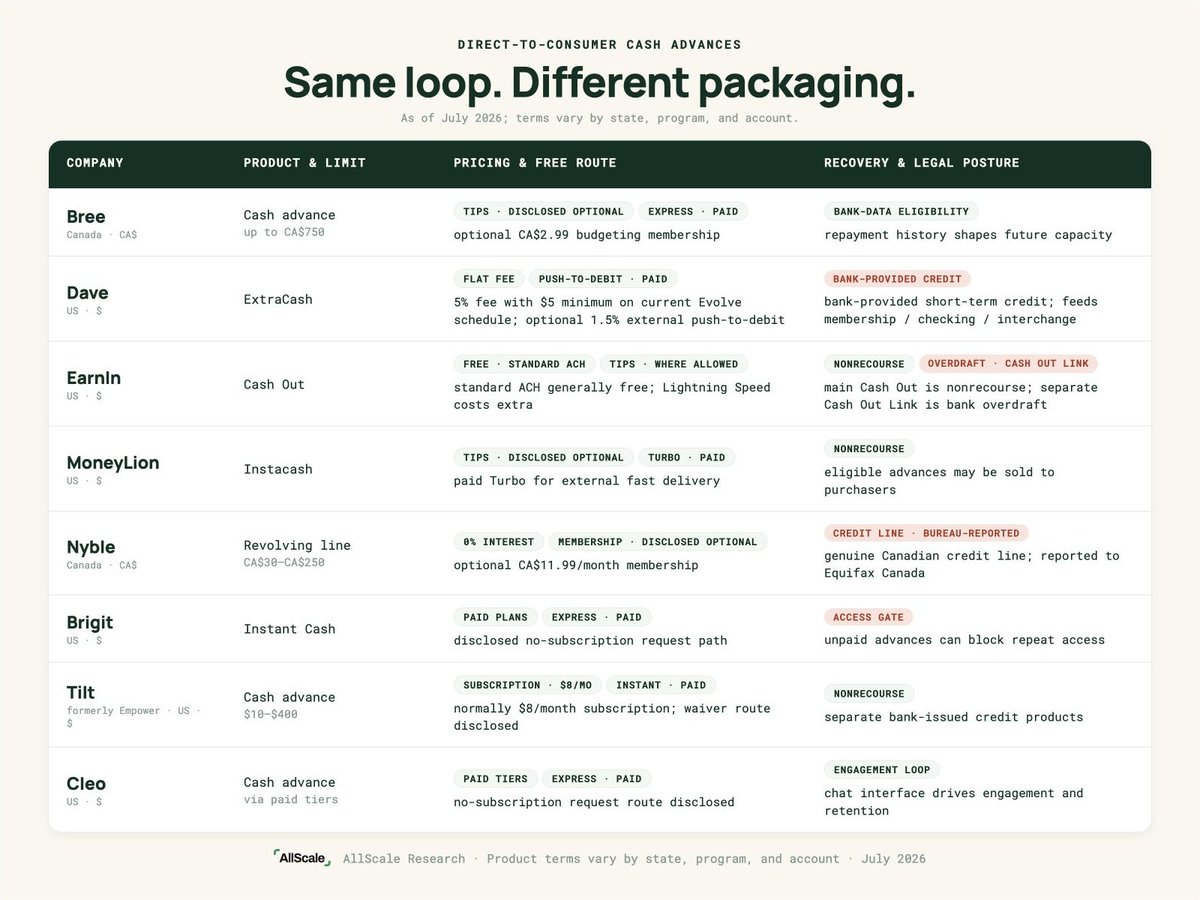
Same loop. Different packaging:

And yes, this can make real money.
Dave's 2025 Form 10-K reported $7.6 billion of ExtraCash originations, up from $5.1 billion in 2024. Its full-year release reported revenue up 60% to $554.2 million and GAAP net income of $195.9 million. In the fourth quarter, it acquired 867,000 new members at a reported cost of $20 each, while ExtraCash monetization net of losses reached 4.8%.
Those are wild numbers for advances that last about 11 days on average.
It is not free money. Dave recorded a $91 million provision for credit losses in 2025. But revenue after payment costs, fraud, expected losses and funding costs can still produce attractive unit economics. The same customer can transact many times a year.
Dave is not alone. Upbound reported that Brigit generated $206 million of revenue and $30.7 million of operating profit during the 11 months it owned the business in 2025, including $42 million of transfer-fee revenue and $44.5 million of net advance losses. Cleo, which remains private, self-reported $136 million of 2024 revenue, $11 million of EBITDA, a customer-acquisition cost of $11 and three-month payback.
The definitions differ, so do not compare the numbers mechanically. The point is simpler: this category can produce real profit, not just downloads.
Growth creates another problem: somebody has to fund the gap.
The worker gets cash today. The provider gets repaid days or weeks later. At small scale, a startup can cover that timing gap with equity or operating cash. At scale, it needs a real capital stack.
Where the advance capital comes from
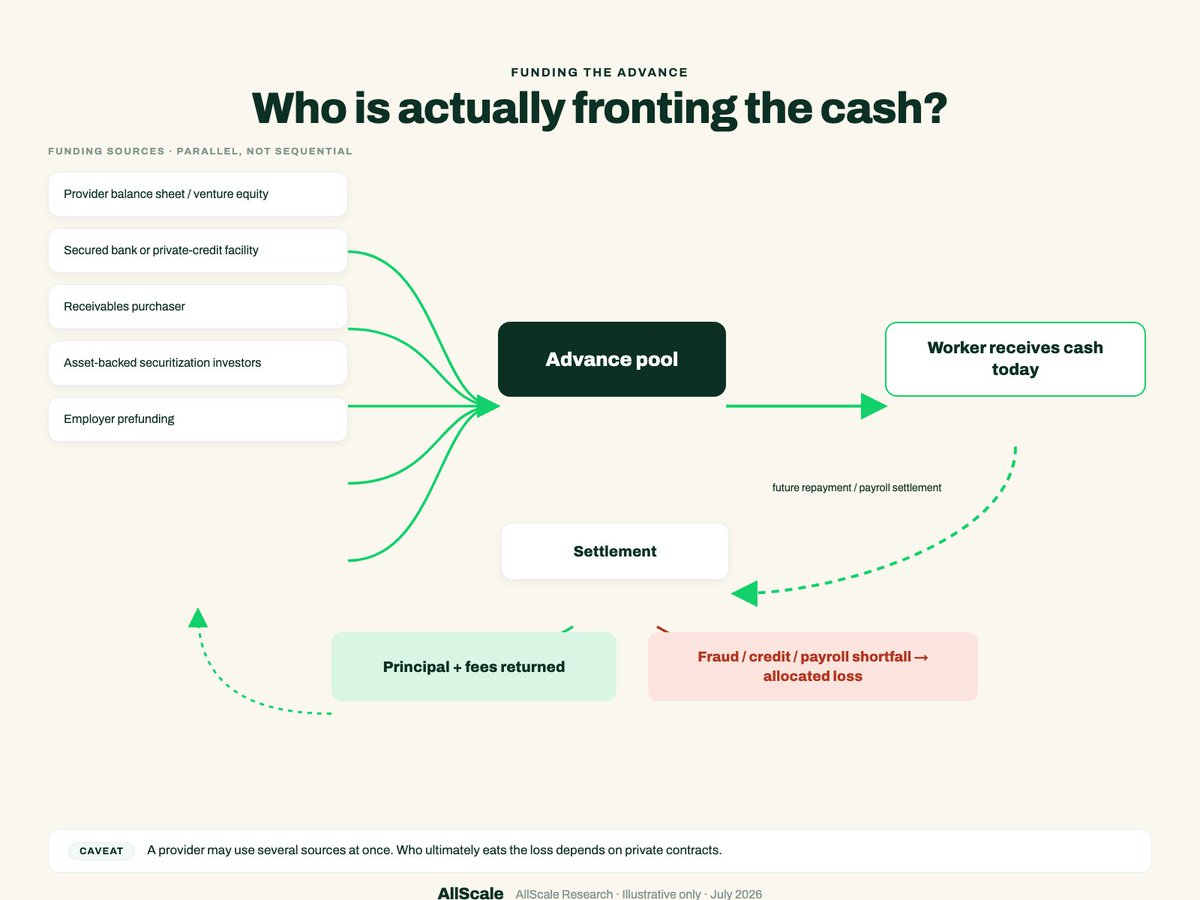
Author's illustration based on public company materials. Actual loss allocation depends on private contracts that are rarely disclosed.
At scale, the funding menu has five common components. They are not a universal sequence, and a provider may use several at once:
MoneyLion makes the sell-the-advances model unusually visible. Gen Digital's fiscal-2026 filing says the Sound Point purchase agreement allowed purchasers to acquire a majority of eligible Instacash advances, subject to conditions and concentration limits, up to $225 million outstanding at a time.
Gen reported $4.126 billion of advances sold during fiscal 2026, a $205 million loss on sale and $343 million of sold advances still being serviced as of April 3, 2026. The disclosed initial term ended June 30, 2026, and we could not find a public confirmation of an extension by this article's cutoff date.
The consumer sees an app. Under the disclosed structure, institutional investors were buying the advances.
Many provider-funded employer EWA programs tap the same capital markets:

Here is the annoying thing: funding is often the least transparent part of the product.
Product pages are precise about speed and employee benefits. They are much less precise about who owns the receivable, who eats the loss or whether anyone has recourse against the employer. “We fund the advance” can mean the company's own cash. It can also mean a special-purpose vehicle financed by a bank, a private-credit fund and a receivables buyer.
Capital keeps the machine running. Data decides who gets access.
Traditional lenders ask a credit bureau what happened over the past several years. Cash-advance apps ask a bank account what is likely to happen next Friday.
Public materials point to recurring-deposit amount and timing, current balance, account transaction history, income and spending patterns, and prior repayment performance. The exact models are proprietary. Most apps do not say whether they detect concurrent use of other advance products. Dave says its CashAI system has learned from more than 180 million ExtraCash originations. Tilt says it reviews real-time income and spending.
That is underwriting even when no FICO score is pulled. In some ways it is more immediate and intimate than a credit report.
Then comes fraud. Providers publish only fragments of their fraud stack: identity verification, bank-account linking and ownership checks, recurring-deposit validation, adaptive limits, and suspension for suspected fraud or unpaid advances. Device, network and velocity models may sit behind those controls, but most companies do not disclose their full rules. Limits on simultaneous withdrawals or total outstanding exposure reduce both fraud and credit risk.
Employer-integrated EWA changes the risk problem. The provider can calculate availability from payroll and time records, limit access to a conservative portion of estimated net wages and recover inside payroll. It is underwriting the employer, the integration and the payroll process more than the individual worker. Terminated employees, reversed time entries, garnishments, taxes, benefits and payroll corrections still create risk. But verified hours remove a lot of guesswork.
This matters legally too. Under the CFPB's nonbinding 2025 advisory opinion, a US product seeking “Covered EWA” treatment must not assess an individual worker's credit risk. A mechanical wage-availability calculation can fit. A model predicting repayment from checking-account behaviour generally cannot.
The free-versus-instant pricing model exists because different payment rails have different costs, speeds and failure modes. This is not boring back-office detail. It determines what can be free, what can be instant and where the margin comes from.
In the United States, free delivery usually travels over ACH. Faster delivery often uses push-to-card services such as Visa Direct or Mastercard Send. Some programs also use faster ACH or an in-house wallet or prepaid account. Direct-to-consumer repayment normally uses an ACH debit or debit-card pull. Employer-integrated repayment uses a payroll deduction, a split direct deposit or another instruction inside the payroll process.
In Canada, providers combine direct EFT, push-to-debit and Interac e-Transfer. Bree says push-to-debit is its most common fast method, standard delivery uses direct EFT and e-Transfer is a fallback. ZayZoon uses Interac e-Transfer for Business through Scotiabank infrastructure. Repayment can use a pre-authorized debit, debit-card transaction or payroll reconciliation.
This is where the regulatory fight starts. An instant push really does cost more than a batch bank transfer, so there is a legitimate basis for a delivery charge. But if the free route takes three business days and the customer's problem is an automatic payment due tonight, the “optional” instant fee may not feel very optional.
Eventually, some repayment pulls fail. Two separate questions matter: what can the provider do to the user, and who ultimately owns the loss?
On user recourse, Bree is not an isolated case. EarnIn's main Cash Out product, MoneyLion, Brigit, Tilt and Cleo also publish nonrecourse language: ordinary nonpayment blocks or can block future access, but is not supposed to create a collection account or credit-bureau report. Their fraud exceptions and debit-authorization mechanics differ. Dave's ExtraCash and EarnIn's Cash Out Link are materially different bank-provided credit or overdraft structures with repayment obligations.

So does Bree just write it off? Under the public 2023 terms, if authorized repayment attempts fail and there is no fraud, economically, yes. Bree keeps the balance outstanding in its own system and blocks more advances, but those terms say it gives up the ordinary legal claim and collection tools. The missing current in-app agreement is why we would not treat that as a universal statement about every 2026 draw.
On loss ownership, nonrecourse and receivables funding can exist at the same time. A provider may hold the loss on its own balance sheet, borrow against the pool, sell expected cash flows to a receivables purchaser or allocate risk through a securitization. MoneyLion is the clean example: its consumer terms say users have no contractual repayment obligation, while Gen's filing reports billions of dollars of advances sold to purchasers. The purchaser is buying expected cash flows, not ordinary recourse debt.
Employer-integrated programs usually settle through payroll, but public materials rarely disclose the full shortfall waterfall. Tapcheck says it assumes the financial risk, but the split with its facility provider is not public. Rain uses an assignment of earned wages. OnePay @Work expressly waives recourse when payroll is insufficient.
The same “get paid early” button can sit on top of very different legal and economic structures. Moving left to right, the product starts looking more like credit and creates more risk that regulators treat it as lending.
From early wage payment to conventional payday credit
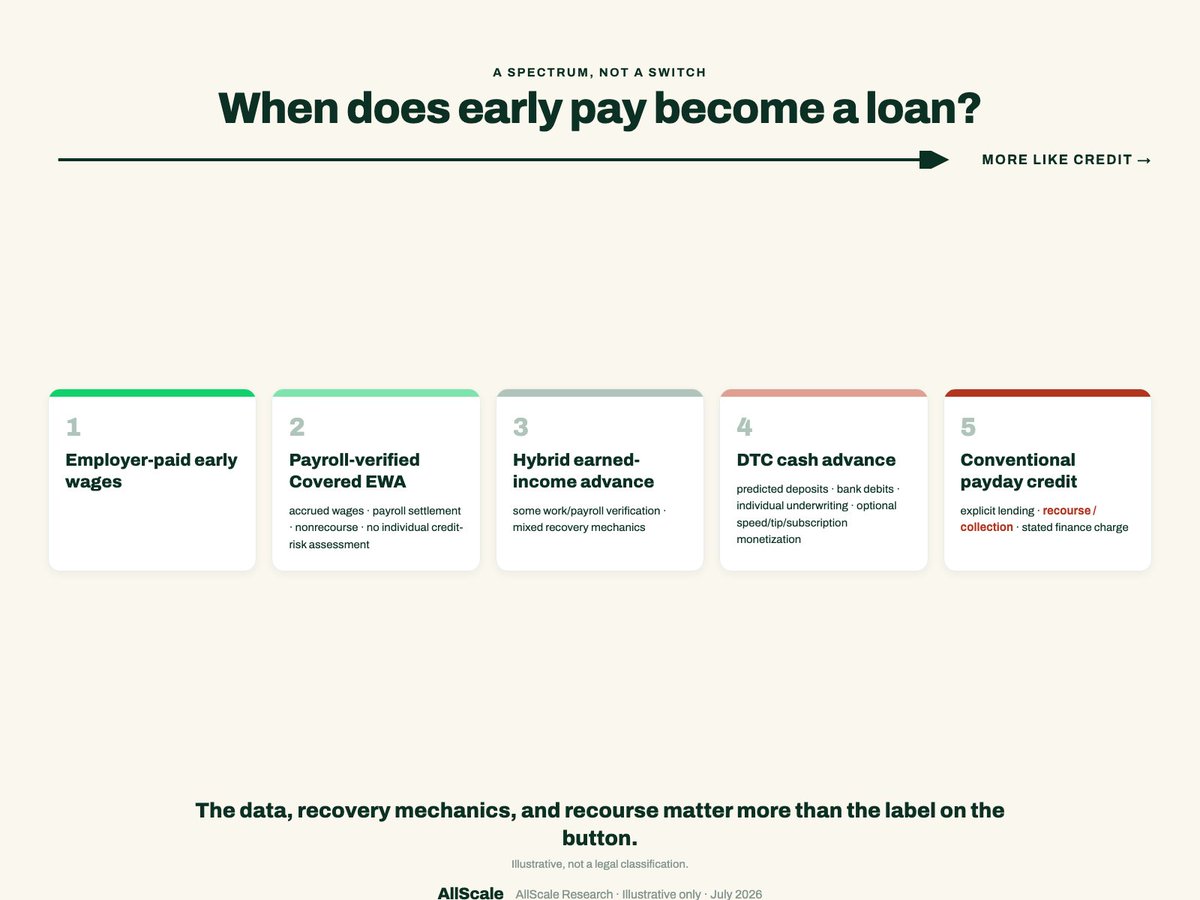
One company can operate more than one model, and tiny product details can move a transaction in either direction.
Canada
Canada's Criminal Code sets the criminal rate above 35% APR and broadly defines interest as charges and expenses paid or payable for advancing credit. Whether a purportedly voluntary tip falls within that definition is fact-dependent.
The separate payday-loan exception applies only to qualifying loans of no more than CA$1,500 and 62 days, made by an authorized lender in a designated province and within the current CA$14-per-CA$100 cost limit. A line of credit or overdraft protection is excluded from the federal payday-loan definition, but not from every other rule. Canada has no single federal EWA safe harbour.
United States
The CFPB's nonbinding 2025 advisory opinion says a narrow form of “Covered EWA” is not Regulation Z credit when it is limited to payroll-verified accrued wages, settles through payroll, is nonrecourse, avoids collection and credit reporting, and does not assess the worker's credit risk. It addresses Regulation Z only.
Products outside that lane are not automatically credit. External-account debits, individual credit-risk assessment and recourse move a product away from Covered EWA. Price alone does not determine whether a product is Regulation Z credit. Under the advisory, expedited fees and bona fide tips are normally not finance charges, although a fee or tip effectively imposed on the user can be.
The legal boundary is being tested, with mixed results. In DC, the Superior Court dismissed the attorney general's unlicensed-lending allegation on primary-jurisdiction grounds, reasoning that EWA classification falls outside judges' conventional expertise. The Court of Appeals later denied interlocutory review. In a separate case, a federal court denied EarnIn's motion to dismiss TILA, Military Lending Act and Illinois lending-law claims in March 2026, without deciding the merits.
New York's MoneyLion and DailyPay cases remain contested. The pending FTC and DOJ case against Dave focuses on alleged deceptive marketing, undisclosed fees and unauthorized tips, rather than a clean test of whether the product is a loan. Product behaviour still matters more than the label on the button.
A $3 fee on a $100 advance for ten days produces a simple annualized rate of roughly 110%. That comparison explains the scrutiny, but it does not by itself determine whether the product is legally credit. Private companies also disclose too little about repeat use, fee selection and loss rates to classify every product confidently from the outside.
The lazy take is that startups renamed payday loans and found a loophole.
The more interesting take is that they built short-duration liquidity machines combining bank or payroll data, automated risk decisions, payment rails and institutional funding.
Compliance arbitrage helped open the market. It is not the whole moat. The durable advantage is operational: accurate data, low losses, cheap capital and a product customers understand. The closer the product stays to wages already earned and genuine user choice, the easier it is to defend. The closer it gets to predicted income and repeat paid urgency, the more it resembles the payday loan it claims to replace.
We're building @allscaleio, a non-custodial stablecoin neobank. We are also helping some of our customers to explore early wage access in emerging markets where local currencies face hyperinflation. If you are already building in EWA and want to explore adding stablecoins, if you are experimenting with on-chain credit-based lending, we are always open to chat and explore together!