

By AllScale Editorial · Updated October 22, 2026 · 13 min
The best way to accept international payments is the route your customers can complete and your business can settle, refund and reconcile. Start with how your buyers already pay. Then check the currency and account in which you need usable funds. Test two suitable routes before committing to a wider rollout.
A customer buying a $40 product on a phone has different needs from a finance team paying a $12,000 invoice. Giving both the same payment instructions may save setup time while creating more abandoned orders or support work. A small set of well-run options is often a better starting point than a long checkout menu.
TL;DR
Define the payment outcome before choosing a provider
Define the buyer, payment amount, required settlement and the people responsible for exceptions. Consider this hypothetical design agency:
A design agency in Germany invoices US business clients $12,000 each month. Clients pay in US dollars by bank transfer. The agency needs the proceeds converted into euros and available in its German operating account by the 25th, before payroll. Its operations manager approves refunds, and its bookkeeper matches each payment and fee to the original invoice.
For this agency, a payment confirmation in an intermediary balance is not enough. The comparison must include conversion into euros and delivery to the operating account by the deadline. A route also needs usable payment references so the bookkeeper can reconcile receipts without chasing each client.
A digital service might instead sell prepaid credits to customers who already hold USDC. Its relevant endpoint could be USDC in a supported wallet, followed by a confirmed credit to the customer’s application balance. There is no reason to add an assumed bank withdrawal to that test unless the business actually needs one.
Specify the merchant’s legal entity and business category too. A method that works for a customer in a country may not be available to your business there. Stripe’s payment-method documentation, for example, distinguishes restrictions by country, currency, product and integration. Treat coverage as a route-specific check. Stripe payment-method overview.
Compare routes by buyer fit, not a single fee ranking
The table separates payment methods from the interfaces used to offer them. “Local methods” is a broad group; a bank redirect, wallet and bank debit can have different timing and dispute rules. Name the actual method in your shortlist.
There is no useful price ranking across those five rows. A link could contain a card option, a stablecoin option or both. Comparing its headline fee with a bank-transfer fee without looking inside the flow mixes different layers of the purchase.
For cross-border ecommerce, begin with one market and a normal shopping journey: phone, checkout language, order value and fulfillment expectation. For international business payments, begin with the buyer’s accounts-payable process: invoice approval, payment reference and acceptable receiving details. Those starting points produce more useful shortlists than a worldwide coverage number.
Where AllScale fits
AllScale Invoice is the relevant starting point when you bill a specific client and share a payment link. Its public page describes stablecoin settlement and client payment options including cards, Apple Pay and on-chain payments. Confirm the options available for your customer’s location and transaction before presenting them as guaranteed choices.
AllScale Checkout is the starting point for website or application payment flows. Its public page describes self-custodial stablecoin checkout and USDT/USDC acceptance. Evaluate the supported token and network, confirmation behavior and your application’s fulfillment logic together.
AllScale’s product directory separates these collection products from Payroll and Claim Link, which serve outgoing-payment workflows. A link for someone to claim funds should not be presented as the same product as a link asking a client to pay. AllScale product directory.
If buyers require bank payment and you require bank settlement, include an eligible bank-collection route in your comparison. Do not force stablecoin conversion into a purchase that gains nothing from it. For any AllScale route, obtain a current quote covering processing, conversion, network costs and any required withdrawal; this guide does not establish an all-in tariff.
Follow custody and refund responsibility through the payment
A success screen answers only part of the question. Record where funds sit after confirmation, who can move them, and what must happen before your business can spend them.
For a provider-held balance, ask about availability, payout timing, reserves and account restrictions under your contract. For a self-custody wallet, specify who can authorize transactions, how access is recovered and how payment approvals are separated from routine support work. Self-custody still requires an operating procedure.
Use three distinct milestones in your records:
Do not use those milestones interchangeably. A payment may be confirmed while a bank payout is pending. A wallet may receive funds before your application has matched them to an order.
Refunds need a route of their own
Before launch, document who approves refunds, how the original payer is verified, which currency or token is returned and who pays any new charges. Decide how partial refunds and exchange-rate changes are handled. Show customers the policy before they pay.
A merchant-issued refund and a card dispute are different processes. Stripe’s documentation describes card disputes initiated through the account holder’s bank, with disputed funds debited and an evidence process for the merchant. A completed sale can therefore still create later work. Stripe dispute lifecycle.
Refunds can also require available funds. Stripe, for example, documents that card refunds may remain pending when the available balance is insufficient; other method types can fail in that situation. Verify your provider’s actual behavior instead of promising that every refund is immediate. Stripe refund documentation.
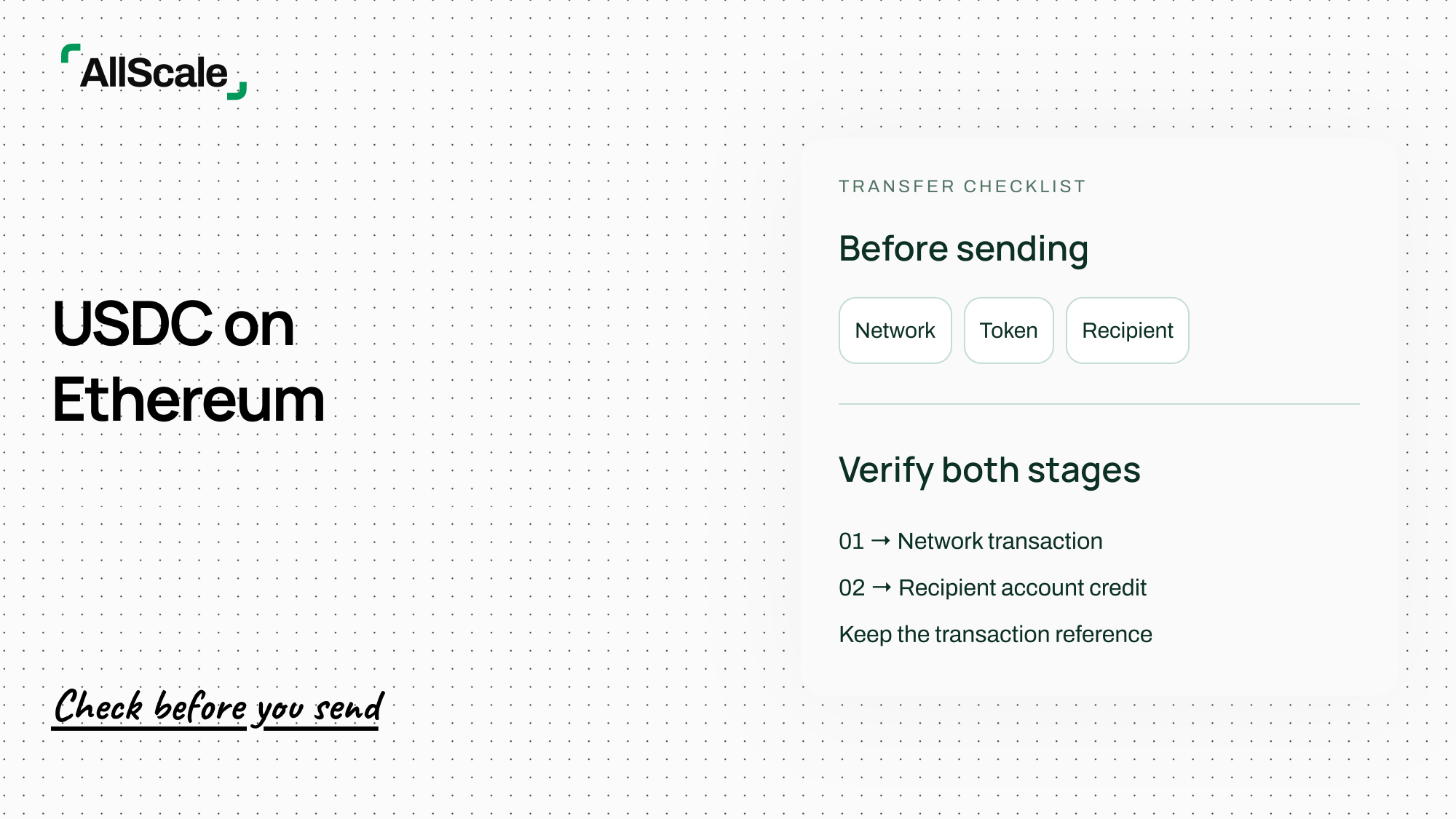
For a direct stablecoin route, establish the refund procedure separately from payment confirmation. Verify the recipient and network through the provider’s supported process; do not send funds to a new address based solely on an unverified support message. Ask what recovery or restriction mechanisms apply to the particular token and service. Avoid treating “no card chargeback” as a promise that there can be no fraud, refund request or commercial dispute.
A card-to-stablecoin on-ramp adds another relationship. Clarify who sells the asset to the customer, who handles identity checks, and who bears a dispute on that purchase. Receiving stablecoins does not by itself explain the liabilities of every earlier step.
Make the checkout survive ordinary exceptions
The easy case is a customer who pays the exact amount and receives a prompt confirmation. Your operating plan also needs to cover the customer who pays late, clicks twice or closes the browser too early.
These are acceptance criteria for the route, not claims that every product handles every case automatically.
Where the integration uses webhooks, ask the team to test retries, duplicate deliveries and events arriving out of order. Stripe explicitly documents these behaviors and signature verification. The same questions are useful when reviewing another provider, but its own documentation must establish the implementation. Stripe webhook guidance.
For a payment gateway for startups, a practical evaluation includes how much of this work the provider handles and how much your team must build. A hosted link can reduce checkout setup while leaving refund approval, fulfillment and reconciliation with you. Stripe’s Payment Links documentation illustrates this distinction: the hosted payment page can be shared without building a checkout page, but it still offers underlying payment methods with their own behavior. Stripe Payment Links.
Run a two-route pilot with the same ten test orders
Choose two routes that serve the same buyer group and satisfy the same settlement requirement. For an invoice business, that might be its existing bank route and an eligible invoice-payment flow. For a digital product with stablecoin-holding customers, it might be the existing checkout and a direct stablecoin alternative.
Use the same ten order profiles on both routes. That means twenty controlled executions, not asking real customers to pay twice for one purchase. Start in test environments; use approved, low-value live transactions only where needed to check actual settlement. Do not create fraudulent transactions or real disputes to test a process.
Some scenarios will not apply equally. A fixed-amount hosted checkout may prevent short payment; mark that case “prevented by design” and retain evidence. An asynchronous bank transfer may require a different delay test from a card checkout. Record those differences instead of forcing identical mechanics or counting “not applicable” as a success.

Use the same buyer profiles and settlement endpoint. Leave a result unscored until it has been observed; this is a test framework, not measured provider performance.
Track six results that can change the decision
Show individual results and the range. Ten test orders can expose a broken refund flow; they cannot establish a dependable market-wide conversion rate or a meaningful 95th-percentile latency. A larger live rollout is needed to assess normal customer behavior. Separate controlled technical success from real customer conversion.
Set pass conditions before looking at results. For example, require every successful test payment to map to exactly one order, require duplicate notifications to produce no extra fulfillment, and require an identified owner for every unresolved exception. Choose your usable-funds deadline and acceptable costs from business needs, rather than inventing universal thresholds.
Choose a primary route and a useful fallback
Select the route that meets the mandatory conditions with an operating burden your team can support. Use the second route where it solves a specific access problem or provides a practical alternative during a failure.
If cards serve most buyers but some business customers require an invoice and bank transfer, offer a clear invoice path. If a stablecoin route works for buyers already holding the supported asset, present it to that audience. Do not make an unfamiliar wallet or conversion step the only way an otherwise eligible customer can pay.
Assign a launch owner, record unresolved limitations and review the first live transactions against the same scorecard. Adding another payment option is justified when it solves an observed problem that the current routes leave open.
Scope and disclosure
AllScale publishes this guide and offers products discussed here. It is a decision framework based on public product pages and official documentation reviewed on October 21, 2026, not a hands-on provider ranking. The pilot scenarios are proposed tests, not completed experiments. Availability, eligibility, fees and refund behavior depend on the provider, jurisdiction, method and contract; obtain current terms for the route you intend to use.
FAQ
What is the best way to accept international payments for a small business?
Start with the customers you already serve. Compare cards and relevant local methods for online purchases; compare bank transfer and invoice-payment flows for business billing. Add a stablecoin route when buyers can use it and its settlement endpoint fits your operations. Test the whole transaction, including a refund, before rollout.
Are payment links a separate payment method?
No. A link opens a payment experience. Its underlying methods determine what the buyer can use and how funds settle. An invoice link may identify a specific customer and amount, while a reusable sales link may serve multiple buyers. Confirm how your chosen product connects each payment to an order.
Do stablecoin payments eliminate chargebacks?
A direct stablecoin payment does not use the card-dispute process. That does not remove refund obligations, fraud exposure or disputes about the goods or services. If a customer buys stablecoins through a card-funded on-ramp, review that provider’s chargeback allocation separately.
Can a customer pay by card while I receive stablecoins?
Some services offer that flow. Check the actual provider, customer-country eligibility, verification steps, fees and refund process. Identify who handles the card transaction and who handles the subsequent stablecoin transfer. Do not assume every customer or card is supported because the option appears on a product page.
Should I settle in local currency or stablecoins?
Choose the endpoint that matches how you use the funds. If bills are paid from a local-currency bank account, include conversion and withdrawal in the comparison. If you use the supported stablecoin directly, test that wallet endpoint. Keep any later conversion cost visible as a separate scenario.
Is the best way to make international payments also the best way to collect them?
Not necessarily. Outgoing payments start with your funding source and a recipient. Collections start with the buyer’s ability to pay and must connect to an order or invoice. A good payout product does not automatically provide a suitable customer checkout.
Put the decision in one payment flow
Choose one buyer segment, define the required settlement endpoint and run the two-route pilot. Keep the route that customers can complete and your team can operate through a refund and reconciliation.
If that pilot includes stablecoin invoice collection or an application checkout, contact AllScale with the buyer countries, order sizes, desired settlement and refund requirements.