
By AllScale Editorial · Updated October 22, 2026 · 10 min
Before sending USDC ERC20, match the Ethereum network, the token and the receiving service. Check the fee shown by your sending wallet or platform, then save the transaction hash so you can verify the transfer and follow up if the recipient has not been credited.
The same USDC label can appear on several networks. An address that looks valid does not prove that a receiving platform will credit a payment on your chosen network. Treat the network, token contract and receiving instructions as one set of requirements.
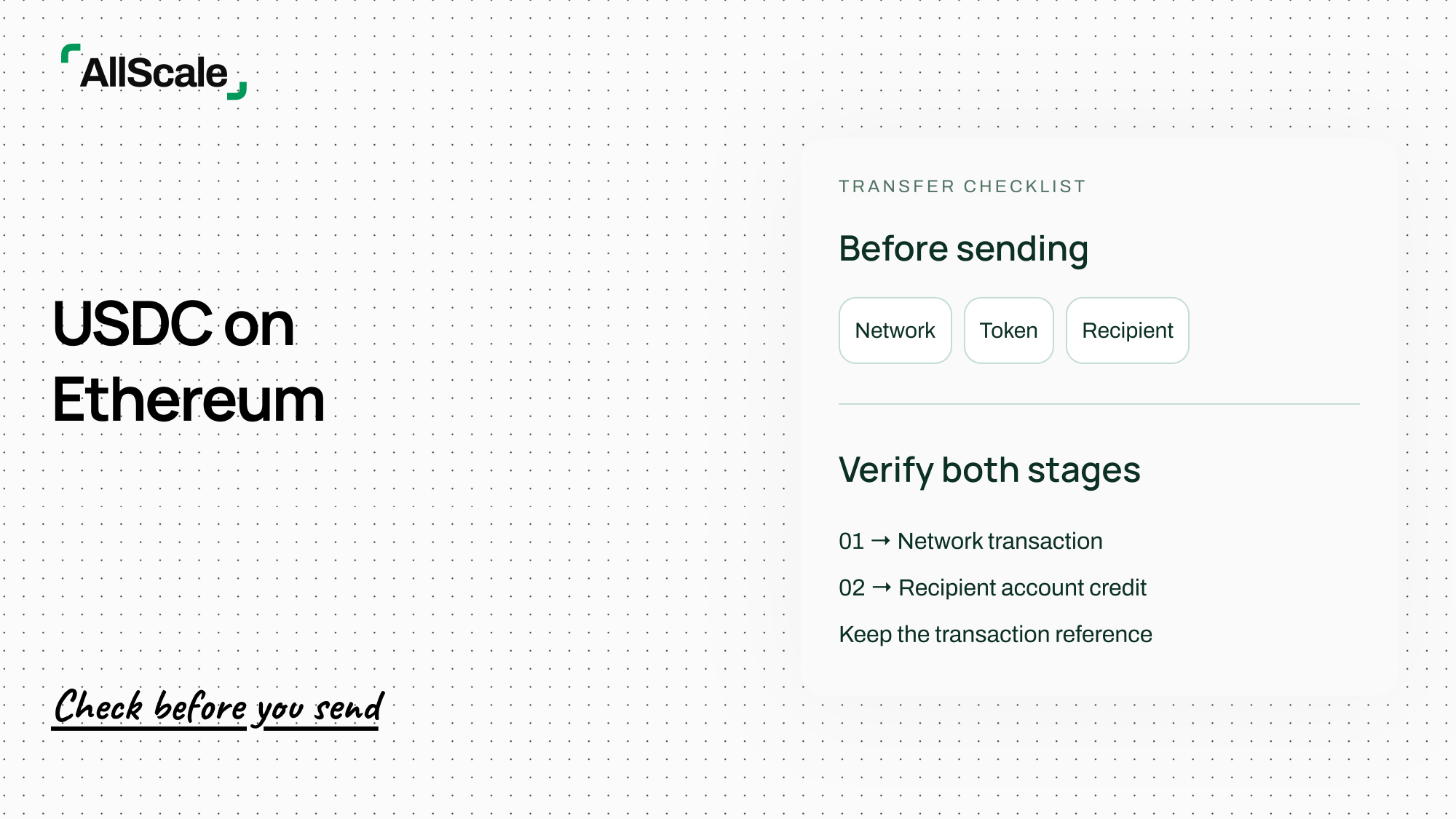
Check the route before sending. Verify the network transaction and the recipient’s account credit separately.
USDC ERC20 transfer checklist
Complete these seven checks before confirming a payment. If the recipient uses an exchange or payment service, use that service’s current deposit instructions for the specific account. Do not substitute details copied from an old transaction or a search result.
The final row is a recordkeeping check: before sending, establish where the reference will appear; after sending, save it. A withdrawal request number may exist before there is an on-chain transaction hash.
For a new receiving route, a small test can help confirm that the destination works. Check any deposit minimum before choosing the test amount, wait for the recipient to confirm credit, and recheck the details for the remaining payment. A successful test does not guarantee that a larger payment meets every limit or review requirement.
Check Ethereum and the token contract
Verify the network
ERC-20 is a token standard: it defines a common interface for fungible tokens. Ethereum is the blockchain route covered in this guide. These are different pieces of information. A platform may use “Ethereum (ERC20)” as a network label, but the label should still be matched with the receiving service’s instructions. Ethereum’s ERC-20 documentation.
An Ethereum-style address begins with 0x, but that format alone does not identify a network. If the receiving page specifies a different network, selecting Ethereum because the address looks familiar is not a valid substitution.
Keep this check specific. “We accept USDC” is less useful than a deposit page that identifies USDC on Ethereum and supplies the appropriate receiving details. If support is unclear, resolve it with the recipient or their service before transferring.
Check the token contract
Circle’s official directory lists the following USDC contract on Ethereum mainnet, checked October 22, 2026:
0xA0b86991c6218b36c1d19D4a2e9Eb0cE3606eB48
Open Circle’s USDC contract directory, select the Mainnet section and find Ethereum. Compare the complete address with the token your wallet or platform is sending. Use the current directory again when preparing a transfer; do not rely solely on a screenshot or abbreviated address.
This is the token contract, not the address to which you should send a payment. Your recipient supplies the receiving address. The contract identifies the asset; the destination identifies where the transfer is going.
Token names and icons are not sufficient verification. A token with a familiar symbol may represent a different contract. Circle lists mainnet and testnet contracts separately, so check that you are looking at the mainnet entry for a real payment.
If the asset is described as bridged USDC or USDC.e, stop and check the exact network and contract with the receiving service. Do not assume support for one version means support for another. This guide covers Circle-listed USDC on Ethereum; other networks and bridged assets require their own checks.
Review fees before sending
USDC fees depend on how you send and where the payment is received. Keep the cost layers separate, then check whether the sending quote already includes any of them.
For a conventional self-managed Ethereum transfer, network gas is paid in ETH. Holding enough USDC for the payment does not necessarily mean you hold enough ETH to execute it. Sponsored or abstracted wallet flows may handle that cost differently; use the actual confirmation screen to establish what you must fund. Ethereum gas documentation.
A hosted platform may quote a withdrawal fee in USDC or another asset. That quote is not necessarily the exact network gas cost. Do not add the network fee a second time if the platform’s quoted charge already covers it. Ask for clarification if the breakdown does not say.
Check the recipient’s expected amount as well. In an illustrative example, a platform deducting a 2 USDC withdrawal fee from a 500 USDC withdrawal would send 498 USDC. A platform charging the same fee on top would debit 502 USDC to send 500 USDC. Neither figure is a current provider quote. The point is to read the “recipient receives” amount rather than infer it from the amount you entered.
Network fees change. Use the estimate for the transaction you are about to approve, and save the actual fee from the completed record. Avoid budgeting from a fixed “USDC transfer fee” quoted without a network, sending method or timestamp.
Send and verify the transaction

Match the Ethereum asset and receiving route, then verify both the transaction and the recipient credit.
1. Prepare the sending balance
Select USDC on Ethereum in the sending wallet or withdrawal interface. Check the amount against the invoice or payment request and confirm how the fee is funded. For a conventional self-managed wallet, check the ETH balance needed for gas as well as the USDC balance.
The result of this step is a funded, identified route. If your funds are on another network, changing a dropdown does not move them to Ethereum. Use only a supported transfer or conversion process after reviewing its own requirements.
2. Obtain and verify the receiving instructions
Get the destination from the recipient’s current wallet or deposit page. Match the network and exact asset, then compare the full address before approving. For a business invoice, retain its reference with the payment record.
If payment details arrive in a changed email thread or an unexpected message, verify them through an established channel. A technically valid address can still belong to the wrong recipient.
3. Review the final confirmation
Check the destination, Ethereum network, asset, amount, fee and expected recipient amount together. Confirm that deposit minimums or other disclosed route requirements are satisfied. This is the point to correct an error before authorizing the transfer.
4. Save the transaction record
After submission, keep the sending platform’s reference and the Ethereum transaction hash when available. A transaction hash identifies an on-chain transaction; it is not the same as the USDC contract address or the recipient address.
Use the sender’s explorer link or open the Ethereum explorer directly. If the platform has not broadcast the withdrawal, ask the platform about that status instead of treating a missing explorer result as proof that money was lost.
5. Read the token-transfer details
On the explorer, check the transaction status and the relevant USDC token-transfer entry: token contract, recipient and amount. Do not read only the top-level transaction destination. For a token transfer, that field may identify the contract being called rather than the person receiving tokens.
Similarly, a top-level ETH value of zero is not enough to conclude that no USDC moved. USDC transfer details are separate from the amount of ETH attached to the transaction. For complex transactions, find the particular token-transfer entry that corresponds to your payment rather than assuming every transfer shown is yours.
6. Confirm credit with the recipient
An explorer showing a successful transaction is one part of the evidence. A hosted receiving service may still apply confirmation thresholds, minimums, account checks or other crediting rules. The recipient should verify their balance or transaction history in that service.
Keep the invoice or payment reference, sent amount, fee record, transaction hash and recipient confirmation together. For a business payment, that set of records is more useful than a cropped “Success” screenshot alone.
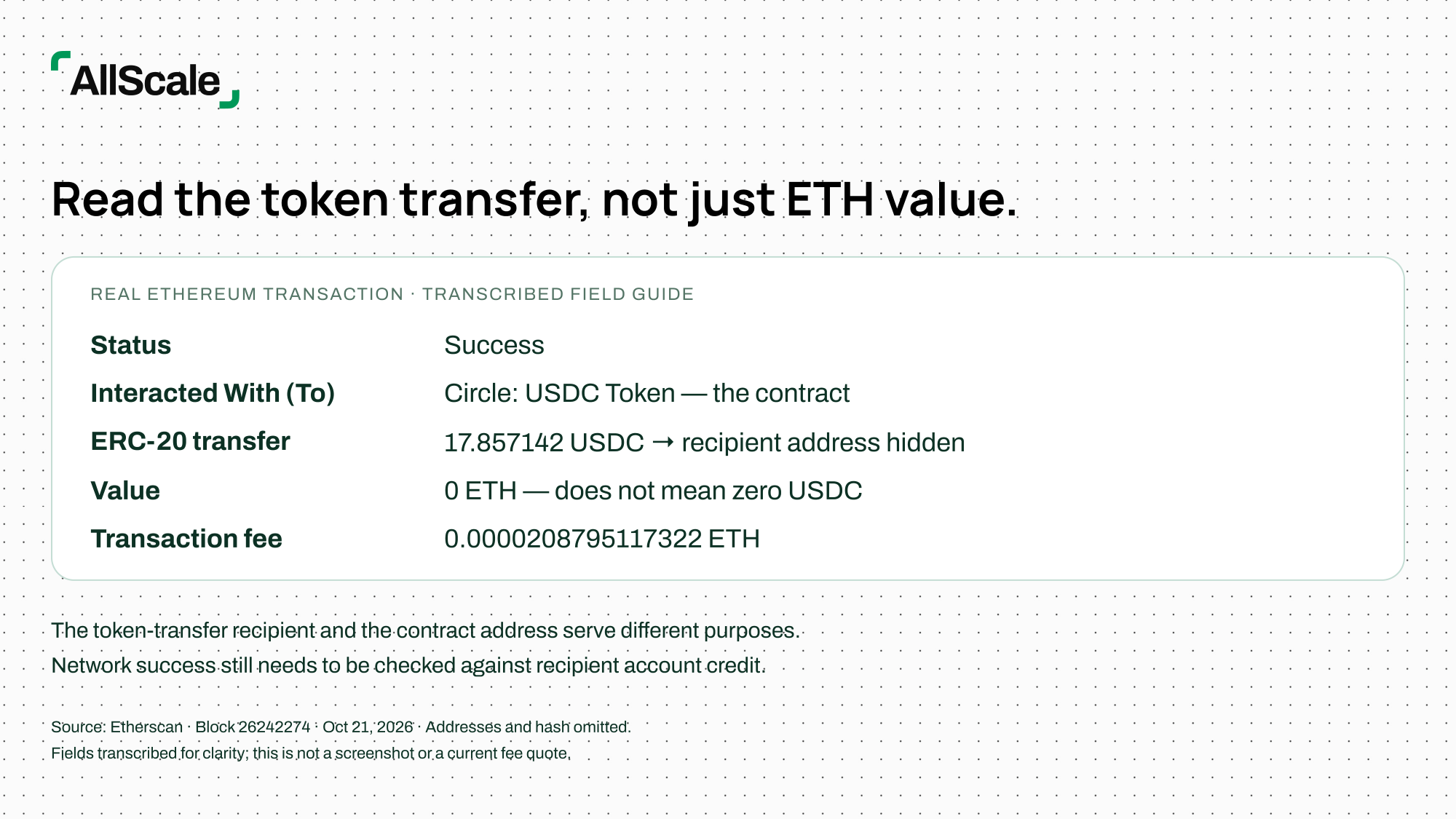
Real transaction, transcribed for readability: Etherscan block 26242274, October 21, 2026. Wallet addresses and the transaction hash are omitted from the visual. This is a field guide, not a screenshot or a current fee quote. The example shows why a transaction’s ETH “Value” and its USDC transfer amount are different fields.
If USDC has not arrived
Start with the existing transaction or withdrawal record before initiating another payment. Resending can create a duplicate obligation if the first transfer is still processing.
If the explorer instead marks a transaction failed or reverted, confirm that the intended USDC transfer did not execute. A failed Ethereum transaction can still consume gas. Resolve the reported cause before submitting a replacement, and check any hosted platform record separately. Ethereum gas documentation.
Send support the details needed to identify the payment through the service’s official channel. A transaction hash can reveal public transaction details, so avoid posting a business payment record publicly when a private support case will do. Never provide a seed phrase or private key to someone offering recovery.
FAQ
Can the same address format work across different networks?
Yes, addresses can look the same across different networks. The format does not establish whether a receiving service supports your payment. Match its explicit network and token instructions before sending.
Do I always pay the transfer fee in USDC?
No. A conventional self-managed Ethereum transfer uses ETH for gas. A platform may quote its withdrawal fee in USDC, and a sponsored wallet may handle gas separately. Read the fee and funding requirements of your actual sending method.
Why is a confirmed transfer missing from my account balance?
Network confirmation and platform credit are separate stages. Compare the hash, token contract, recipient and amount with the receiving service’s crediting requirements. If they match and the service’s stated processing conditions have been met, contact the receiving service with the record.
Should I send USDC to the contract address listed by Circle?
No. Use Circle’s contract address to verify the token. Send the payment to the receiving address provided by your intended recipient for the supported Ethereum route.
Is USDC ERC20 the same as every token called USDC?
No. The symbol alone does not identify the network or contract. This article covers the Circle-listed mainnet USDC contract on Ethereum. Check other networks and bridged versions independently.
Keep the payment route specific
The useful question is whether this USDC contract, on Ethereum, can be credited to this recipient through this service. Establish that before sending, then retain both the network record and the recipient’s confirmation.
For a business collection workflow, explore AllScale Invoicing and confirm the asset and network supported by the actual invoice before requesting payment. Support in one wallet or product should not be assumed to apply to every AllScale workflow.
Published by AllScale. Official token and network references were reviewed on October 22, 2026. This guide explains transfer checks; it does not report a live transfer test or guarantee crediting times, recovery or fees for any service.