
By AllScale Editorial · Updated October 21, 2026 · 12 min
A cross border transaction fee may be only one line in a much larger bill. To compare cross-border payments, account for the provider charge, the exchange rate, network or intermediary deductions, receiving costs and the cost of refunds or failed payments. Then calculate what the recipient can actually use.
A quote that says “$25 transfer fee” does not tell you what a $10,000 invoice will deliver. The answer also depends on which currency the recipient needs, when conversion happens and whether the fee is added to your bill or deducted from the payment.
TL;DR
- Check five cost layers: provider, FX, network or correspondent, receiving or withdrawal, and refund or exception costs.
- Compare the same funding currency, destination currency, amount and delivery requirement. A wallet credit and a local bank deposit are different endpoints.
- Test quotes at your 10th, 50th and 90th percentile transaction values. A fixed fee can dominate small payments, while a percentage charge becomes more important on large ones.
- Count each cost once. An FX margin already reflected in the quoted rate must not be subtracted again.
What does a cross-border transaction fee cover?
The term can mean a specific international-payment surcharge or the wider cost of sending money between countries. This guide uses it in the broader business-payment sense. If you are looking at a card statement or merchant-processing contract, ask what that particular fee covers before adding it to your model.
Payment collection and outgoing transfers also have different cost structures. For collections, start with the customer's gross payment and work toward your business's usable settlement. For payouts, start with your funding amount and work toward the recipient's usable funds. Keep those journeys separate when evaluating cross border payment solutions.
Provider fees
A provider may charge a fixed amount, a percentage, a subscription or some combination. Record the fee's calculation base: a percentage of the invoice is different from a percentage of the amount remaining after another deduction.
Ask whether processing, funding and payout are included in one charge. If a monthly plan is required, allocate its cost across a realistic number of transactions. Keep that allocation separate from the fee deducted on any individual payment.
Foreign-exchange cost
The exchange rate can change the result even when the advertised transfer fee is low. Record both the provider's executable rate and a reference rate captured at roughly the same time.
Use a consistent direction, such as euros received per US dollar converted. With that convention, a lower provider rate delivers fewer euros. Do not compare it directly with a quote expressed as dollars per euro without first converting the units.
A reference rate is a comparison baseline, not a promise that you can transact at that rate. A difference between a quote and a benchmark can also reflect timing. Preserve timestamps and quote expiry so that the comparison is meaningful.
Network and correspondent-bank charges
Some bank transfers pass through intermediaries that can take fees along the route. Wise's official Swift documentation describes the possibility of correspondent-bank charges; the sending provider's own fee is therefore not always the complete deduction. Wise Swift transfer documentation.
For an on-chain payment, check the exact network and who pays its transaction fee. Ethereum's documentation explains that gas costs depend on the computation required and network demand. A fee observed on one network or at one time is not a dependable estimate for every stablecoin transfer. Ethereum gas documentation.
Receiving, withdrawal and conversion costs
Define where the payment is finished. A recipient may have a credited platform balance but still need to withdraw to a bank, convert a currency or sell a token.
If the agreed endpoint is a local bank deposit, include those steps. If the recipient wants to retain the supported token, do not add a hypothetical cash-out fee as though it has already been incurred. Show the alternative endpoint separately.
Refunds and exceptions
A successful-payment quote does not tell you the cost of a refund, a rejected transfer or a payment sent to incorrect details. Ask which original charges are retained and whether a new fee or conversion applies.
Policies are service-specific. For example, Stripe's Mexico support page states that its original processing fees are not returned when a payment is refunded. That is a policy for the stated market, not a universal rule for cross border payment providers. Stripe's Mexico refund policy.
For budgeting, add an expected exception cost using your own history: exception rate × average incremental cost per exception. Include only costs not already counted in the successful-payment model. Track unrecovered principal and staff time separately so they do not get disguised as provider fees.
Compare quotes by who pays each layer
A cost can be paid on top by the sender, deducted from the amount in transit or charged later to the recipient. “Sender pays” describes a commercial arrangement; it does not, by itself, prove that every downstream charge has been covered.
| Cost layer | What to obtain from each provider | Who bears it? | How to record it |
|---|---|---|---|
| Provider | Fixed and percentage fees, funding charges, minimums and plan costs | Sender, recipient or both, depending on the contract | Currency, fee base and whether added or deducted |
| FX | Executable rate, rate direction, expiry and any separately charged conversion fee | Whoever funds the conversion or receives less after it | Applied rate plus timestamped reference; no double counting |
| Network / correspondent | Supported route, included charges and possible external deductions | Confirm for each leg | Actual fee where known; unresolved exposure where unknown |
| Receiving / withdrawal | Cost to reach the agreed final account or asset | Often recipient-facing, but negotiable | Destination, currency and final usable amount |
| Refund / exception | Retained fees, return charges and reconversion policy | Depends on policy and the event | Separate event linked to the original transaction |
Use unknown, not zero, when a provider cannot specify a charge. You can still compare a known subtotal, but it should not be labeled an all-in quote.
Worked example: a $10,000 invoice
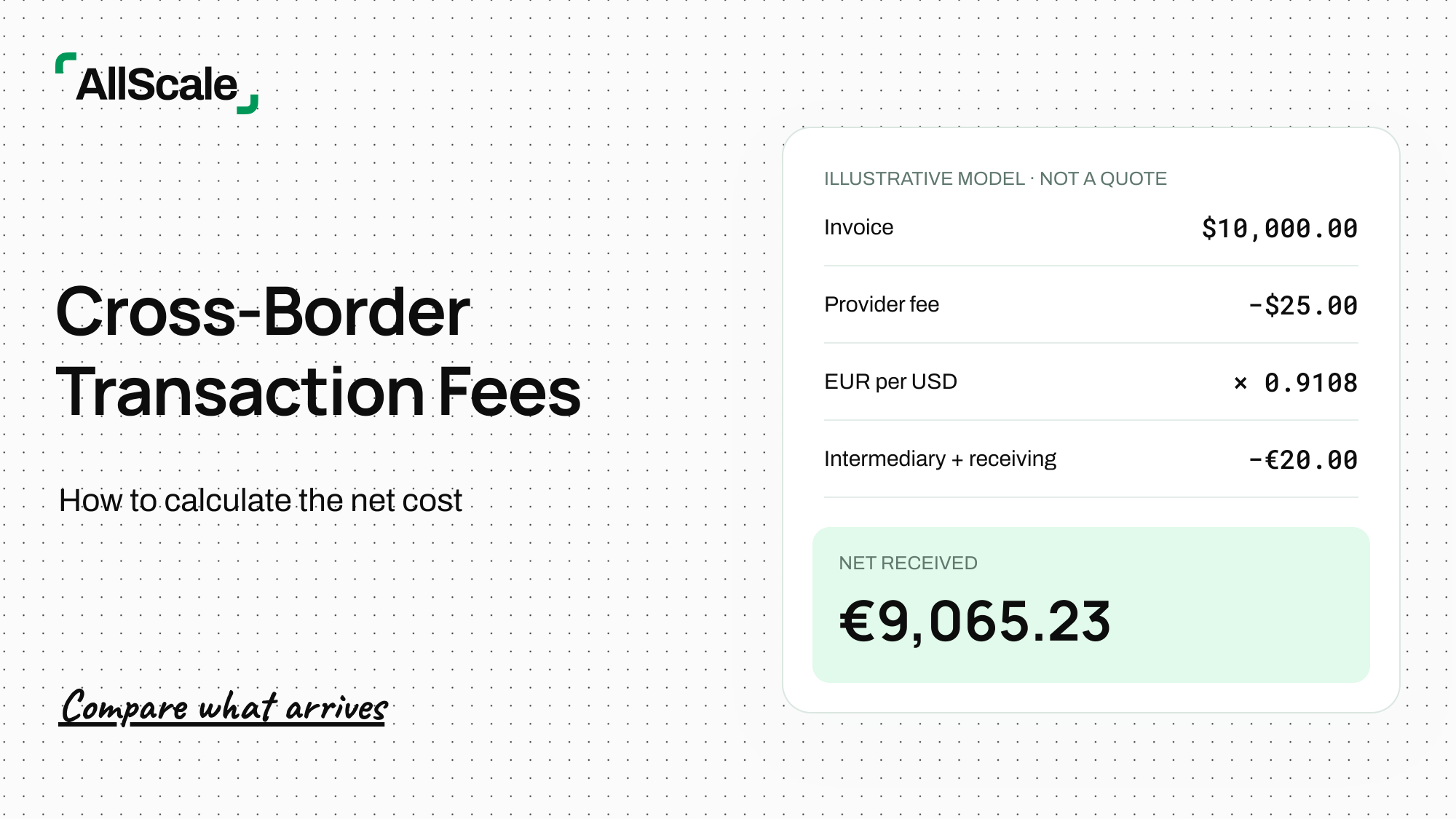
Assume a business sends $10,000 USD to a supplier who wants euros in a bank account. The parties agree that the following deductions come out of the invoice amount.
These inputs are invented for the calculation. They are not live rates, market averages or an AllScale price:
- Reference rate: €0.9200 per $1.
- Provider rate: €0.9108 per $1.
- Provider fee: $25, deducted before conversion.
- Intermediary deduction: €15, after conversion.
- Receiving fee: €5, after conversion.
- No additional sender charge, subscription allocation or exception cost in this example.
| Step | Calculation | Amount |
|---|---|---|
| Invoice | Starting amount | $10,000.00 |
| Amount converted | $10,000 − $25 | $9,975.00 |
| Converted funds | $9,975 × €0.9108 | €9,085.23 |
| After intermediary deduction | €9,085.23 − €15 | €9,070.23 |
| Net received | €9,070.23 − €5 | €9,065.23 |
| Reference value | $10,000 × €0.9200 | €9,200.00 |
The recipient receives €134.77 less than the reference value. That is an effective cost of approximately 1.46% of the €9,200 reference amount.
You can reconcile that gap without inventing another fee:
| Component of the gap | Calculation | EUR equivalent |
|---|---|---|
| Provider fee at the reference rate | $25 × €0.9200 | €23.00 |
| FX difference on the amount actually converted | $9,975 × (€0.9200 − €0.9108) | €91.77 |
| Intermediary and receiving fees | €15 + €5 | €20.00 |
| Total | €23 + €91.77 + €20 | €134.77 |
The FX difference is already present in the €0.9108 rate. Subtracting an additional 1% from the converted payment would count it twice.
Use one denominator consistently
For a complete route comparison, define:
Route cost in the funding currency = total sender outlay − (net received ÷ reference rate).
Here, the reference rate is destination-currency units per funding-currency unit. Then:
Effective route cost = route cost ÷ total sender outlay × 100%.
For this example, $10,000 − (€9,065.23 ÷ 0.9200) is approximately $146.49, or 1.46% of sender outlay. Use unrounded intermediate values and round the final answer.
If the sender pays a separate charge on top, add it to total outlay. The invoice value alone would then understate the amount spent. This metric describes the combined payment-route cost; it does not decide who should bear it under the contract, and it is not an accounting treatment for FX gains or losses.
If the supplier must receive a fixed net amount
Suppose the agreement instead promises €9,200 net. Under the same fixed fees and rate, the required funding would be:
(€9,200 + €20) ÷ 0.9108 + $25 = $10,147.97, rounded up to the next cent.
A real provider may apply different rounding rules or fee thresholds, so request an executable guaranteed-net quote. Do not assume that sending the invoice's original $10,000 meets a net-payment commitment.
Test small, typical and large payments
An average invoice can hide a costly payment mix. Export your recent transactions, separate them by currency corridor and use the 10th, 50th and 90th percentile values as quote inputs. These represent smaller, median and larger payments in your own dataset.
The following is a synthetic example, not observed customer data. Suppose those values are $500, $5,000 and $25,000. Two hypothetical quotes have the same destination, timing and FX treatment, with all modeled costs expressed in USD:
- Quote A: $25 + 0.5% of the payment amount.
- Quote B: $5 + 1.0% of the payment amount.
There are no additional costs in this simplified comparison. These quotes are unrelated to the $10,000 example above and do not represent named providers.
| Illustrative order value | Quote A cost | A as % of order | Quote B cost | B as % of order | Lower modeled cost |
|---|---|---|---|---|---|
| P10: $500 | $27.50 | 5.50% | $10.00 | 2.00% | B |
| P50: $5,000 | $50.00 | 1.00% | $55.00 | 1.10% | A |
| P90: $25,000 | $150.00 | 0.60% | $255.00 | 1.02% | A |
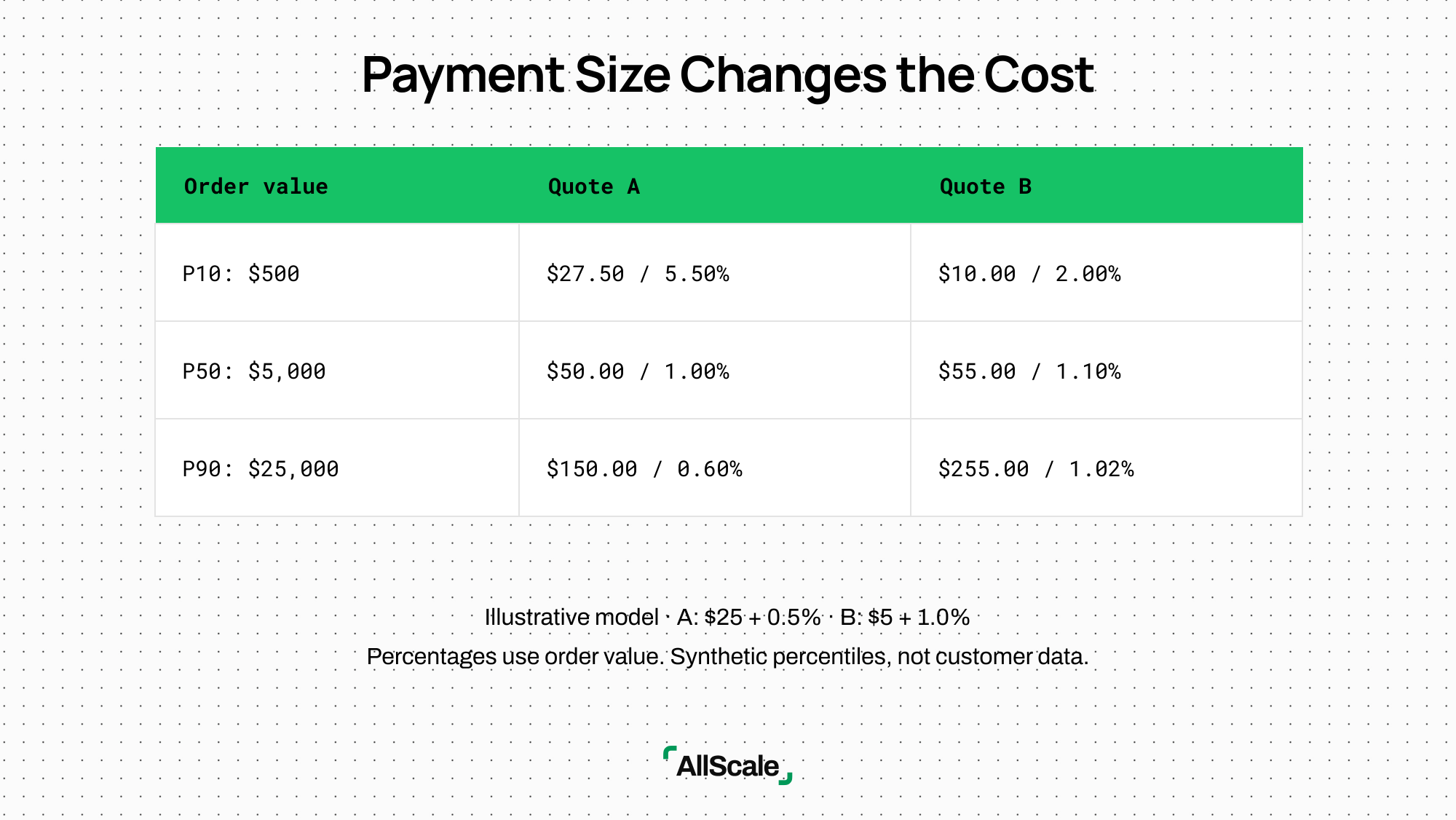
Illustrative model: A = $25 + 0.5%; B = $5 + 1.0%. All figures also appear in the table above. No named provider pricing is represented.
The two formulas break even at $4,000, where both cost $45. Below that amount, B is cheaper under these assumptions; above it, A is cheaper.
This table measures cost as a percentage of order value. It is not the sender-outlay percentage used in the previous section. Label the denominator rather than mixing the two metrics in one report.
Three percentiles are useful test cases, but they do not establish your annual budget. For that, apply the quoted formula to every transaction or to representative volume bands, then add plan fees and expected exceptions. Divide total modeled costs by total payment value for a volume-weighted rate. Taking a simple average of the three percentages would misrepresent the payment mix.
Keep a ledger that explains the net amount
The most useful payment record connects the invoice to both the funding debit and the final receipt. Keep the original currency amounts even if your reporting system also translates everything into one currency.
| Record | What to retain |
|---|---|
| Invoice and funding | Invoice ID, gross amount and currency, total sender debit, charges paid separately |
| Fees | Type, amount, currency, payer and the stage where each was charged |
| FX evidence | Applied rate, direction, amount converted, reference source, timestamps and quote expiry |
| Settlement | Net amount, destination currency or asset, receiving account type and usable-funds date |
| References | Provider transaction ID; network and transaction hash for an on-chain leg |
| Exceptions | Original payment reference, return or refund, retained fees, new conversion and resolution |
For stablecoin routes, record the token and network as well as the amount. A token transfer and a later fiat withdrawal may need separate records. If you cannot observe the recipient's final bank receipt, say which milestone your reconciliation actually verifies.
Request quotes that you can compare
Send each provider the same payment specification:
- Your payer entity and country, recipient country and account type, and required funding and destination currencies.
- The three representative payment amounts, expected monthly volume and required receipt dates.
- The agreed endpoint: platform balance, supported wallet or local bank account.
- A breakdown of sender-paid charges, deductions and recipient-paid charges, including third parties.
- The executable exchange rate, its direction, validity period and the amount to which it applies.
- A return/refund scenario and the treatment of original fees, new charges and reconversion.
- Any minimums, plan fees, volume commitments or availability conditions behind the quote.
Ask for a guaranteed net amount where available. Otherwise, separate the known cost from estimated and unresolved charges. Run a small permitted test through the complete route before committing recurring volume.
For recurring contractor payouts, our guide to paying international contractors covers beneficiary verification, approvals and the records to keep alongside the fee model.
Where AllScale fits
AllScale Invoice provides a way to request payment through a shareable invoice link. Use the same fee worksheet to confirm the collection method and the asset or currency your business ultimately receives.
For an outgoing payment, AllScale Claim Link describes a sender-prepaid network fee. That explains who funds that part of the route; it does not establish that later conversion or withdrawal is free. Confirm those costs if the recipient needs fiat at the end.
AllScale's pricing page does not currently publish a tariff. Obtain a route-specific quote rather than assuming zero fees or a cost advantage over other cross border financial services.
Disclosure and method: AllScale publishes this guide and offers payment products. We reviewed official documentation on October 21, 2026. We did not run live comparative transactions. All numerical scenarios are illustrative; availability, fees and exchange rates must be confirmed for the selected route. This is a purchasing and reconciliation model, not tax or accounting advice.
FAQ
What is an all-in cross-border payment fee?
It is a quote that accounts for the defined journey from funding to the agreed receipt destination. Check whether it includes FX, external deductions, withdrawal and any charges paid separately. A successful-payment quote can still exclude refunds or exceptions; those exclusions should be explicit.
Who pays the fees: sender or recipient?
The agreement should specify both responsibility and deduction mechanics. A sender can pay a fee separately, or it can reduce the transferred amount. Confirm the net receipt when the contract promises a fixed amount to the recipient.
Can there be a cross-border fee without currency conversion?
Yes. Sending and receiving in the same currency does not rule out provider, intermediary or receiving charges. Remove an FX cost from the model only when no conversion occurs along the selected route.
Are fees refunded when the payment is refunded?
Do not assume so. Original processing fees may be retained, and a return may involve new charges or an exchange-rate change. Ask for the selected provider's applicable policy and reconcile the refund separately from the original payment.
Are stablecoin payments free if the recipient pays no gas?
No recipient gas charge does not mean no route cost. The sender or platform may pay the network fee, and funding, conversion or withdrawal can have separate costs. Define whether the recipient wants the token or a fiat bank deposit before comparing routes.
What is the cheapest cross-border payment solution?
There is no single cheapest option across all amounts and destinations. Compare supported routes at your actual order sizes and required receipt endpoint. A lower fee is useful only if the route also meets your delivery and operational requirements.
Compare what arrives
Before accepting a quote, make sure it answers two questions: how much leaves the sender, and how much becomes usable by the recipient? Keep unknown charges visible until you can resolve them.
If your collection or payout workflow may fit AllScale, contact us to review the route and its fee assumptions.