

By AllScale · Updated October 20, 2026
To pay international contractors, confirm their working relationship and tax documentation, agree on the currency and fee responsibilities, choose a supported payment method, and reconcile each invoice against what the contractor actually receives.
A $2,000 invoice can leave your account as $2,000 and still arrive short. A transfer fee may come out of the principal. Currency conversion may reduce the payout further. And a payment marked “completed” may only have reached a platform balance that the contractor still needs to withdraw.
A reliable payment process makes those details clear before the first invoice is due. This guide covers the decisions and records you need for a recurring contractor pay run, with a worked example you can adapt to your own quotes.
TL;DR
- Confirm contractor status and applicable tax documentation before setting up recurring payments. A payout tool does not make that decision for you.
- Compare routes by the currency the contractor needs, the total cost, and when funds become usable. Include withdrawal and conversion costs.
- Keep the invoice, approval, payment reference, exchange-rate evidence, and any exception together so finance can explain the final amount.
Start with the working relationship
Before choosing how to pay overseas contractors, establish who you are contracting with, where they perform the work, and whether the arrangement qualifies as independent contracting under applicable rules.
For U.S. federal tax purposes, the IRS considers behavioral control, financial control, and the type of relationship. Its guidance calls for assessing the whole relationship; there is no single decisive factor. Working remotely does not itself establish contractor status. Other jurisdictions require their own assessment. IRS worker-classification guidance.
Record the legal name of the individual or business, the service scope, work location, and the basis for the classification decision. If the arrangement is unclear, resolve it with a qualified adviser before building a recurring contractor workflow around it.
Then put the payment terms in writing:
- Amount and currency: Is the invoice denominated in USD, local currency, or an agreed digital asset?
- Due date: When must the contractor have access to the funds?
- Fee responsibility: Who pays transfer, conversion, receiving, and withdrawal fees?
- Completion: Does payment mean a bank credit, a platform balance, or receipt of a specified token on a specified network?
- Changes: How will you verify a new beneficiary account or wallet address?
For U.S. tax analysis, the location where services are performed generally determines the source of personal-service income. The payer’s location and the payment destination do not settle that question. Record changes in work location and send them for tax review when necessary. IRS guidance on personal-service income.
Choose a payment route the contractor can use
The best way to pay international contractors depends on their destination currency, the available routes, and how much payment administration your team needs. Start with the recipient’s needs, then compare the full journey from funding to usable money.
A payout platform is a service layer: it may use bank transfers, stablecoins, or other rails underneath. Ask what happens after you submit the payment.
| Option | When it fits | Costs to check | Limits to resolve before use |
|---|---|---|---|
| Local bank payout through a bank or transfer service | The contractor wants local currency in an existing bank account | Funding fee, transfer fee, FX spread, receiving charges | Supported corridors, account requirements, cutoffs, and actual bank-credit timing |
| International bank wire | The recipient needs a bank deposit and a suitable local payout route is unavailable | Sending fee, correspondent-bank deductions, receiving fee, FX | Potential deductions, tracking, and recall or return procedures |
| Contractor payout platform | Your team needs invoice collection, approvals, or batch payment administration | Subscription or per-contractor charges, transfer fees, FX, withdrawal charges | Which functions are included, who holds funds, and whether “paid” means credited to the platform or the final account |
| Stablecoin payment | The contractor agrees to receive a supported token and can hold or convert it | Funding or purchase cost, platform fee, network fee, conversion and cash-out charges | Token and network compatibility, custody, local availability, liquidity, and recovery options |
Treat this table as a selection framework, not a price ranking. There is no universal cheapest route: the answer changes with the amount, corridor, funding method, and recipient’s withdrawal needs.
If the contractor needs local currency
Request a quote that shows the amount reaching their bank account. Compare it with alternatives at roughly the same time, using the same funding currency and delivery requirement. A low advertised transfer fee is only one part of the comparison.
If you need a repeatable monthly workflow
Test whether a contractor payment platform lets your team approve invoices, restrict who can change beneficiary details, and export records that match your accounting process. Do not assume every product includes those functions—or that a product labeled “payroll” handles employment obligations.
If the contractor prefers stablecoins
Agree on the token, network, amount, and receiving destination. Confirm that the recipient’s wallet or exchange supports that exact combination. For a new destination, use a small test payment before releasing the remaining amount.
If the contractor needs to cash out, include that step in the comparison. Token receipt and local bank receipt are different milestones. Stablecoins also introduce issuer, custody, and loss-of-peg risks; a dollar-denominated token should not be treated as an unconditional guarantee of a dollar in a bank account.
Changing the rail does not remove applicable sanctions obligations. OFAC states that its compliance obligations apply to virtual-currency transactions as they do to traditional fiat transactions. OFAC FAQ 560.
Where AllScale fits in the workflow
For recurring contractor payments, AllScale Payroll is the closest fit: its product page describes approval before a due date, scheduled payments, downloadable team invoices, and payment-issue notifications. Confirm your team’s setup and funding requirements before the first run. These payment functions do not establish worker status or replace statutory payroll obligations.
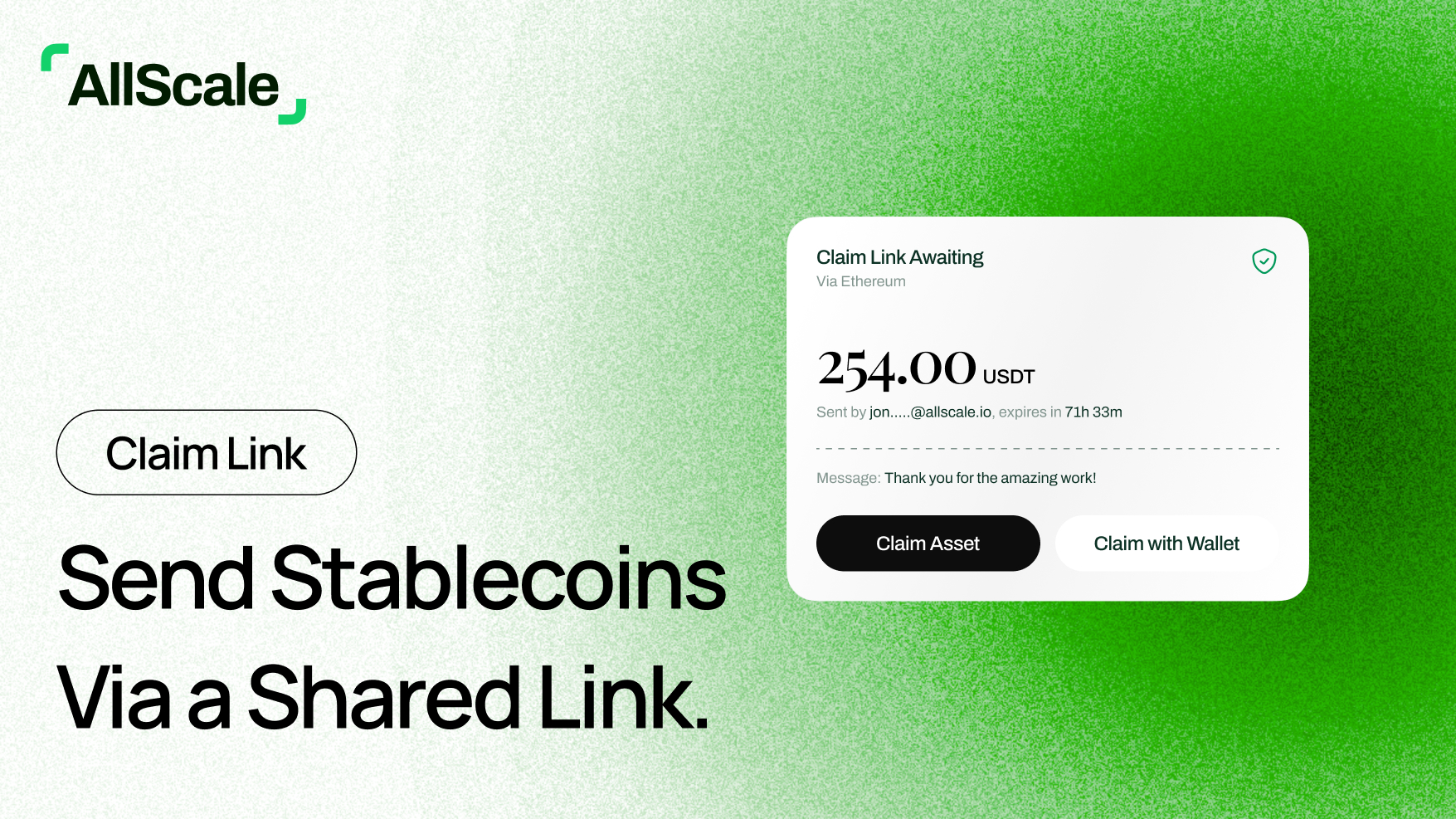
For an individual service payment, AllScale Claim Link offers a different handoff: create a USDT or USDC payout link and share it with the recipient, who claims to an AllScale balance or a supported wallet. The sender prepays the network fee. Before adopting it for contractor payments, confirm applicable limits and what happens to unclaimed funds; receiving tokens does not itself provide a local-currency bank payout.
AllScale Invoice belongs on the collection side. A contractor billing a client can share an invoice payment link and track its status. In this article’s scenario, that is the contractor requesting payment from your business. It should not be confused with your business distributing a recurring pay run.

Three ways to organize a payment. Invoice shows the billing request; Payroll and Claim Link show outgoing payment workflows. These are separate options, not a required sequence or a claim of automatic integration.
| Your task | Product to explore | What to confirm |
|---|---|---|
| Collect payment for an invoice | Invoice | Available payment methods, settlement asset, fees, and feature availability |
| Organize recurring contractor payments | Payroll | Schedule, funding, recipient eligibility, and required records |
| Send an individual payout for the recipient to claim | Claim Link | Supported destination, limits, claim status, and unclaimed-funds handling |
Worked example: what happens to a $2,000 invoice?
Suppose a contractor invoices $2,000, wants euros, and has agreed to the deductions below. These are hypothetical inputs to demonstrate the calculation, not an AllScale quote or market benchmark. The example excludes tax withholding.
Assume a reference exchange rate of €0.9200 per $1, a provider rate of €0.9108 per $1, a $10 fee deducted before conversion, and a €3 receiving charge.
| Step | Calculation | Result |
|---|---|---|
| Gross invoice | Starting amount | $2,000.00 |
| Provider fee | $2,000 − $10 | $1,990.00 to convert |
| FX conversion | $1,990 × €0.9108 | €1,812.492 |
| Network or intermediary charge | Assumed zero for this example | €0.00 |
| Receiving charge | €1,812.492 − €3 | €1,809.492 |
| Net received, rounded | Round at the final step | €1,809.49 |
At the reference rate, $2,000 would equal €1,840.00. The gap is €30.51, or approximately 1.66% of that reference value. It consists of the provider fee’s €9.20 reference value, €18.308 of FX difference on the converted amount, and the €3 receiving charge.
Do not subtract the FX spread again: it is already reflected in the provider’s exchange rate.
If the contract instead promises €1,840 net, funding only $2,000 is insufficient under these assumptions. Ask for a quote that delivers the required net amount, with the sender covering the relevant costs. Specify whether any tax withholding is handled separately.
Use the same discipline for stablecoin quotes. Compare the total funding cost with the agreed token amount delivered—or with the local currency ultimately received if cash-out is part of the payment commitment.

Hypothetical calculation, not an AllScale quote. All assumptions and figures are also shown in the table above.
Build a proof pack for every pay run
A receipt answers where the money went. Finance also needs to know why the payment was approved and how it relates to the invoice.
Keep a payment record linked to the following evidence. Sensitive tax and identity documents can remain in a restricted system rather than being copied into every batch folder.
| Record | What to retain |
|---|---|
| Invoice and agreement | Invoice number, service period, agreed amount and currency, and fee terms |
| Classification | Reference to the assessment, reviewer, and date; any relevant change in the working arrangement |
| Tax-form status | Applicable documentation, validation status, and review or expiry date where relevant |
| Beneficiary verification | Approved recipient details and evidence of independently verified changes |
| Approval | Who authorized the payment, the amount, and when |
| Payment receipt | Provider reference, status, timestamp, and destination; token, network, and transaction hash where applicable |
| FX and fee evidence | Quote, applied exchange rate, itemized deductions, and quote validity |
| Reconciliation and exceptions | Ledger reference, amount received where available, shortfall or return, owner, and resolution |
For freelancer payments, link each invoice to its transaction even when several payments share one batch. If a contractor reports a shortfall, this lets finance distinguish an agreed deduction from a payment error without reconstructing the entire run.
Review exceptions every month
Address urgent issues when they occur. Use the monthly review to find recurring failures and improve the process.
| Exception | Immediate response | Before closing the issue |
|---|---|---|
| Duplicate invoice | Hold the suspected duplicate and compare vendor, invoice number, amount, and service period | Record whether it was a duplicate, a revision, or a valid separate invoice |
| Changed bank or wallet details | Hold payment to the new destination; verify through an established contact channel | Record who verified and approved the change |
| Failed screening or unresolved match | Pause the payment and route it to the responsible compliance reviewer | Follow the documented disposition; do not try another rail to bypass the hold |
| Ledger mismatch | Compare invoice currency, fees, FX, and settlement status | Explain the difference and make the approved accounting adjustment |
For returned payments, confirm the funds’ location and status before sending a replacement. An immediate retry can create a double payment if the first transfer is still in progress.
Track the reason and time to resolution. Repeated beneficiary errors suggest an onboarding problem; recurring unexplained deductions suggest that your quote or contract terms need work.
Questions to ask a payment provider
Use one realistic invoice and destination when asking these questions. Specific answers are more useful than a general country-coverage claim.
- Can you support our payer entity, this contractor’s location, and the required destination currency or token?
- What will we pay in total, and what will the contractor receive after all known deductions?
- Which charges remain outside the quote, including receiving-bank or cash-out fees?
- What does each payment status mean, and when are the funds usable by the contractor?
- Who holds the funds at each stage, and what happens if an account or payment is restricted?
- What controls and exports support approvals, beneficiary changes, and reconciliation?
- What happens after a return, a wrong beneficiary, or a failed transfer? Which fees are refundable?
Run a small pilot through the full route, including withdrawal if needed. Confirm the recipient’s amount and timing, then reconcile the records before expanding the pay run.
Disclosure and scope: AllScale publishes this guide and offers payment products. This article does not rank providers or report hands-on product testing; it combines official references with a proposed operating checklist. Confirm current pricing, eligibility, supported routes, and included controls before choosing a product. A payment service does not replace worker-classification, tax, or local compliance advice. AllScale product information.
FAQ
Do international contractors need W-8BEN or W-8BEN-E?
In a U.S. payer context, Form W-8BEN is generally used by foreign individuals to document foreign status, while W-8BEN-E serves foreign entities where applicable. The correct form depends on the payee and income. These are not universal forms for every international engagement. Follow the relevant W-8BEN instructions and W-8BEN-E instructions.
An individual claiming a treaty exemption for compensation from services performed in the United States may need Form 8233 instead. Get the tax treatment reviewed rather than assuming a W-8 form makes every contractor payment exempt. IRS treaty-benefit guidance.
Should I pay the gross invoice or guarantee a net amount?
Follow the agreement. A gross invoice amount does not explain who bears payment deductions. Specify the invoice currency, the required receipt amount, and responsibility for transfer and conversion costs. If you promise a net amount, obtain a quote that delivers it and address tax withholding separately.
What should I do if a payment is returned?
Get the provider’s reason, confirm whether funds have returned to your available balance, and check for fees or FX differences. Correct and reverify the recipient details before retrying. Link the original transfer, return, and replacement in your records.
Can I recover money sent to the wrong beneficiary?
Contact the provider immediately with the transaction reference and request a recall or recovery attempt. Recovery depends on the route and payment status and is not guaranteed. For on-chain transfers, do not assume there is a bank-style cancellation mechanism. Preserve the transaction details and follow the provider’s recovery process.
Can I pay international contractors in stablecoins?
Consider this route only where permitted, with the contractor’s agreement and a supported receiving destination. Confirm the token, network, fee terms, and cash-out needs before payment. Apply the same classification, documentation, and applicable compliance checks as for other methods.
Make the next pay run easier to reconcile
Choose the route that meets the contractor’s actual payment needs. A local bank payout may be the most practical choice for someone who needs local currency; a stablecoin route may fit someone who explicitly wants and can use that asset.
Before approving the batch, make sure you can answer: what is owed, what will arrive, and what evidence will connect the two? To discuss whether AllScale fits your contractor payment workflow, contact us.