

By AllScale Editorial · Updated October 23, 2026 · 12 min
Before following up on a past due invoice, check the agreed due date, payment status and whether your client received the correct payment details. Then send a short reminder with the invoice number, outstanding amount and a clear next step. Keep a record of replies and any revised payment date.
An unpaid invoice can mean several things: the client missed the email, accounts payable needs a purchase order number, a transfer is processing, or someone disputes the work. Your first message should help identify which problem needs solving. A more forceful version of the same reminder will not fix missing information.
Check the past due invoice before following up
A past due invoice has an outstanding amount after the applicable payment deadline. Start with the agreed terms, including any documented extension. Do not assume that every invoice becomes overdue 30 days after issue. If the contract leaves the deadline unclear, check the requirements that apply to the transaction before asserting a date. For example, UK government guidance describes a statutory rule where no payment date was agreed; that rule should not be copied into a global reminder policy. UK guidance on when commercial payments become late.
Review the record before opening your email draft:
If a client says payment is on its way, ask for the amount, initiation date and payment reference. Compare those details with your receiving records. A remittance notice can help trace a payment; it is not by itself confirmation that funds have arrived. While you investigate, change the follow-up to a status check so the client is not prompted to pay twice.
Keep one person responsible for the invoice. If both the project manager and finance team send reminders, the client can receive conflicting amounts or deadlines. Record the latest status where both teams can see it.
Send a clear first reminder
A useful payment reminder email answers three questions quickly: which invoice, how much remains due, and what should the client do next? Include the original due date without guessing why the client missed it. Give them an easy way to report an error or a payment already in progress.
The following examples are fictional, fully written messages. Alex is a freelance designer; Maya is the client's billing contact. Invoice INV-1042 totals USD 1,200 and was due October 12, 2026. Initially, no payment or credit has been recorded. The example.com address is a non-live example of an invoice link, not an AllScale payment page. Adapt the names, dates, amounts and link to your own verified record before sending.
First reminder email
Hi Maya,
I’m following up on invoice INV-1042 for the September design work. The outstanding amount is USD 1,200, due October 12, 2026.
You can review the invoice and payment instructions at https://example.com/invoices/INV-1042. Please include INV-1042 as the payment reference.
If payment is already in progress, please share the payment reference and date sent so I can check it. Otherwise, could you confirm the expected payment date? Please let me know if your team needs any invoice details corrected.
Thank you,
Alex
Before sending, open your real payment link and check the invoice number, amount and recipient details. An expired link or attachment for a different customer gives the client another reason to put the request aside. Send the message to the billing contact using your established business channel.
The message asks for an expected date, rather than inventing a new contractual deadline. If the client proposes a date you can accept, confirm that arrangement in writing and set your next check accordingly.
Follow up when the first reminder gets no response
Use the same email thread where practical. Refer to the previous message and say what you need to resolve. If an email bounced or the contact has left, fix the destination before sending a stronger reminder.
In this example, Alex sends the first reminder on October 13. With no reply or payment recorded, Alex follows up on October 16. Those dates illustrate one workflow; they are not a universal three-day rule. Set the timing from the agreed due date, customer relationship, any reply and your business's follow-up policy.
Follow-up reminder email
Hi Maya,
Following my message on October 13, our records still show USD 1,200 outstanding on invoice INV-1042, which was due October 12.
The invoice and payment instructions are available at https://example.com/invoices/INV-1042. Please let me know whether your team needs a purchase order number, different billing contact or corrected invoice details to process it.
Could you confirm the payment status and the date we should expect payment? If it has already been sent, the payment reference will help me trace it.
Thank you,
Alex
If there is still no response, contact the known accounts-payable team or project owner through an established channel. Ask who is handling the invoice and what is blocking approval. After a call, email a brief account of the agreed next step and ask the client to correct anything you misunderstood.
Avoid adding threats of legal action or service suspension to a routine reminder. If an unpaid invoice reaches that stage, review your contract and the relevant legal process before deciding what action to take. This guide covers ordinary invoice follow-up, not a formal demand procedure.
Keep a follow-up log
The log should let another person continue the conversation without rereading every email. Keep the invoice identifier, balance and responsible owner alongside these fields:
This is a fictional log for INV-1042. On the promised payment date, check what the client agreed: initiation or receipt, and any relevant cutoff or time zone. Do not call a same-day promise broken before its agreed conditions have passed.
A reusable log can be a spreadsheet or a note attached to the invoice. Record facts separately from assumptions: “no reply as of October 16” is useful; “client is refusing to pay” is not established by silence.
Handle disputes, partial payments and missing details
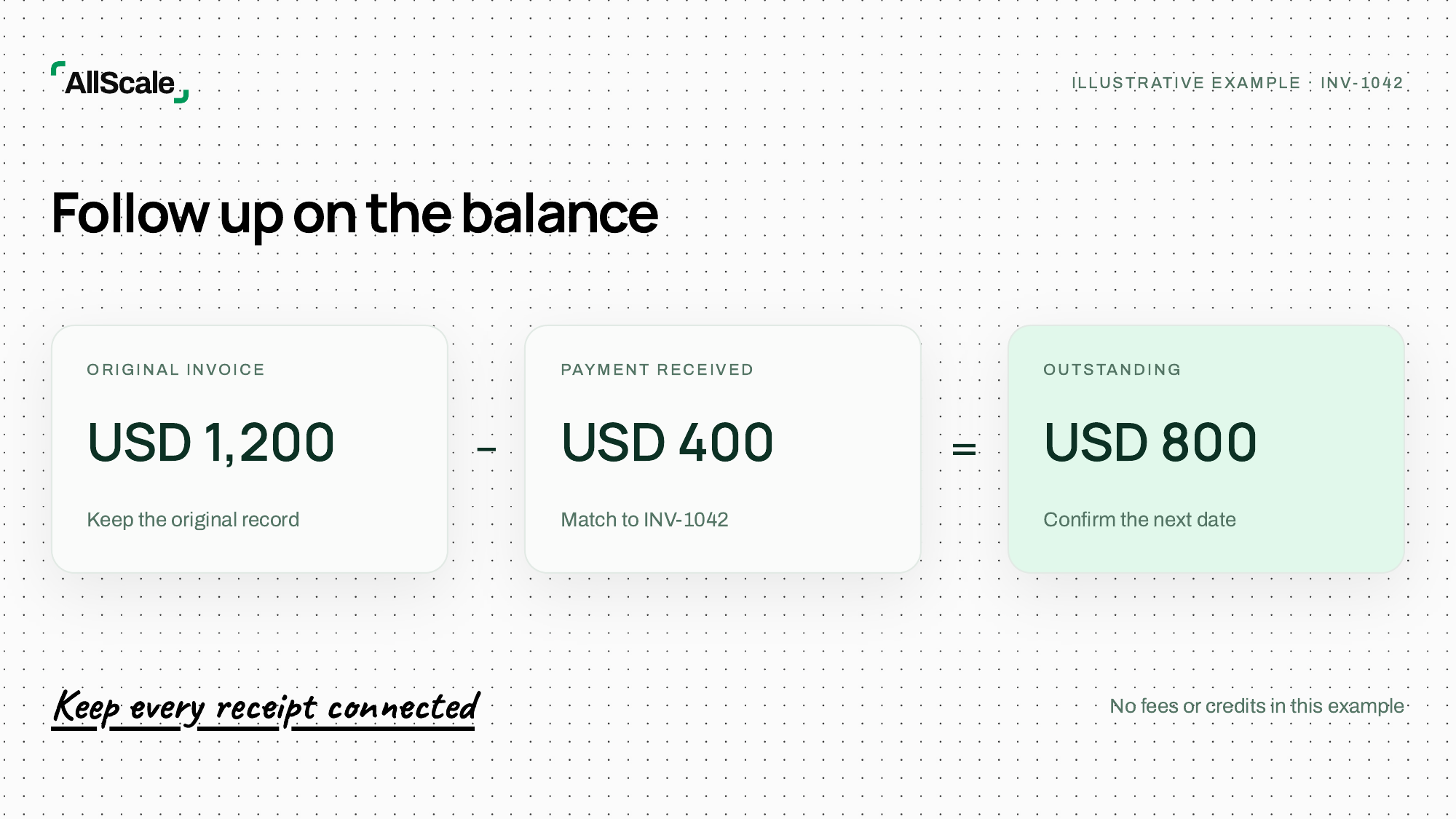
Keep the original invoice and record the payment received; follow up on the USD 800 balance. Illustrative example, not a product screenshot.
Match a partial payment before asking for the balance
Suppose USD 400 is received on October 19 and matched to INV-1042. The balance is:
USD 1,200 invoiced − USD 400 received = USD 800 outstanding.
Keep the original invoice total visible and record the receipt against it. Do not overwrite the total with USD 800 and lose the history, or send a second USD 1,200 invoice that looks like another charge. If a correction or credit is genuinely needed, keep the adjustment traceable to the original record.
Partial payment confirmation email
Hi Maya,
Thank you for the USD 400 payment received on October 19. We have matched it to invoice INV-1042, originally USD 1,200. The remaining balance is USD 800.
You proposed October 22 for the remaining payment. I can work with that date; please confirm when we should expect the funds to arrive, or let me know if your records show a different balance.
The invoice and payment instructions remain available at https://example.com/invoices/INV-1042. Please use INV-1042 as the reference for the balance payment.
Thank you,
Alex
For a cross-border payment, check the currency and any deductions before concluding that a short receipt is an intentional installment. If the client sent the full amount but your account received less, compare the payment record and agreed fee allocation. A currency or fee difference needs reconciliation; it should not silently become a discount or an extra charge.
If the client needs installments, agree the amounts, dates and payment method in writing. Keep the original due date and the revised arrangement in the record, and assign someone to check each receipt.
Clarify a dispute before continuing routine reminders
A disputed amount needs a review of the work or terms. Ask the client to identify the line item and explain the difference between the invoice and their understanding. Gather the accepted quote, scope, delivery evidence and relevant correspondence.
The following is an alternative scenario, not another event in the log above: Maya raises a question about INV-1042 before any payment is received.
Dispute clarification email
Hi Maya,
Thank you for raising your question about invoice INV-1042 for USD 1,200. Could you identify the line item or payment term you would like us to review and explain how it differs from your records?
I’ll compare the details with the agreed scope and delivery record, then confirm the proposed next step with you. If you believe only part of the invoice is affected, please identify that amount so we can discuss the remaining balance separately.
Thank you,
Alex
Record the disputed amount separately from the total outstanding. Pause generic reminders about that issue while the review is active, and agree when the client will hear back. If a credit or revised invoice follows, retain the reason and approval; do not erase the disagreement from the history.
Supply missing billing or payment details
A missing purchase order number, incorrect legal entity or inaccessible invoice can stop an otherwise approved payment. Confirm exactly what the client needs and provide the corrected document or working link. Keep the invoice reference consistent unless your invoicing process requires a documented replacement.
For changed bank or wallet details, use your established verification process. Do not casually introduce a new destination into a reminder email and expect the client to trust it. Explain how they can verify the change through a known channel.
Check the basis for a late charge
Do not add a standard percentage to every overdue invoice. Check the contract, transaction type and applicable requirements first, then document any permitted charge and its calculation. UK government guidance, for example, distinguishes statutory interest from a different contractual interest rate. That is jurisdiction-specific guidance, not a worldwide fee schedule. UK guidance on interest for late commercial payments.
The fictional USD 1,200 invoice in this article has no added interest, late fee or credit. Its USD 800 balance reflects only the USD 400 payment received.
Make the next invoice easier to pay
Before the next engagement, agree the payment terms and identify who receives and approves the invoice. On the invoice itself, state the due date, currency, payment reference and receiving instructions. Include any purchase order information the client's process requires.
A shareable invoice link can give the client one place to find the request. Review AllScale Invoicing for invoice creation and shareable payment links. Confirm which payment options are available in the actual client flow before offering them. A link gives the client a way to pay; it does not resolve a scope dispute or establish that payment has arrived.
Keep delivery, payment processing and receipt as separate statuses in your working record. Mark the invoice paid only after you have matched sufficient payment or approved adjustments to the balance. If your software sends reminders automatically, check its treatment of pending payments, partial receipts and disputes before enabling a schedule. This article does not establish those automation features for AllScale.
Once the balance is received, acknowledge it, update the invoice record and stop further reminders. That final step prevents a settled client from receiving another overdue notice.
For the next billing request, create an invoice with the agreed details. Creating a document is separate from delivering it to the client and confirming receipt of funds.
Frequently asked questions
Should I send a reminder if a payment is already pending?
Check the payment evidence and expected processing stage first. If you contact the client, ask for the reference and clarify the status. Do not request another payment while you are still tracing the first one.
How should I handle a partial payment?
Match the receipt to the correct invoice, calculate the remaining balance and confirm it with the client. For INV-1042, USD 400 received against USD 1,200 leaves USD 800. Keep the original total, receipt and next agreed date visible.
How often should I send a past due invoice email?
Use the agreed due date, the client's replies and any promised payment date to set the next contact. A bounced email needs an address correction; an active dispute needs review; a pending transfer needs tracing. A fixed sequence of increasingly urgent messages does not serve all three situations.
Should I add a late fee to every overdue invoice?
No. Establish whether the terms and applicable rules permit it, and confirm the basis and amount before adding a charge. Do not copy a rate from a template or from a different jurisdiction.
Should I create a new invoice for an unpaid balance?
For an ordinary partial payment, retain the original invoice and record the receipt and remaining amount against it. If your accounting process requires a correction or separate document, make its relationship to the original clear so the client does not mistake it for another charge.
Published by AllScale. The emails, dates and follow-up log are illustrative examples, not customer records or legal notices. Product information and the linked official guidance were reviewed on October 22, 2026. AllScale offers the invoicing products linked in this article.