

By AllScale Editorial · Updated October 24, 2026 · 17 min
The right Wise alternative depends on the job you need to replace: a business transfer, client collection, currency balance or stablecoin payment. Start with your country, the payer’s method and the recipient’s required asset. Then compare the complete route, not just a headline transfer fee.
This guide compares Airwallex, Revolut Business, Payoneer, OFX and AllScale, with Wise Business as the baseline. They are not interchangeable accounts. A service that helps a client pay an invoice may not solve a supplier’s need for euros in a bank account, and a stablecoin wallet does not automatically replace local receiving details.
TL;DR: Wise alternatives by payment task
These are editorial shortlists by use case, not an overall ranking. Availability and account approval come first.
For a personal transfer to family or friends, start with services and accounts explicitly intended for personal remittances. The business onboarding, features and prices below are not a personal-transfer recommendation.
Quick comparison: use the same criteria
Official pages checked October 22, 2026. The pricing examples use US pages where available; they are not global tariffs. “Eligibility” identifies an onboarding check, not a guarantee of approval. Provider-specific sources and limitations follow the table.
Provider
Best-fit task
Eligibility
Payer method
Recipient asset
Holding model
Cost components
Main limitation
Wise Business
International bank payments; currency balances
Supported country, business type and activity
Supported funding methods; bank receipts through eligible account details
Supported fiat currency
Provider-managed balance
Setup, conversion, sending and some receiving fees
Account features differ by location and currency
Airwallex
Accounts plus collections and spending
Business onboarding; entity, ownership and industry review
Bank transfers; separately enabled card/local-method acceptance
Supported fiat balance or bank payout
Funds held through financial institutions
Plan, FX, processing and transfer charges
A business account does not establish approval for every payment product
Revolut Business
Currency management and team spending
Eligible company, applicant residence and industry
Bank transfers and enabled business payment services
Supported fiat balance or bank transfer
Account structure depends on regional entity
Subscription, allowances, excess usage and FX timing
A plan's included usage can be exhausted
Payoneer
Marketplace and direct business collections
Account and receiving-route approval
Supported marketplace payouts, bank receipts and payment-request methods
Payoneer balance, then eligible withdrawal
Provider-managed account; separate terms for embedded services
Collection, conversion, withdrawal and applicable account fees
Payer and marketplace compatibility must be checked
OFX
Business transfers and FX management
Business type and registration-based verification
Eligible bank funding and account payment routes
Supported fiat account or bank payout
Provider-managed business account
Plan, quoted FX margin and route fees
A zero subscription does not establish a zero-cost transfer
AllScale
Stablecoin invoices, checkout and payouts
Service, jurisdiction and channel eligibility
Supported token/network; other methods only where enabled
Supported stablecoin; bank endpoint requires a separate verified route
Self-custody wallet; external service terms also apply
Processing, conversion, network and any withdrawal costs
Not equivalent to every Wise bank-account or fiat feature
Provider-managed balances and self-custody wallets allocate control differently. “Provider-managed” here is an operational description, not a claim that all five fiat services have the same legal status or deposit protection. Read the agreement for the entity actually serving your business.
Why you can trust this review: methodology
AllScale publishes this article and is one of the services reviewed. We compared current official product, pricing, eligibility and support pages using the same questions: who can open the account, how money enters, what the recipient gets, who controls the balance, and which charges or limits apply.
This is a desk review. We did not open six accounts, obtain matched live quotes, run payments or test support response times. “Best-fit” recommendations are editorial judgments about documented workflows, not measured performance scores. The numbered profiles below organize the review; they do not rank the companies from best to worst.
Where a source does not establish a route or all-in price, the article says what must be confirmed. We have not treated a worldwide marketing claim as proof that every business, country, currency and product is supported.
How to choose a Wise alternative
Identify the job that needs replacing
Choose a concrete requirement before comparing brands. A US agency paying a French supplier EUR 4,500 by a specified date needs an eligible USD-to-EUR bank payout. A software company collecting USDC from wallet-holding customers needs a supported on-chain collection flow and a way to reconcile each order. Those are different purchases.
Separate four tasks:
Task
What the replacement must demonstrate
Business transfer
Correct beneficiary receives the required currency, amount and reference by the relevant deadline
Direct client collection
The client can use the offered method and the payment maps to the right invoice
Currency management
Needed balances, receiving details, permissions and withdrawals are available to your entity
Stablecoin payment
Exact token and network are supported, with the intended wallet or bank endpoint verified
Check eligibility before comparing rates
Country coverage can describe a payout destination, a currency you can hold, or a place where a business can register. These are different conditions. Give each shortlisted provider your incorporation country, business activity, ownership information and intended payment route. Ask which legal entity will serve you and whether the specific product is available after verification.
An existing Wise account also does not prove eligibility elsewhere. For example, Wise lists sole traders and freelancers among supported business types, while Revolut Business's US product page excludes sole traders from that business product. Check your legal form before spending time comparing plans. Wise business eligibility; Revolut Business eligibility.
Test receipt, refunds and records
For a collection route, establish what happens after a customer pays: where funds sit, when they become usable, how a refund is approved, and what reference finance can export. For a payout, test beneficiary details, approval permissions and payment-status reporting. Check account recovery and who can authorize transactions, especially for self-custody funds.
If you need an API, evaluate webhook handling, duplicate-event protection and accounting integration as part of the project. A hosted payment link may reduce front-end work, but your team still needs a process for exceptions. For broader context, compare business payment workflows before narrowing the migration to one route.
Check before switching
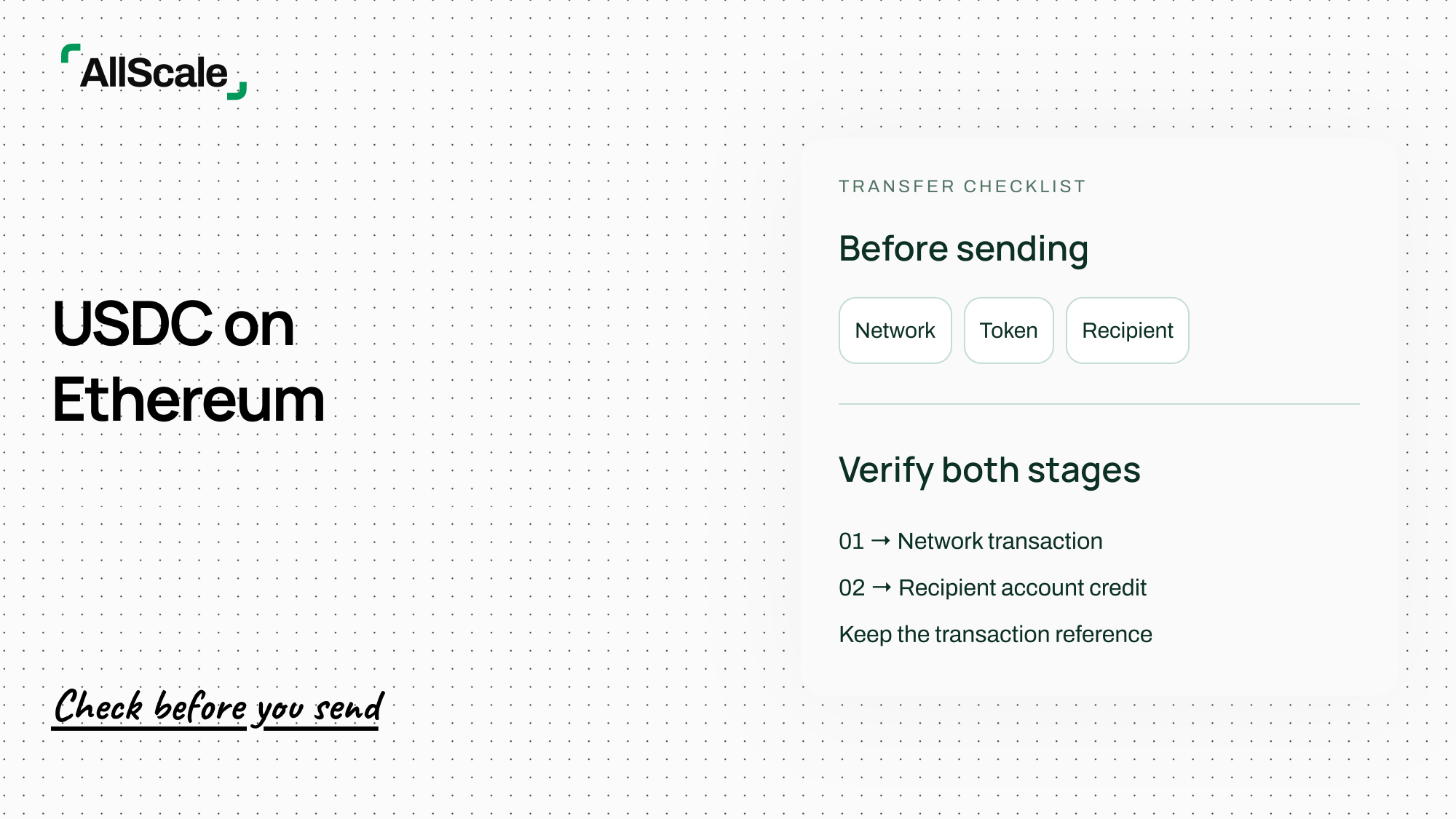
Use this migration checklist after the new account is approved, before replacing payment instructions:
Keep the previous route available while outstanding transactions are being resolved, where your provider and circumstances allow. A successful small test does not establish that a larger payment will pass every limit or review.
1. Wise Business: the baseline
Overview
Wise Business combines international payments, receiving details and currency management. Its US business page also describes batch payments and accounting connections. Use the features you currently rely on as the benchmark. Wise Business.
Best For
Businesses whose main requirement is an eligible fiat transfer or receiving account, without a separate reason to change the workflow.
Key Features
Supported currency balances, local receiving details where available, supplier payments and team tools. Support for your business country and activity must be confirmed during onboarding. Eligibility.
Pros
Keeping Wise in the comparison exposes whether an alternative actually improves cost, access or operations.
Cons
A supported destination does not mean all account features are available where your business is registered. Some payment types have distinct receiving charges.
Pricing
The US page lists USD 31 for receiving account details, sending/conversion fees from 0.23%, and USD 6.11 for receiving USD wire and SWIFT payments. The “from” rate is not a quote for your currency pair. Wise US pricing.
Why We Picked It
A baseline prevents a comparison of alternatives from assuming that switching is automatically worthwhile.
2. Airwallex: accounts, collections and spending
Overview
Airwallex offers business accounts alongside payment acceptance, billing and spend products. Its account page describes funds held with financial institutions and safeguards governed by local regulation. Airwallex Business Account.
Best For
Teams evaluating several finance workflows together, rather than replacing only an occasional transfer.
Key Features
Currency accounts, FX and transfers, cards and payment acceptance. The relevant collection methods and account currencies need route-level confirmation. US verification requirements include business and ownership documentation. US verification requirements.
Pros
Its range gives a team a reason to evaluate collections and spending in the same operational review.
Cons
Payment acceptance has its own pricing and setup. Do not assume an approved account gives you every merchant method or feature.
Pricing
The US Explore plan lists USD 0 per user/month. The FX schedule lists 0.5% above interbank for major currencies and 1% for others; SWIFT and processing charges are separate. Airwallex US pricing.
Why We Picked It
It represents a broader account-and-operations alternative, with scope that should be tested against your actual needs.
3. Revolut Business: plan-based currency and spend management
Overview
Revolut Business packages account and spending capabilities into subscription tiers. Its regional legal structure varies: its US page describes a technology-services model working with partner banks. Revolut Business.
Best For
Eligible companies that can estimate monthly transfers and FX activity and want to compare those needs with plan allowances.
Key Features
Currency accounts, local and international transfers, team access and plan-dependent controls. Company registration, applicant residence, legal form and industry affect eligibility. Eligibility guidance.
Pros
Published allowances make it possible to compare a plan with a known monthly transaction pattern.
Cons
Usage beyond the allowance and exchanges outside market hours can add costs. A low subscription price alone does not identify the right tier.
Pricing
The US page lists Basic from USD 10/month, Grow from USD 40 and Scale from USD 140. It lists a 0.6% FX charge beyond the plan allowance and 1% outside market hours. Check all applicable conditions. Revolut US plans.
Why We Picked It
It is a useful comparison when predictable team activity makes subscription allowances meaningful.
4. Payoneer: marketplace earnings and client payments
Overview
Payoneer receiving accounts let eligible clients and platforms pay into a Payoneer balance. Receiving-account approval and the payer guidelines must be checked before you share details. Payoneer receiving accounts.
Best For
Businesses whose collection needs include supported marketplaces or direct international clients.
Key Features
Receiving accounts, payment requests and bank withdrawals. Payoneer also documents Bridge-provided USDC/USDT services with a phased, eligibility-dependent rollout; it should not be described as universally fiat-only. Payoneer stablecoin service.
Pros
A suitable receiving route may fit an existing marketplace or client-payment process without asking the payer to adopt an unrelated workflow.
Cons
Marketplace support, payer restrictions and withdrawal costs need separate checks. Access to one service does not establish access to the embedded stablecoin offering.
Pricing
The public schedule lists client card payments at up to 3.99% plus USD 0.49 and US ACH bank debit at 1%. Receiving and withdrawal fees vary with location, method and currency. Payoneer pricing.
Why We Picked It
It deserves a separate review when the source of revenue, particularly a marketplace, constrains the replacement options.
5. OFX: business transfers and FX management
Overview
OFX's US business platform includes currency accounts, payments and FX tools. Its support material lists bank-funding routes including ACH, Fedwire, direct debit and SWIFT. OFX US business help.
Best For
Businesses comparing bank payouts and currency management, including teams that want to discuss their FX requirements with a provider.
Key Features
International payments, local receiving details for supported currencies, and business-account controls. Verification depends on business type and registration location. OFX registration guidance.
Pros
The business-account offering allows a broader comparison than the cost of one transfer alone.
Cons
The quoted exchange rate matters. A free subscription or waived transfer charge does not remove the FX margin or every route cost.
Pricing
The US page lists Standard at USD 0 per user/month and Full Suite at USD 75/month including five users, with USD 10 for each additional user. OFX US pricing. Its fee schedule states that the FX margin is included in the quoted exchange rate. OFX fee schedule.
Why We Picked It
It is relevant when the replacement task centers on fiat payouts and ongoing FX needs.
6. AllScale: self-custody stablecoin workflows
Overview
AllScale offers separate products for collecting and distributing funds. Its Checkout page describes self-custody settlement and USDT/USDC acceptance. That is a specific payment model, not a claim to reproduce every Wise feature. AllScale Checkout.
Best For
Businesses whose payer and recipient can use the supported stablecoin route and whose treasury process can manage wallet-based funds.
Key Features
Invoice requests client payments; Payroll organizes team payouts; Claim Link sends a payout that the recipient claims. Claim Link is not an invoice collection link. Confirm asset, network and recipient requirements for the selected product.
Pros
Distinct collection and payout workflows give a stablecoin-using business a relevant place to start, while self-custody changes who controls wallet funds.
Cons
Bank settlement requires a separately supported route. Self-custody adds access and authorization responsibilities. Jurisdiction and channel restrictions still apply; an exhaustive country-by-product eligibility matrix was not verified for this review. AllScale agreement.
Pricing
An all-in, globally applicable tariff was not established from the reviewed pages. Obtain the applicable processing, conversion, network and withdrawal charges for your exact flow. Do not turn “gas abstraction” into a claim that the entire payment is free.
Why We Picked It
It addresses a different settlement requirement: usable stablecoins rather than an assumed fiat bank balance.
Feature comparison matrix
This matrix summarizes the documented scope above. It does not claim that a feature is enabled for every account. “Confirm” means the reviewed material does not establish that requirement for your route.
Provider
Fiat currency balances and receiving details
Client collection
Team or batch payment workflow
Stablecoin workflow in this review
Wise Business
Supported currencies and eligible accounts
Account details and available collection features
Batch payments documented
Not assessed; do not infer support
Airwallex
Global Accounts and wallet
Separate payment acceptance products
Batch transfers documented
Not assessed; do not infer support
Revolut Business
Regional account and currency availability
Confirm the relevant receiving/merchant service
Plan-dependent team and transfer controls
Not assessed; do not infer support
Payoneer
Approved receiving accounts and balances
Marketplace and eligible direct-client methods
Batch-payment product listed
Bridge-provided service; rollout and eligibility apply
OFX
Supported business-account currencies
Bank receipts through supported details
Bulk payments documented
Not assessed; do not infer support
AllScale
Confirm bank channel separately; not a general equivalence claim
Invoice and Checkout
Payroll and Claim Link serve different payout tasks
Self-custody flows; exact token/network must match
Pricing comparison: calculate the complete route
The published figures above describe different things. Wise's minimum percentage, Airwallex's FX markup, Revolut's subscription, Payoneer's collection charge and OFX's quoted exchange rate cannot be ranked in one “transfer fee” column. AllScale also needs a route-specific cost breakdown before a meaningful comparison is possible.
For each quote, capture these fields at the same time:
Quote field
What to hold constant or record
Business and destination
Same sender country, recipient country and account type
Funding
Same source currency and funding method
Delivery
Same recipient currency, required amount and arrival requirement
Total debit
Every amount charged to the sender, including separately charged fees
Net received
What reaches the required bank account or wallet after known deductions
Expected timing
Funding, conversion, transfer and recipient-credit stages
Other costs
Setup, subscription allocation, receiving, withdrawal and refund charges where applicable
Worked example: a lower transfer fee can deliver less
Illustrative arithmetic only, not provider quotes or a live exchange rate. A US business has a total budget of USD 5,000, funded from its US bank account, to pay a supplier's French EUR bank account within two business days. Both hypothetical routes are assumed eligible and to meet that deadline. No receiving deductions or additional charges are assumed beyond those shown.
Route
Total debit
Fee deducted before conversion
Quoted EUR per USD
Net received
Assumed timing
A
USD 5,000
USD 25
0.9200
EUR 4,577.00
Within two business days
B
USD 5,000
USD 0
0.9100
EUR 4,550.00
Within two business days
Route A delivers (5,000 − 25) × 0.9200 = EUR 4,577. Route B delivers 5,000 × 0.9100 = EUR 4,550. Despite showing no separate transfer fee, B delivers EUR 27 less. These rates are hypothetical; the example demonstrates the calculation, not a recommendation for a named provider.
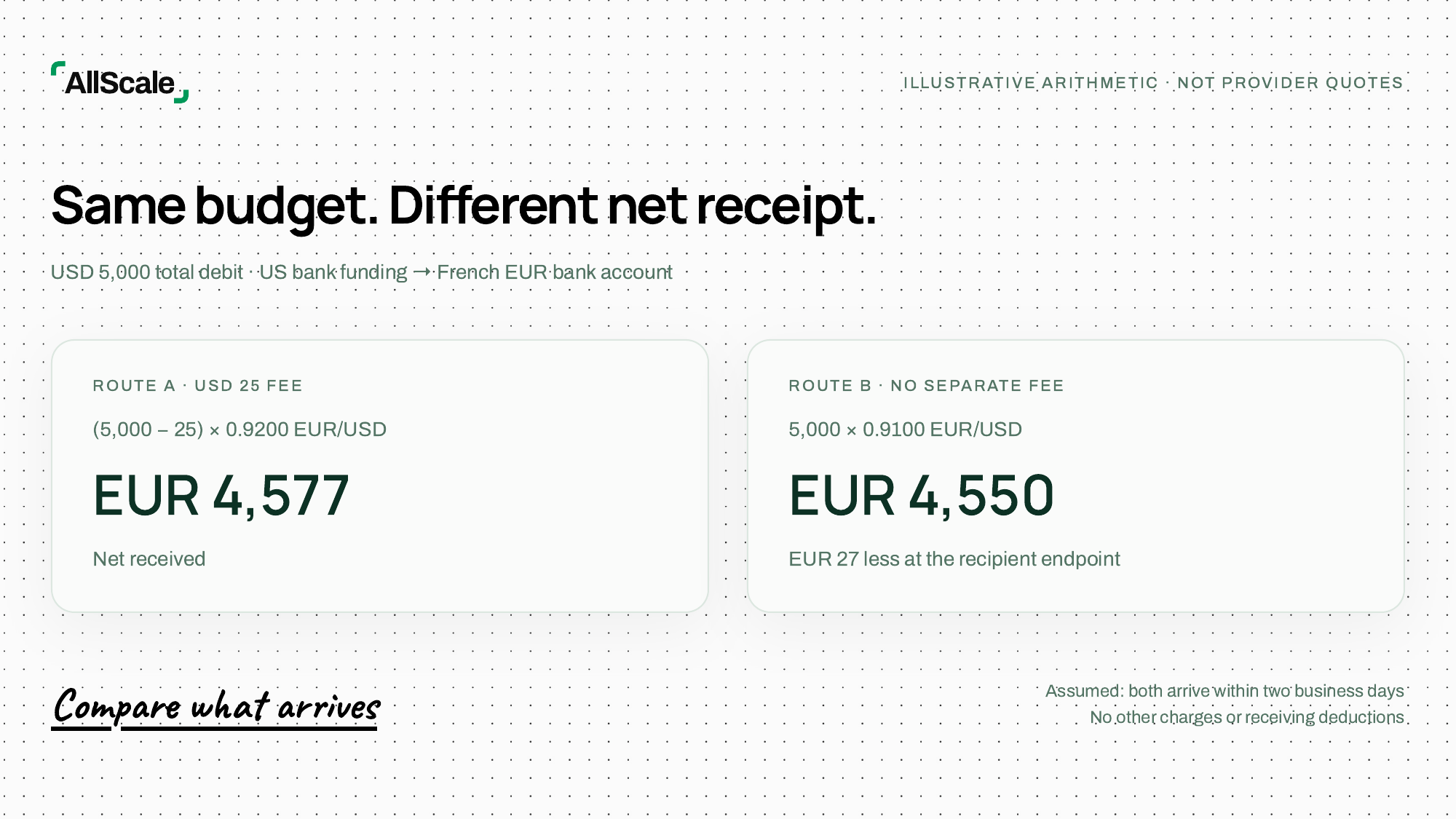
Hold the sender budget and recipient endpoint constant. This illustration is not a current quote from any provider.
If the supplier must receive exactly EUR 4,500, run a second comparison with that fixed net amount and compare the required total USD debit. Do not mix fixed-budget and fixed-recipient-amount quotes in one ranking.
For monthly plans, also compare the full month's activity. A subscription may cover several services; record it separately before allocating a share to one payment. Do not add an FX spread twice when it is already reflected in the quoted rate.
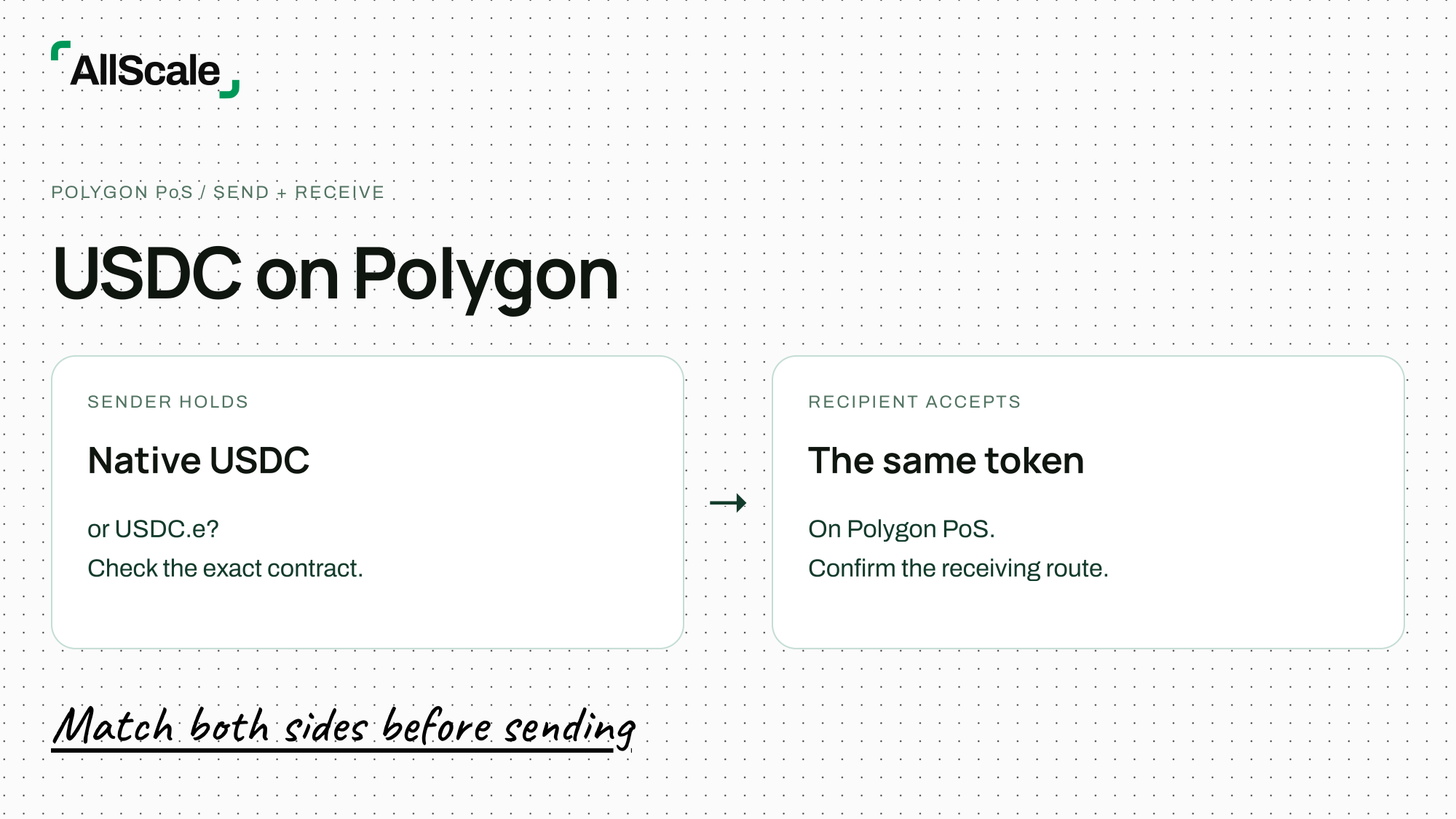
A stablecoin route ending in USDC is not an equivalent result to euros in the supplier's bank. To include it in this example, verify and price every required funding, token transfer, conversion and EUR withdrawal stage, including timing. If the supplier wants USDC instead, define that as a separate scenario.
Which option should you choose?
When AllScale fits—and when another option fits better
AllScale is worth testing when receiving USDT or USDC is the desired business outcome. It may also be relevant for approved contractor payouts where recipients can use the supported asset. Invoice, Payroll and Claim Link should be evaluated as separate tasks rather than treated as one universal transfer interface.
If your essential requirement is specific local bank details, a fiat currency balance or a supplier's guaranteed bank endpoint, start with providers that document that exact route for your business. Do not make the recipient learn a new asset or withdrawal process merely to preserve a preferred vendor choice. A business can retain one provider for fiat needs and use another for a distinct stablecoin workflow.
Frequently asked questions
Is the lowest advertised transfer fee the cheapest option?
Not necessarily. Compare total debit and net receipt at the same time, including applicable conversion, receiving and withdrawal costs. Include subscription or setup costs where they affect your actual usage.
Can a stablecoin wallet replace every Wise feature?
No. A supported USDT or USDC payment is different from a local receiving account, currency balance, bank payout or spending product. Map each existing requirement to an explicitly supported replacement.
Which Wise business alternatives work for freelancers?
Check legal form and registration country first. A sole trader and an incorporated company can face different eligibility rules. Wise explicitly lists freelancers among supported business types; each alternative's current application and product rules must be checked independently.
Does a provider's country coverage mean I can open an account there?
No. Coverage may refer to where payments can be sent rather than where businesses can be onboarded. Verify your entity, applicant residence, business activity and the particular product before switching.
What should I check before changing payment instructions?
Confirm eligibility, payer acceptance, the recipient's required asset and a completed test of the new route. Export records and track outstanding payments on the old route. Communicate changes through a trusted channel.
Is AllScale the only option here with stablecoin functionality?
No. Payoneer also describes an embedded Bridge-provided stablecoin service with eligibility and phased availability. Compare the specific service, custody arrangement, supported networks and fees rather than assuming the same token name means the same operating model. Payoneer stablecoin details.
Replace a workflow with evidence
Choose the service that completes your required payment and leaves usable records. Keep a working fiat route when that is what clients or suppliers need; add stablecoin workflows where they solve a specific collection or payout problem.
If that requirement includes self-custody stablecoin payments, explore AllScale Payment Products and confirm the product, eligibility, asset and endpoint before changing instructions.