Before paying a supplier invoice, put it beside the purchase order and the delivery or accepted-work record. Check the references, quantities, prices and currency, then identify anything that needs the supplier’s clarification. A matching total is useful, but it does not tell you whether the right goods arrived or the extra work was approved.
The basic distinction in purchase order vs invoice is who creates the document and what it does: the buyer creates a purchase order to record an order; the supplier issues an invoice to request payment. Keep both records, because each answers a different question in the payment review. FreshBooks explains this document distinction.
Use the five steps below to decide what is ready for approval and what remains unresolved. The goods and service examples are illustrative; the payable amount depends on the actual agreement and approval records, not just the arithmetic shown here.
Compare the records side by side
Start with the buyer and supplier names, then locate the PO number and invoice number. They identify different documents. Record them in separate fields, even when the invoice includes the buyer’s PO reference.
| Field | Purchase order | Invoice |
|---|---|---|
| Issued by | Buyer | Supplier |
| Purpose | Record the items or work being ordered | Request payment for the billed items or work |
| Number | Buyer’s PO number | Supplier’s invoice number, with the PO reference where requested |
| Timing | Usually raised during the ordering process | Issued at the agreed billing point, which may include an advance or milestone |
| Next action | Check the approved order and any changes | Compare billed details with the agreement and relevant delivery or approval evidence |
Do not treat the presence of a PO number on an invoice as proof that every charge was authorized. Find the underlying order and read its lines. Check whether the invoice cites the current order or an earlier version that was later amended.
For a repeat supplier, use the specific invoice number as well as the PO reference. One order may lead to several invoices, and an invoice may cover more than one approved line or delivery. Reusing the PO number as the invoice identifier can make those records difficult to distinguish.
If your business does not issue purchase orders, use the contract, written order or other agreed purchasing record. Follow the buyer’s actual billing requirements. The practical question is whether you can trace the requested payment to agreed work and price, rather than whether every purchase has the same paperwork.
Match the order, invoice and delivery
Check individual lines before approving the total. Compare the item or service description, quantity, unit price, currency and any separately agreed charges. Where your process requires receipt or acceptance, include that record too.
Goods: ten ordered, eight received
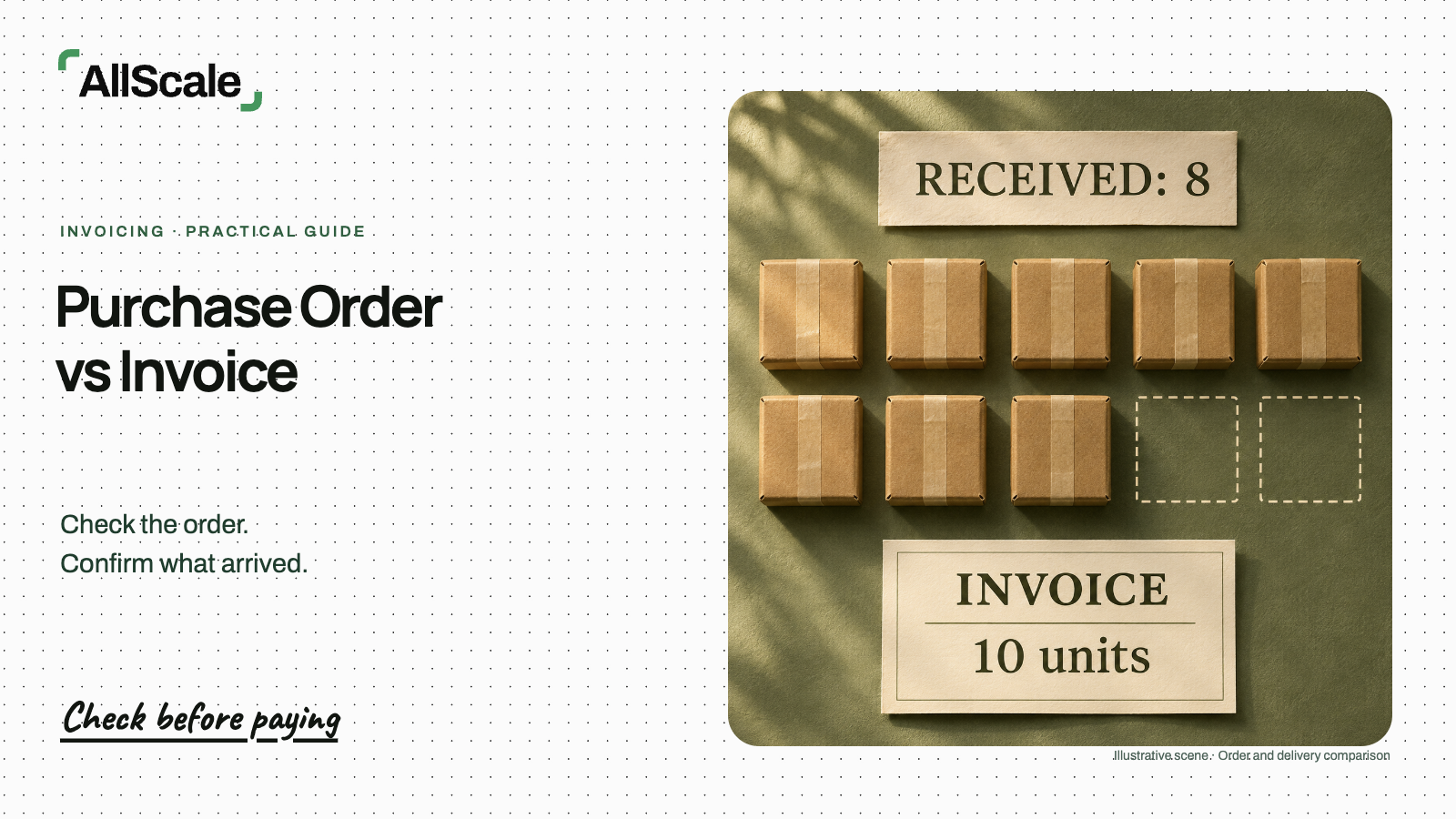
An illustrative PO orders 10 units at USD 100 each, for a total of USD 1,000. The receiving record shows eight units delivered, while the supplier invoices all ten.
| Record | Quantity | Amount or implication |
|---|---|---|
| Purchase order | 10 units | USD 1,000 at the agreed unit price |
| Delivery record | 8 units received | Two ordered units are not recorded as received |
| Supplier invoice | 10 units billed | USD 1,000 requested |
| Review finding | 2-unit difference | Confirm delivery status and the agreed billing arrangement |
The two-unit difference is a reason to investigate. It does not automatically establish that USD 800 is the amount you should pay. The agreement may provide for advance payment, split deliveries or another billing arrangement. Check it, confirm whether another shipment is expected, and document the agreed treatment before changing the payment.
10 × USD 100 = USD 1,000
Two units need clarification.
Confirm the billing agreement before payment.
Illustrative goods example: compare the order, delivery and invoice, then clarify the two-unit difference before approving payment.
Services: an approved milestone plus extra work
For services, the relevant evidence might be an accepted milestone, an approved timesheet or confirmation of the service period. Match what was billed to what the agreement requires, including any acceptance conditions.
Suppose a project owner approved a USD 1,200 milestone, but the invoice requests USD 1,400, including USD 200 of additional work. Ask for the written approval covering that extra work. If it exists, attach it to the review. If it does not, ask the supplier and project owner to resolve the charge or arrange a corrected invoice.
Record the USD 1,200 approved milestone and USD 200 under review separately. That distinction helps the reviewer make a decision; it is not permission to short-pay the invoice without checking the agreed terms and approval process.
Resolve a mismatch before changing the payment
Describe the exact line that differs. “The invoice is wrong” gives the supplier little to work with. A useful query identifies the invoice, PO, line item and evidence needed to complete the review.
| Difference | Next action | Evidence to retain |
|---|---|---|
| Quantity | Compare billed units with the order and receiving record; confirm whether a receipt is missing | Delivery confirmation and supplier explanation |
| Price | Check the agreed unit price, discount and any approved change | Quote, order amendment or written approval |
| Currency | Confirm the agreed billing currency before preparing payment | Agreement and supplier confirmation or corrected invoice |
| Missing PO reference | Identify the correct order with the buyer’s purchasing contact | Confirmed PO reference or approved alternative record |
| Partial delivery | Confirm outstanding delivery and whether the invoice follows the billing agreement | Receiving record, delivery plan and agreed billing treatment |
Ask the supplier to explain the discrepancy or issue the appropriate corrected document. Keep the original invoice and the correction connected in your records so a later reviewer understands what changed. Do not silently edit the supplier’s invoice to make it match your internal system.
A missing reference can be an administrative issue rather than a disagreement over the work. Route it to the person who placed the order and ask them to identify the relevant approval. If the customer requires the PO reference on the invoice, have the supplier include it in the corrected version.
For the service example above, a ready-to-adapt clarification email could read:
Hi Maya,
Invoice INV-204 requests USD 1,400 against PO-078. Our approved milestone is USD 1,200; the invoice includes USD 200 for additional work. Could you send the written approval for that change, or a corrected invoice? We need this to complete the payment review.
Thank you.
These names and references are illustrative. In an actual email, identify the specific difference and request the evidence needed to resolve it. Keep the response with the invoice rather than relying on a verbal explanation that the next reviewer cannot see.
Keep invoice and payment references connected
Once the review is complete, hand over the approved amount, currency, invoice number and relevant PO reference to the person preparing payment. Use the payment reference agreed with the supplier and retain both document numbers internally.
For a combined payment, record the allocation. For example, a USD 900 transfer covering a USD 500 invoice and a USD 400 invoice needs two allocation entries linked to the same transfer. Do not record USD 900 against each invoice. If the transfer’s reference field cannot hold the full breakdown, send the supplier a separate explanation through the agreed channel.
Check that a replacement invoice has not left the original queued for payment. A correction can create a duplicate-payment risk if both versions remain active in separate systems or email threads. Record which version is current and why the earlier one should not be paid.
For the actual transfer, follow the invoice payment steps. This review establishes which payment is approved; the payment workflow still needs to verify the recipient, instructions and execution status.
If paying in stablecoins, also confirm the accepted asset, network and receiving information. A matching PO and invoice do not establish that a wallet address or network is correct. For a Base payment, the USDC on Base transfer checklist covers the network-specific checks.
After sending, connect the completed payment record to the invoice allocation. Keep a pending transfer distinguishable from a settled payment, and record any remaining invoice balance separately.
Confirm the decision and keep an audit trail
Before handing the invoice over for payment, complete these five checks:
- Document identity: the buyer, supplier, PO reference and invoice number have been checked.
- Order details: scope, quantities, prices and currency agree with the purchasing records, including approved changes.
- Receipt or acceptance: the required delivery or accepted-work evidence is attached.
- Differences: each discrepancy has a resolution or a named owner and next action.
- Payment decision: the approved amount, currency, reviewer and decision date are recorded.
Keep unresolved differences in a small log rather than burying them in email. In the examples above, the log could look like this:
| Item | Open question | Owner | Next action |
|---|---|---|---|
| Goods invoice: 10 billed, 8 received | Were the remaining two units delivered, or is billing before delivery agreed? | Purchasing contact | Confirm receipt and billing terms with supplier |
| Service invoice: USD 200 extra work | Was the additional scope approved? | Project owner | Attach written approval or request correction |
Set a follow-up date for each item and update the decision when the evidence arrives. Where only part of an invoice is approved, record that explicitly and confirm how the payment will be handled under the agreement. Keep the order, invoice, delivery evidence, approved changes and payment record together for later reconciliation.
For suppliers preparing the payment request, AllScale Invoicing provides a shareable invoice link. Continue managing purchase orders and procurement approvals through the buyer’s existing process; this guide does not assume an AllScale purchase-order matching feature.
Frequently asked questions
Should the PO number and invoice number be the same?
They identify different documents and should be kept in separate fields. Include the buyer’s PO reference on the invoice when requested, alongside the supplier’s invoice number. This makes the relationship traceable without confusing the two identifiers.
Can an invoice be issued without a purchase order?
Some purchases use a contract, written order or another agreed record instead. Follow the buyer’s billing requirements and keep evidence of the agreed scope and price. If a PO is required but missing, ask the buyer’s purchasing contact to resolve it.
Should I change an invoice when it differs from the PO?
Ask the supplier to explain the difference or issue a corrected document. Keep any approved change with the order records. Do not silently change their invoice or assume that changing an internal amount settles the disagreement.
Does a purchase order confirm that payment was made?
No. A PO records the order. An invoice requests payment. Use the completed payment record and, where available, the recipient’s receipt to document that payment was made.