
By AllScale Editorial · Updated October 27, 2026 · 9 min
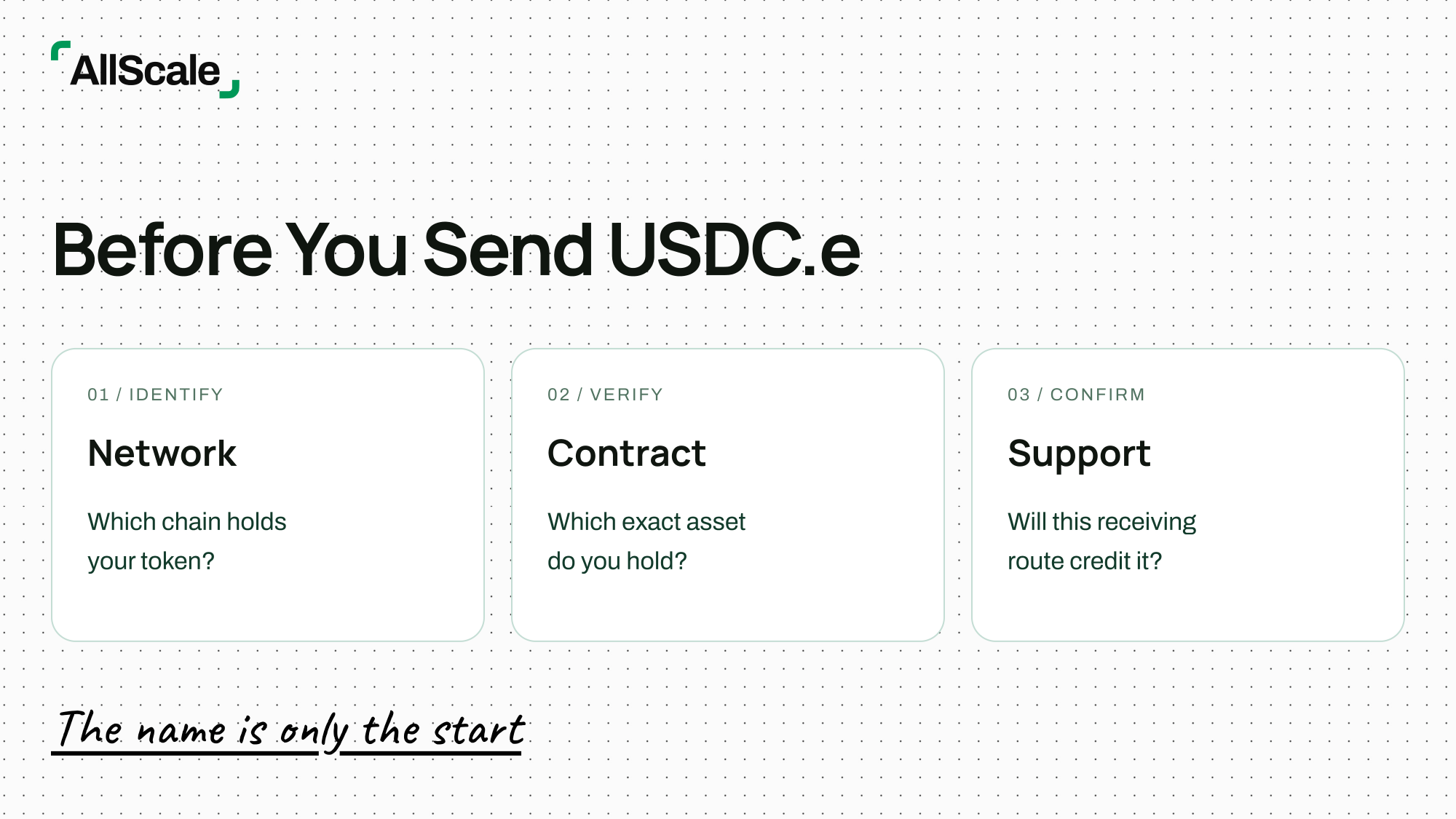
If you hold USDC.e, check its network, token contract and the recipient’s supported assets before sending. A service that accepts native USDC may not accept your bridged token. Identify the asset first, confirm the receiving route, and only then decide whether to send it or arrange a supported conversion.
The decision starts with the balance you already hold. A familiar USDC logo, a dollar-denominated balance or an address beginning with 0x does not answer the receiving-support question.
Identify the USDC.e you hold
Open the token details in the wallet or platform that holds the balance. Record the displayed name, the network and the full contract address. Keep these together: a token symbol without its network is an incomplete description of the asset.
USDC.e commonly denotes a bridged form of USDC. Native USDC is issued by Circle on a supported blockchain; a bridged representation involves a third-party bridge or platform. Naming is not standardized across every wallet or bridged asset. Circle’s native-versus-bridged USDC explanation.
For native USDC, compare the network-specific contract against Circle’s current mainnet directory. For a bridged token, find the contract in the relevant network or bridge provider’s official documentation. A mismatch with Circle’s native contract does not, by itself, prove that an unfamiliar token is legitimate USDC.e.
Illustrative holding record — Polygon PoS:
This example uses a real contract identified in Circle’s Polygon guidance, but it is not a screenshot of a customer account. It does not identify USDC.e on every network. The contract is an asset identifier, not a payment destination.
If a hosted platform does not expose a contract, check its deposit and withdrawal documentation. Ask which token it will actually withdraw on the selected network; the balance label inside the platform may not supply that detail.
Compare native USDC and USDC.e for a payment
The practical distinction is whether your asset can be credited through the recipient’s chosen route. Understanding the token’s origin helps establish what needs checking, but it cannot replace the receiving service’s policy.
Bridged assets add dependencies on the bridge and its handling of the underlying asset. A provider accepting native USDC has not necessarily accepted those dependencies or integrated that bridged token. Circle’s explanation of bridged USDC.
A separate point matters when considering cross-chain tools: Circle’s CCTP USDC transfer flow moves native USDC between supported networks. Do not assume it accepts USDC.e just because the destination asset is USDC. A service may offer an additional conversion step, but that step and its costs need their own verification. Circle’s CCTP overview.
Check the receiving service before transfer
Use the current receiving page for the intended account. Find answers to these questions before authorizing the payment:
- Does the route explicitly accept the bridged token you hold, or does it only mention native USDC?
- Which network does the route support?
- Which full token contract is accepted on that network?
- Which deposit address and any additional receiving instructions apply to this account?
- Are there deposit minimums, account restrictions or crediting conditions?
A help article for another network or another product is not sufficient. Check the actual deposit or payment flow the recipient intends to use.
When the receiving page only lists “USDC,” ask the service to identify the accepted contract. For example, Circle Mint’s current FAQ says its Polygon PoS route supports native USDC rather than USDC.e. That is a policy for Circle Mint, not a universal rule for every wallet or payment platform. Circle Mint’s supported-blockchain FAQ.
A precise question to send support
Example support question for the Polygon token above:
Please confirm whether this receiving route accepts USDC.e on Polygon PoS with token contract 0x2791Bca1f2de4661ED88A30C99A7a9449Aa84174. If it does, which deposit instructions and minimum amount apply to my account?
This is a complete example, not a request for an editor to fill in missing copy. For another asset, use the verified network and contract from your own holding record. A reply saying only “we support USDC” leaves the original question unanswered.
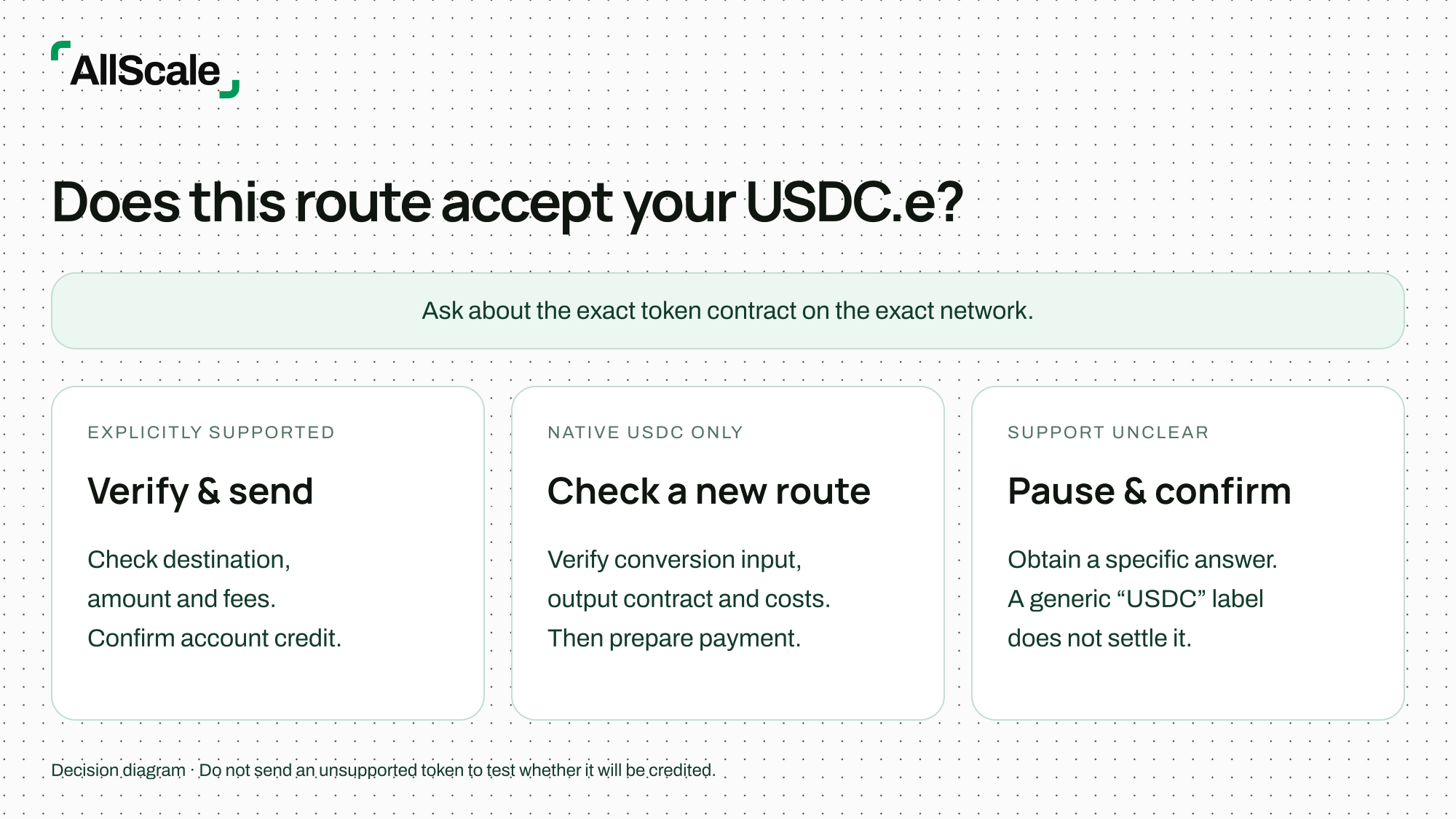
Choose the next step from explicit support for the token contract and network. This is a decision diagram, not an AllScale interface.
When the receiving route does not support USDC.e
Do not send USDC.e directly to a route that accepts only native USDC. First determine whether the platform holding your funds offers a supported way to obtain the required asset, or whether the recipient can provide a different supported receiving route.
Check what a conversion will deliver
A swap on one network exchanges one token for another. A bridge moves value between networks and may produce a different token representation. A hosted platform may offer its own conversion and withdrawal process. Each route must accept your precise input asset and deliver the token and network the recipient requires.
Before choosing a route, establish:
- Input: the network and full contract of the USDC.e you hold.
- Output: the destination network and full contract you will receive.
- Cost: quoted output amount, service fee, network fees and any separate approval transaction.
- Execution conditions: minimum received, quote expiry, slippage settings where relevant, and any additional claim or withdrawal step.
- Destination: whether the result goes to your own wallet or directly to the recipient, and whether that destination is supported.
For a same-network swap, follow the selected service’s own instructions. Uniswap’s official swapping guidance explains its web-app process. It is an operational reference, not confirmation that a particular USDC.e pair has suitable liquidity or is available in your location. Verify the token contracts and current quote in the actual service before approving anything.
Do not infer a guaranteed one-for-one output from the similar names. The amount delivered after a conversion and subsequent payment may differ from the starting balance. Compare the final recipient amount with the invoice obligation before proceeding.
Keep the conversion separate from the client payment
Illustrative example: a business owes a supplier 500 native USDC on Polygon PoS but holds USDC.e on that network. The supplier confirms it accepts only the native token. The business first checks a supported conversion that delivers Circle-listed native USDC to its own wallet. It reviews the quoted output and costs, completes the conversion, then verifies the resulting contract and balance.
Only after that does it prepare the supplier payment using the verified deposit instructions. The conversion transaction and the supplier payment have separate records. If the conversion delivers less than the amount needed, the business must resolve the shortfall before treating the invoice as paid.
This is a workflow example, not a live quote or a recommendation to use a particular conversion service. If no suitable route can be verified, agree another payment method with the recipient.
If you already sent an unsupported token
Trace the original transaction before attempting another payment. Collect its network, hash, token contract, destination and amount, plus the deposit instructions used. Ask the receiving service whether that exact deposit can be recovered or credited.
Recovery depends on who controls the destination and what the service can support. A successful on-chain transaction does not guarantee recovery, and another transfer will not repair the first one. Use the service’s official support channel and never disclose a private key or recovery phrase.
Keep records and confirm receipt
After any conversion, verify the new asset before sending it onward. After payment, check the network transaction and the recipient’s credited balance separately.
A hash identifies a blockchain transaction. It does not explain which invoice was being paid, whether the amount satisfies the invoice or whether a hosted service has credited the recipient’s account. Preserve those business details with the transaction evidence.
If the token transfer succeeded but the account has not credited, compare the actual contract and network with the receiving policy. Also check minimums, required confirmations and any review notice. Contact the receiving service with that evidence instead of resending immediately.
For client collections, AllScale Invoice provides an invoicing and payment-link workflow to explore. Review the payment options shown for the specific invoice. This article does not establish that an AllScale product accepts USDC.e or provides a bridge.
Frequently asked questions
Is the token symbol enough to identify USDC.e?
No. Use the network and full token contract together with the symbol. Similar names can refer to different bridged assets and receiving requirements.
Should I send USDC.e when the recipient only lists USDC?
Confirm the exact contract and network first. A generic USDC label is not proof that the bridged token is accepted.
Can I turn USDC.e into native USDC by renaming or importing the token?
No. Changing a wallet label or importing a contract changes what the wallet displays. It does not convert the asset. A conversion requires a supported transaction or service that delivers the intended output token.
Does CCTP convert USDC.e automatically?
The CCTP USDC transfer flow is for native USDC transfers between supported chains. Do not assume a CCTP-enabled service accepts USDC.e as input; verify any additional conversion process separately.
Does AllScale provide a bridge for USDC.e?
This guide does not verify an AllScale bridge for USDC.e. Check the receiving options available in your account and use the relevant conversion service’s official instructions for any separate conversion. An invoice or receiving link should not be treated as a bridge.
Published by AllScale. Official references were checked on October 22, 2026. Examples illustrate verification steps; no live conversion, fee quote or recovery test is claimed.