
By AllScale Editorial · Updated October 27, 2026 · 11 min
For a routine U.S. business payment with enough lead time, ACH is often the first route to price. For an urgent payment, compare the same-day ACH and domestic wire options your bank actually offers. For a recipient outside the U.S., first establish which cross-border route can reach their account in the required currency.
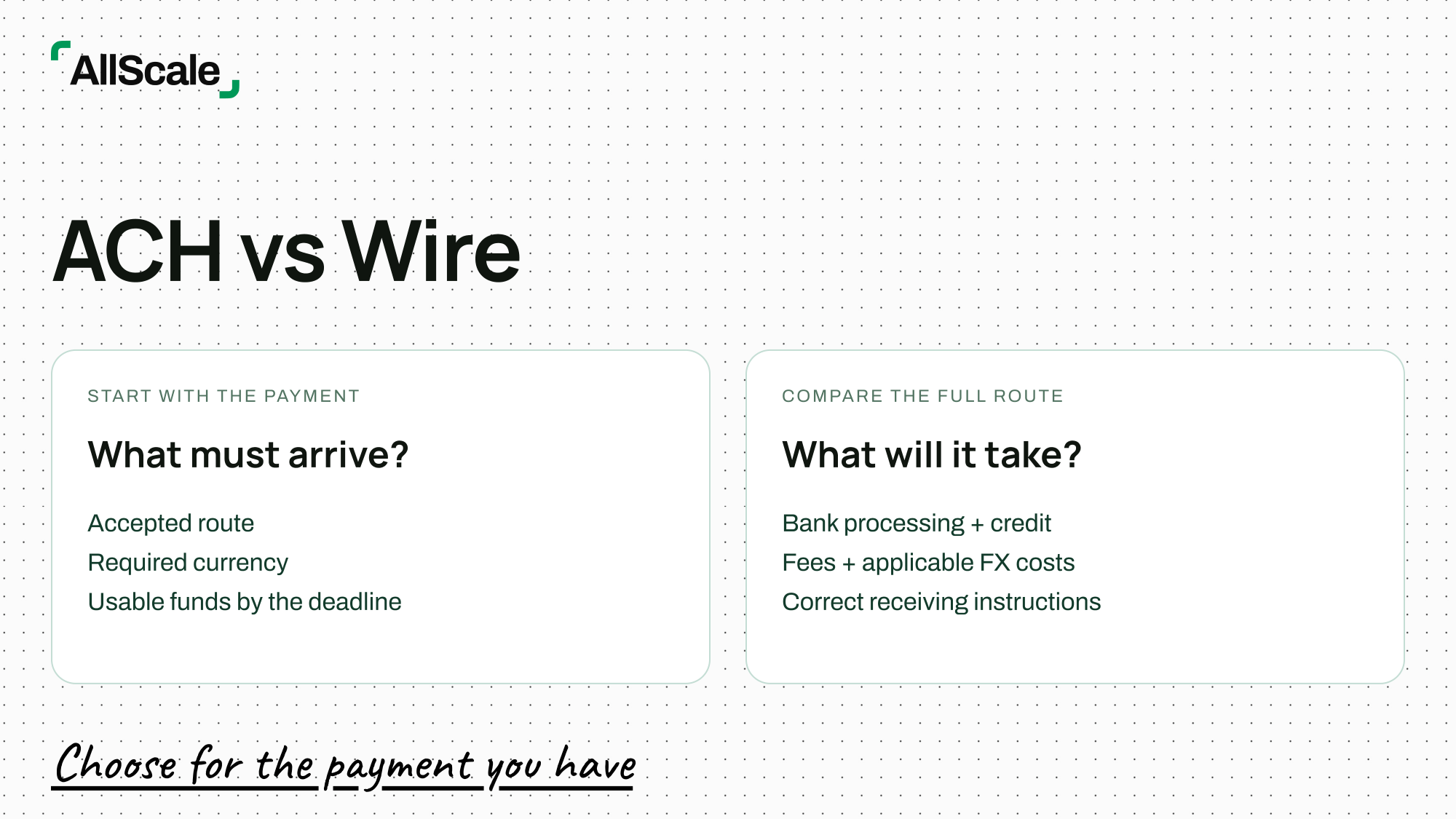
The useful ACH vs wire comparison starts with four questions: will the recipient accept it, when must the money be usable, what will the complete payment cost, and which receiving details apply? A familiar label such as “wire” does not answer all four.
ACH vs wire: a practical decision table
ACH is the U.S. Automated Clearing House network, used for electronic credits and debits. This guide focuses on business payments you initiate, such as paying an invoice, rather than authorizing a merchant to debit your account. A U.S. domestic wire and an international wire also need separate treatment: the destination, currency and participating banks change the process.
Payment size can rule out a route before fees matter. Check your bank’s per-payment and daily limits, any approval requirements and the limit for the selected service. Network capabilities are not the same as your account’s permitted payment amount.
Do not treat an overseas contractor’s location as proof that ACH is unavailable, or that it is available. They may have an eligible U.S. receiving account through a provider, but the account must accept your type of business payment. If they need local currency in another country, include that provider’s conversion and withdrawal steps in the comparison.
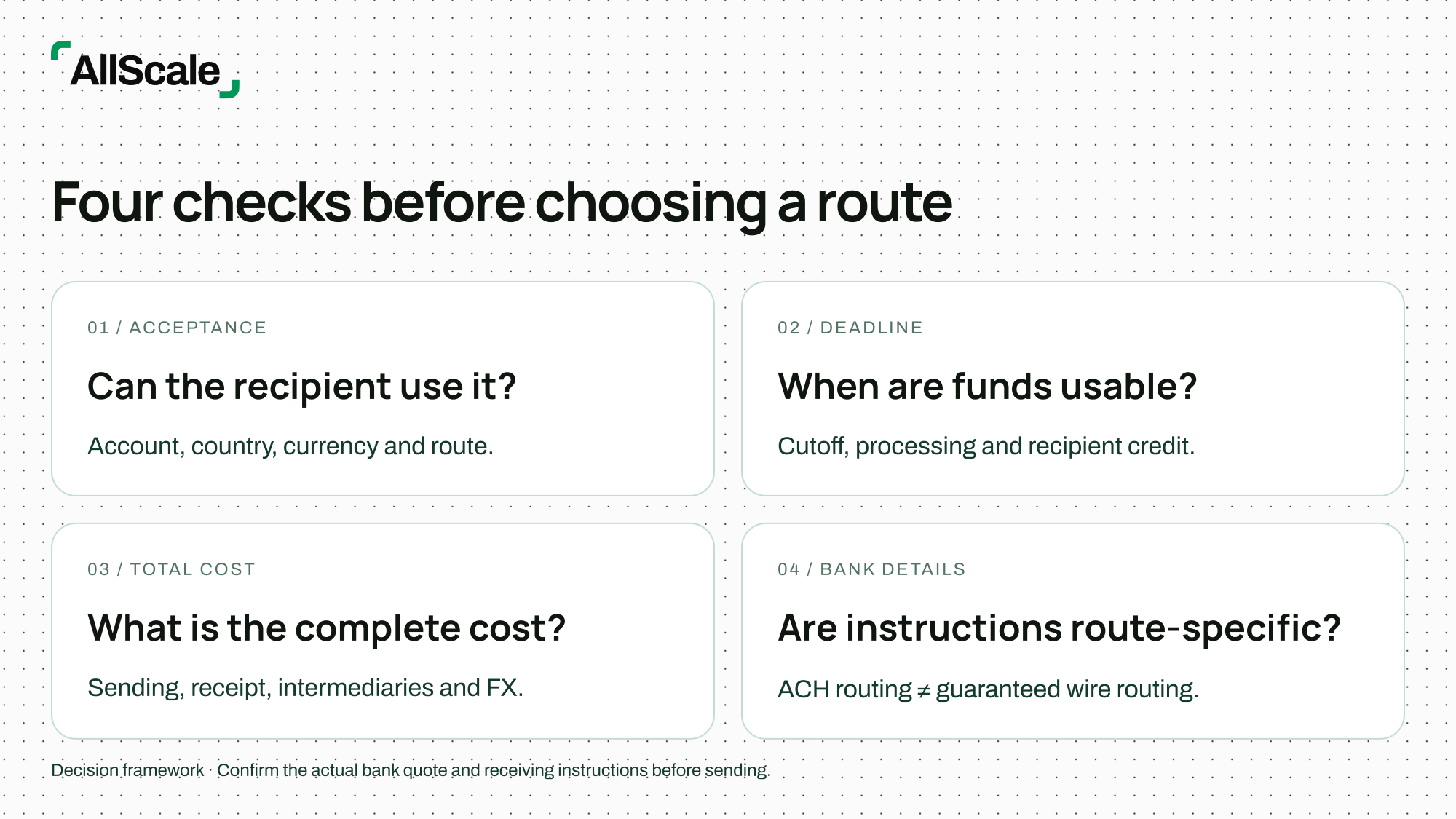
Check acceptance, timing, total cost and route-specific bank details before choosing.
Compare total cost and timing
Separate submission from usable funds
A payment moves through several stages: you submit it, your bank accepts and processes it, the payment system handles it, and the receiving institution makes it available to the beneficiary. The deadline on an invoice usually concerns the last stage.
Nacha says ACH payments can process the same business day or be scheduled for the next day or two business days ahead. Same Day ACH is a service to verify with your bank; it is not an automatic feature of every ACH submission. Nacha’s ACH overview.
For a domestic wire sent through Fedwire, the Federal Reserve describes settlement between participating institutions as immediate and final once processed. That does not mean the interval from clicking “send” to the beneficiary’s usable balance is always immediate. Bank review, submission deadlines and recipient processing remain relevant. Federal Reserve explanation of Fedwire.
Ask the sending bank for the applicable cutoff, its time zone and the expected delivery date for the exact payment. Check weekends and holidays in the relevant banking calendars. A bank’s customer cutoff can be earlier than the payment system’s operating deadline.
Use one payment amount and one destination currency
Compare fees on the same basis:
Payment cost = sending charge + applicable intermediary and receiving charges + currency-conversion cost.
Use one currency to compare those costs. When an exchange-rate markup is already included in a quoted rate, do not add the same markup again as a separate charge. Also distinguish a fee paid on top from a deduction that reduces the amount received.
For example, a supplier owed USD 5,000 needs to know whether it will receive USD 5,000. “No transfer fee” is incomplete if the route converts currency at a marked-up rate or the receiving bank deducts a charge. Bank of America explicitly notes that its foreign-currency international wires can have no outbound transfer fee while still including an exchange-rate markup. Bank of America’s wire-transfer disclosure.
A published bank example, with its limits
As checked on October 22, 2026, Chase’s business payment page lists standard ACH delivery as one business day, with the first ten monthly payments priced at USD 2.50 each. It lists same-day ACH at 1% of the payment amount, capped at USD 25, with delivery by the end of the day. Its combined domestic/international wire overview gives a USD 0–40 fee range and a 1–5 business-day delivery range. These are that service’s published descriptions, not universal ACH or wire prices. Chase business payment services.
For an illustrative USD 5,000 payment, applying those published ACH fees gives USD 2.50 for a payment among the first ten standard ACH payments, or USD 25 for same-day ACH because the percentage fee reaches the cap. This calculation covers the sending service charge only. Account eligibility, applicable terms, recipient fees and the actual delivery commitment still need checking.
The broad wire range does not establish the price or timing of your particular USD 5,000 domestic wire. Obtain the route-specific quote before comparing it. A range covering several services is not a substitute for a like-for-like estimate.
Understand what can be corrected
ACH is not a general “undo” button. Nacha allows reversals for specified errors under defined conditions and deadlines; changing your mind about a valid payment is different from correcting an erroneous entry. Ask your bank which cancellation, return or reversal process applies to the payment’s actual status. Nacha’s reversal rules.
For a released wire, contact the sending bank immediately if something is wrong. A recall request is not a guarantee that the funds can be returned. Do not choose a route on the assumption that a mistaken destination can be fixed afterward.
Use the correct receiving details
Ask for instructions labeled for the payment route you intend to use. An ACH routing number copied from an old invoice may not be the right number for a wire. Bank of America, for example, distinguishes routing numbers by transaction type in its guidance. Bank of America routing-number information.
A SWIFT/BIC identifies an institution; it does not replace the beneficiary’s account identifier. Nor should you invent an IBAN for a country or account that does not use one. Follow the receiving bank’s instructions for that destination. Bank of America’s domestic and international wire guidance.
Keep the original receiving instructions with the approved invoice. If a supplier changes its bank details, confirm the change through an established contact method before updating the payee record. Verify the full account information, amount and beneficiary again on the final approval screen.
For recurring payments, a saved payee reduces data entry but does not prove that the account or receiving policy is still current. Retain the payment confirmation and match it with the supplier’s acknowledgement or your reconciliation record.
Match the route to the payment task
The following scenarios are illustrative examples, not bank quotes. Each starts with the recipient’s required outcome.
Supplier invoice with time to plan
A U.S. business owes a supplier USD 5,000 in five business days. The supplier accepts both ACH and domestic wire into its U.S. account.
Compare standard ACH first. If the bank’s expected delivery meets the due date and the fee is lower, there is little reason to pay extra solely for a faster route. Confirm the account’s ACH limit, cutoff, payment approval lead time and the supplier’s instructions. Schedule enough time to resolve a rejected payment rather than submitting at the last possible moment.
Service fee needed urgently
A vendor needs USD 5,000 available today before releasing an agreed service. Both parties are in the U.S., and the request arrives during the banking day.
Compare available Same Day ACH and domestic wire options. Ask whether the relevant cutoff is still open, whether the amount is within your account limits and when the vendor can use the funds. If the vendor only accepts wire for this obligation, ACH is not an alternative just because its advertised fee is lower. If the cutoff has passed, establish a revised deadline with the vendor instead of assuming a wire will arrive immediately.
Cross-border contractor requiring local currency
A U.S. company owes an overseas contractor the agreed local-currency equivalent of a USD 5,000 service fee. The contractor needs funds in their local bank account.
Compare an international wire with any eligible provider route that accepts ACH funding and completes the local payout. An ACH-funded international service is more than an ACH transfer: include its funding, currency conversion and payout stages. Verify the recipient’s net local-currency amount, who bears deductions and the expected bank-credit date.
If both parties can use stablecoins, that can be an additional comparison. The contractor’s required local bank balance remains the endpoint, so the analysis must include conversion and withdrawal rather than stop at a wallet transfer.
Once you know which payment route fits, compare cross-border payment platforms by country eligibility, receiving method and the complete cost for your specific payment.
When a stablecoin route is worth comparing
A stablecoin route is relevant when the sender can fund it and the recipient can receive the supported asset on the supported network. It is not a substitute for every bank payment. The recipient may need a bank deposit, may not accept digital assets, or may face limitations on conversion and withdrawal.
Use the same endpoint as the bank comparison:
A network confirmation and a local bank deposit are different events. If the recipient needs local currency, compare the time and cost through to that bank deposit. If they will retain and use the stablecoin, do not add an imaginary withdrawal step. Stablecoin value and conversion availability should not be assumed risk-free.
AllScale’s product range offers relevant workflows to investigate: Invoice for client payment requests and shareable links, and Payroll for scheduled team payments. Claim Link offers a link-based stablecoin payout flow, including uses such as refunds. Review the supported payment options, account eligibility and receiving arrangements in the specific flow. These product pages do not establish that AllScale provides every ACH or wire route discussed here.
Explore AllScale Payment Products when a supported stablecoin workflow fits the payment task. Keep the required receiving asset or bank currency explicit when evaluating it.
Frequently asked questions
What is the main difference between ACH and wire transfers?
ACH is a U.S. electronic payment network with standard and same-day services. Wires use bank-transfer routes that can be domestic or international. Compare the actual service’s acceptance, timing, charges and receiving instructions rather than treating either label as a complete specification.
Are ACH and wire bank details always the same?
No. Use instructions for the selected route. A bank can provide different ACH and wire routing numbers, while an international wire may require SWIFT/BIC, an IBAN or additional local details.
Does a wire always arrive immediately?
No. The bank’s acceptance and processing, cutoff time, checks and receiving institution can affect when the beneficiary can use the funds. Immediate settlement within a payment system does not remove those stages.
Can I reverse an ACH payment if I change my mind?
Do not assume so. Cancellation depends on whether it has been released, and ACH reversal rules cover specified errors. Contact your bank promptly to establish what is possible for the payment in question.
Is ACH always cheaper than a wire?
Standard ACH may be cheaper for a routine domestic payment, but compare the actual account prices and delivery service. Same-day charges, fee waivers, recipient costs and currency conversion can change the result.
Can a stablecoin transfer replace any bank payment?
Only if both parties can use the supported asset and receiving route. Include funding, conversion and any required bank withdrawal before comparing the complete payment.
Published by AllScale. Official network guidance and the cited bank examples were checked on October 22, 2026. AllScale offers payment products referenced in this article. No hands-on bank transfer test is claimed; the scenarios are illustrative, and actual terms depend on the selected account and route.