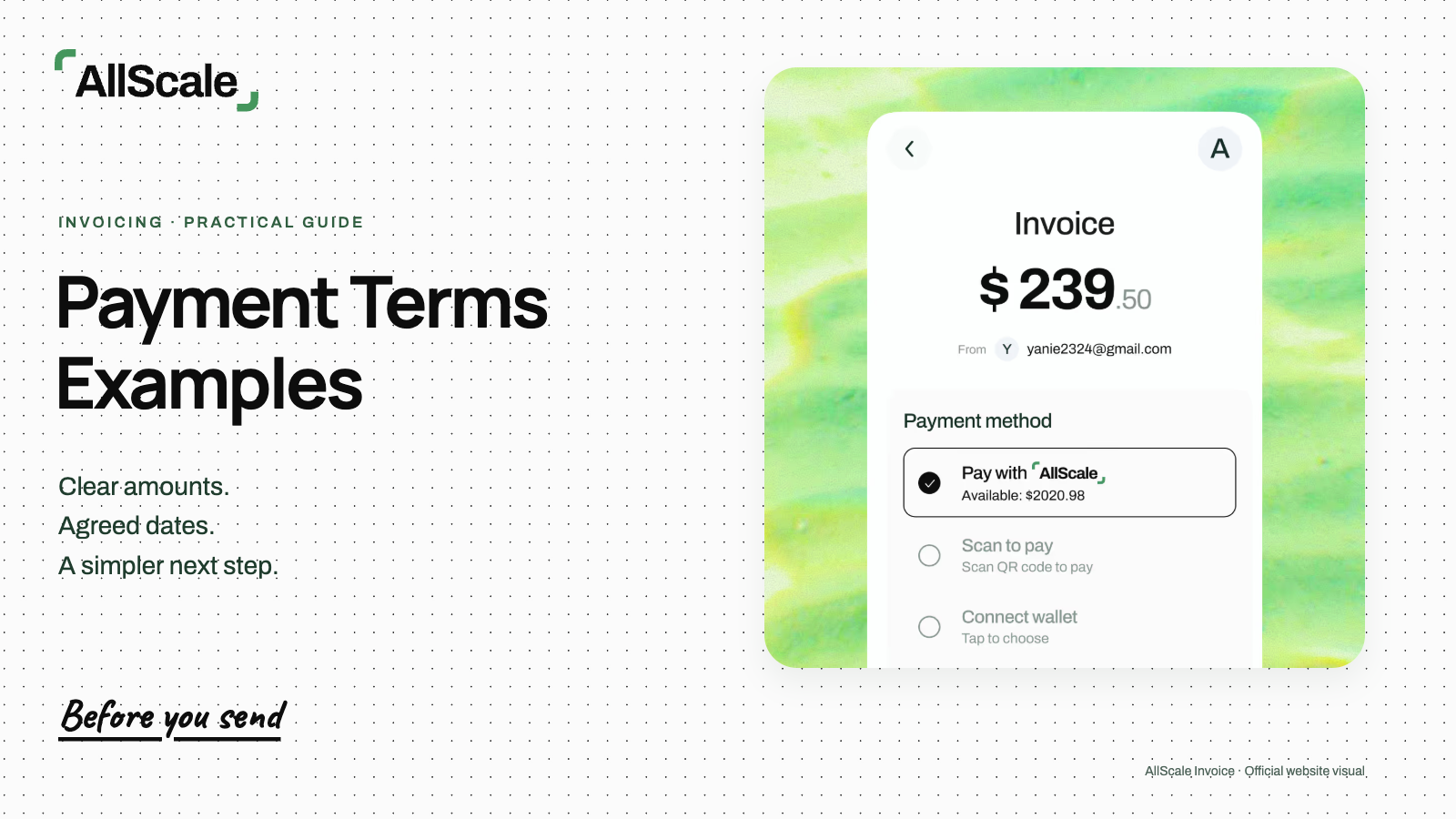
Payment terms examples are useful when they answer the questions a client needs to act on: how much is due, what triggers the payment, when it must arrive and which method to use. Choose payment terms that tell the client when payment is due, how much to pay and which method to use. Start with the examples below, then match the wording to the agreement for the work.
“Net 14” is a start. “USD 1,500 due on 16 November 2026, by the agreed bank transfer route, reference INV-1042” gives the person paying the invoice much more to work with.
This guide includes five copyable templates and completed examples. The bracketed fields in the templates are intentionally there for readers to customize; the worked examples show how the finished terms should read. All amounts, businesses and dates in those examples are illustrative.
Choose the payment trigger before writing the terms
Decide whether payment follows an invoice date, a completed milestone or an agreed advance payment. Choose this with the client before issuing the invoice, particularly if someone other than your project contact will approve or send the payment.
| Client work | Payment trigger | Fields to include | Check before agreeing |
|---|---|---|---|
| New project with upfront work | An agreed advance before work starts | Advance amount, start condition and balance schedule | What happens if the project is cancelled or the scope changes |
| Delivered services | Invoice date or receipt, as agreed | Issue date, due date, amount and reference | Whether the client's approval process can meet the deadline |
| Ongoing consulting | A defined service period | Period covered, retainer amount and due date | Which services are included and how additional work is approved |
| Project with several stages | Acceptance of a defined deliverable | Stage, acceptance owner, amount and deadline | How acceptance is recorded and what happens if review is delayed |
A milestone needs a recognizable finish. “After the design phase” leaves room for disagreement. “After the named client approver accepts the homepage design in writing” gives both sides something they can record.
Payment terms examples for common client work
Use a complete sentence that identifies the amount or schedule, due date and agreed payment route. Each template below is wording to adapt to an existing agreement, rather than a substitute for agreeing the commercial terms.
1. Due on receipt
Copyable template
Payment is due when you receive this invoice. Please use [agreed method] and include invoice [number] as the payment reference.
Replace: payment method and invoice number. Confirm that the client has agreed to pay on receipt and knows where to find verified payment instructions.
Completed example: Payment of USD 650 is due when you receive invoice INV-1041. Please use the bank transfer instructions on the invoice and include INV-1041 as the payment reference.
Use this when prompt payment on delivery of the invoice is part of the agreement. It may be a poor fit for a client that requires a purchase order and several approval steps. If a specific calendar deadline matters, agree and state that date too.
2. Net 14
Copyable template
Payment of [amount] [currency] is due on [due date], 14 days after the invoice date of [issue date]. Please pay using [agreed method].
Replace: amount, currency, issue date, due date and method. This example counts calendar days from the invoice date; use a different starting point only if your agreement specifies it.
Completed example: Payment of USD 1,500 is due on 16 November 2026, 14 days after the invoice date of 2 November 2026. Please pay by bank transfer and use INV-1042 as the reference.
Check the actual date rather than entering “Net 14” and leaving the client to calculate it. If the agreement instead starts the clock on receipt or acceptance, say so and calculate the deadline from that event.
3. A 40% advance and the balance later
Copyable template
A 40% advance of [amount] [currency] is due before work starts. The remaining 60% is due on [date] after [agreed deliverable] is accepted.
Replace: advance amount, currency, balance date and deliverable. Add the full project price and payment method to the invoice or agreement so the percentages have a clear basis.
Completed example: The agreed project price is USD 5,000. A 40% advance of USD 2,000 is due by 2 November 2026, before work starts. The remaining USD 3,000 is due on 30 November 2026 after the final design files are accepted. Please use the bank transfer instructions on each invoice.
The advance and balance add up to USD 5,000. Record the advance against the project, then show it as already paid when calculating the balance. Agree what happens if acceptance moves beyond the planned date. Avoid describing an advance as non-refundable unless the agreed terms and applicable rules support that treatment.
4. Milestone payments
Copyable template
Payment for [stage] is due on [date] after [acceptance owner] confirms [deliverable]. Invoice [number] covers this stage only.
Replace: stage, deadline, acceptance owner, deliverable and invoice number. Include the stage amount and agreed method in the finished wording.
Completed example: USD 1,800 for Stage 2 is due on 20 November 2026 after the client's project lead confirms acceptance of the working checkout prototype. Invoice INV-1043 covers Stage 2 only. Please pay by the agreed bank transfer route.
Keep the approval message with the invoice. If review is delayed, resolve the revised deadline with the client instead of leaving an acceptance condition and a fixed date in conflict.
5. Monthly retainer
Copyable template
[Amount] [currency] covers the agreed services from [start date] to [end date]. Payment is due on [date] using [method]. Additional work follows the separately agreed scope and price.
Replace: fee, currency, service period, deadline and method. State whether the retainer is billed in advance or after the service period.
Completed example: USD 2,400 covers the agreed consulting services from 1 to 30 November 2026. This retainer is billed in advance and is due on 1 November 2026 by bank transfer. Additional work follows the separately agreed scope and price.
Keep the monthly dates current. Copying last month's invoice without updating the service period can create an avoidable approval question even when the fee has not changed.
State the currency, method and fees clearly
An invoice currency and a settlement asset are separate choices. Agree on them before sending the invoice. For an international client, “pay in dollars” may still leave the asset, transfer route and fee allocation unresolved.
| Field | What the terms should establish |
|---|---|
| Invoice currency | The currency used to price the work, such as USD |
| Payment asset | What the client may send, such as USD through a bank route or USDC under a separate agreement |
| Accepted route | The verified bank instructions, payment link or supported asset-and-network combination |
| Fees | Who bears each applicable charge and whether the invoice must be received in full |
| Reference | The invoice number or other identifier needed to match the payment |
Illustrative stablecoin wording: Invoice INV-1044 is priced at USD 1,500. The parties have agreed to payment of 1,500 USDC using an agreed conversion basis of 1 USD per USDC. Payment is due on 16 November 2026 through the verified receiving instructions, on a network supported by both parties. The sender pays any separate transfer charge so that 1,500 USDC is received against this invoice.
That conversion basis is a term of this example, not a statement that USDC always trades at exactly USD 1. For a different arrangement, record the agreed rate source, timestamp and resulting asset quantity. Confirm the actual network and receiving instructions before sending funds; a token name alone is not a complete route.
If using a payment link, review the options and charges displayed in that flow. Do not promise a payment method or network that the particular invoice does not offer.
Put the terms where the client can use them
Keep the due date visible on the invoice and repeat the key action in the delivery message. The reader should not have to find a deadline buried in a paragraph of notes.
For the Net 14 example above, the date area should show Issued: 2 November 2026 and Due: 16 November 2026. Put the fuller terms in the notes area and the verified payment method and reference in the payment section.
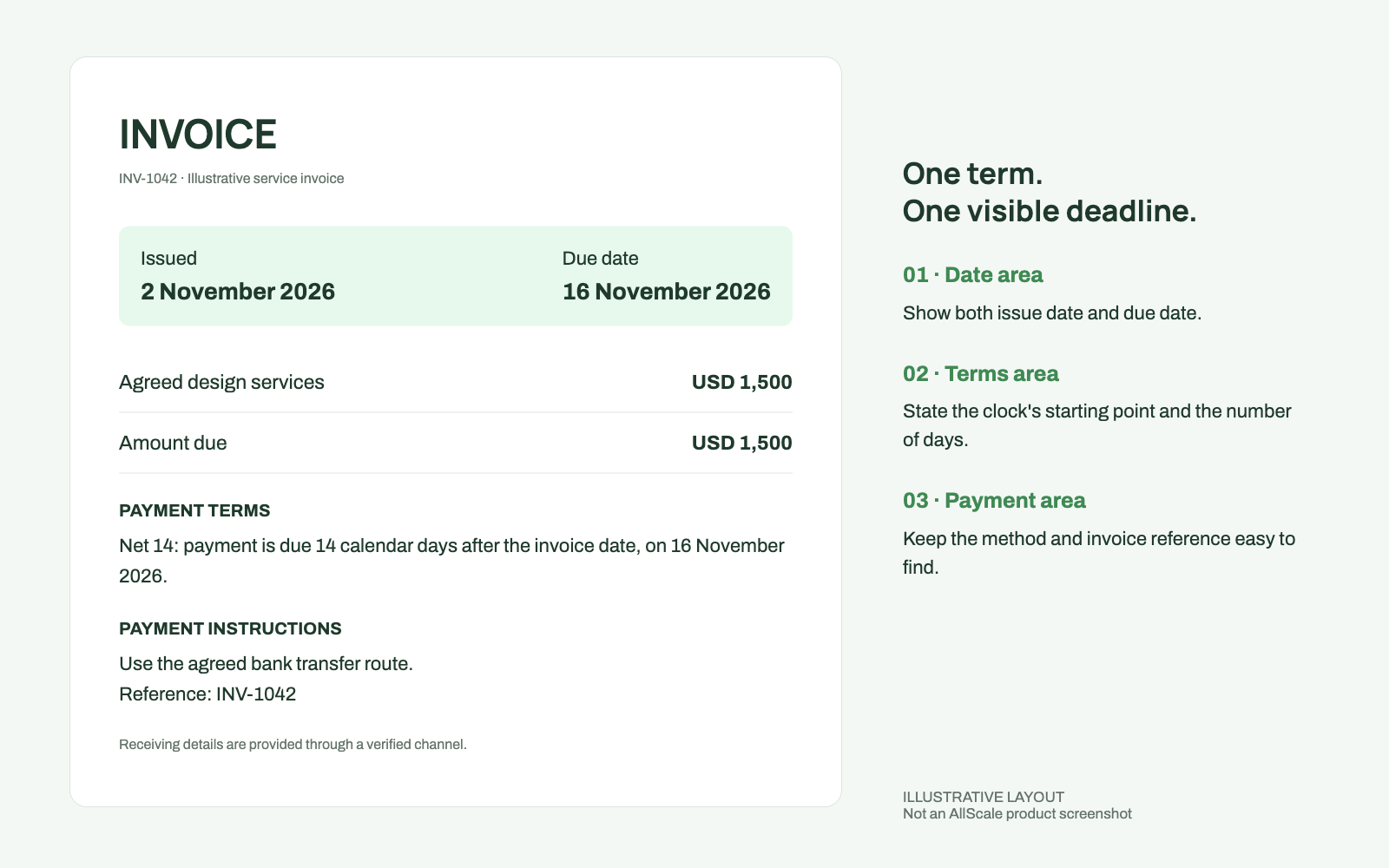
Illustrative invoice layout, not an AllScale product screenshot.
The accompanying message can be short: “Please find invoice INV-1042 for USD 1,500, due on 16 November 2026. Use the bank transfer instructions on the invoice and include INV-1042 as the reference.” Send it to the person or address that actually handles invoices, along with any purchase order reference already agreed with the client.
Use the same amount, deadline and method in the invoice, delivery message and project record. Before sending, check that payment instructions are current and that any required attachment is present.
Resolve changes before the due date
If the scope or payment schedule changes, confirm the revised terms and keep the version linked to the invoice.
| Change | What to do |
|---|---|
| Additional work | Confirm the new scope, price and payment trigger before adding the charge. Reference the approved change in the invoice record. |
| Different payment method | Verify the revised receiving details through a trusted channel. Confirm the asset, route and any change in charges before the client pays. |
| Partial payment | Record the amount received and date, calculate the remaining balance, and confirm whether its deadline has changed. |
For a USD 1,500 invoice with USD 600 received, the remaining balance is USD 900 before any separately agreed credits or adjustments. An acknowledgment should say USD 600 received, not mark the full invoice paid.
Late-payment rules depend on the transaction and jurisdiction. For example, UK guidance on commercial late payments distinguishes agreed deadlines from statutory rules when no date is agreed. Check the rules that apply to your transaction before adding interest or collection charges.
Once an agreed deadline has passed, use the past due invoice guide for follow-up messages and payment-record checks.
Frequently asked questions
Should I write a date or only Net 14?
Use an explicit due date together with the agreed term so the client can act without calculating it. Make sure both refer to the same deadline. State the starting event if it is something other than the invoice date.
Can I ask for a deposit and the balance later?
Yes, when that schedule is agreed with the client. State the deposit amount or percentage, when it is due and the event that triggers the remaining balance. Also agree how cancellations, scope changes and delayed acceptance affect the schedule.
How do I state a stablecoin payment option?
State the invoice currency, accepted asset and agreed receiving route separately. Confirm the asset and network before sharing payment details. Record the conversion basis and asset quantity where the payment asset differs from the invoice currency.
Can I add a late fee after sending the invoice?
Check the existing terms and applicable requirements, agree on any additional charge, and record the change before updating the amount due. Do not assume that inserting a new fee into a reminder makes it payable; statutory rights and contractual terms need to be considered for the particular transaction.
Turn the agreed terms into an invoice
Use the free invoice generator to create an invoice PDF when you need a document to share. Creating or downloading a PDF does not itself send a payment or prove the client has received the invoice.
For a payment request, AllScale Invoice provides a separate invoicing workflow. Its official guide describes entering the recipient, amount, currency, due date and service description, sending the request, and reviewing invoice history. Check the available payment options for the invoice you create.
Start with the terms you and the client have agreed. Then make the amount, due date and next payment action easy to find.