After submitting a business payment, send the supplier your payment reference, amount, currency and invoice allocation. State the status you can verify, and ask the supplier to confirm receipt and allocation when the funds arrive. Remittance advice is the message that explains which invoices you intend a payment to cover.
Start with these details:
- Your business name and the supplier’s name or customer-account reference.
- Payment date, amount, currency and transaction reference.
- Each invoice number and the amount allocated to it.
- Any remaining invoice balance.
- The payment’s current status and whether receipt has been confirmed.
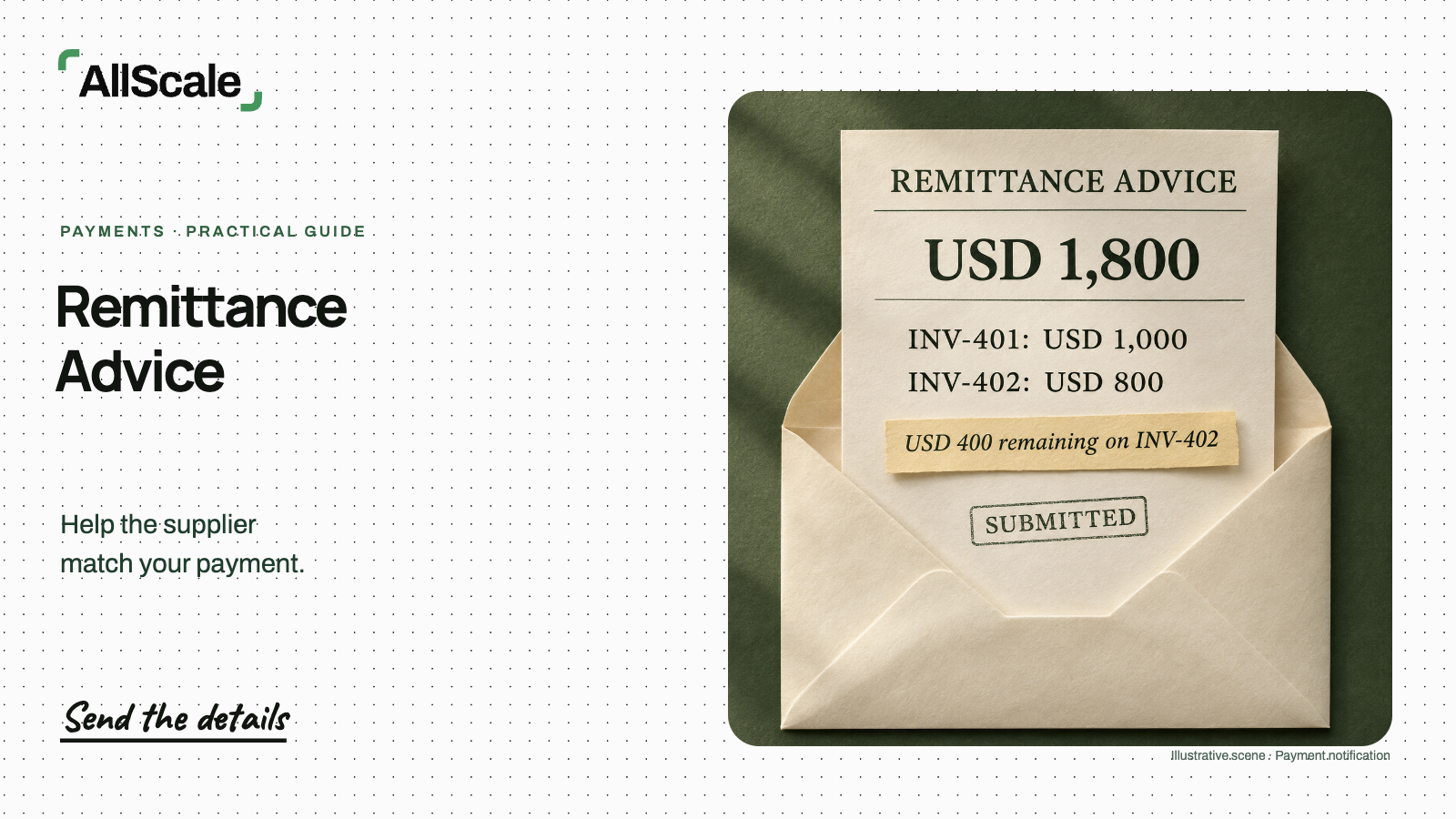
A short email and a small allocation table are usually enough for a manual workflow. The example below shows a USD 1,800 payment covering one invoice in full and another in part. It is an illustrative record, not an AllScale screen or an automatically generated payment notice.
Start with the payment and invoice references
Copy the transaction details from the payment record rather than reconstructing them from memory. Use the invoice numbers exactly as the supplier issued them. If your business trades under a different name from the bank sender, include the customer-account reference the supplier uses to identify you.
| Field | Illustrative entry | What to check |
|---|---|---|
| Payer | Cedar Studio | Business name associated with the payment |
| Supplier | Harbor Design | Intended recipient and supplier account |
| Customer account | CEDAR-01 | Reference used in the supplier’s records |
| Submitted date | 11 November 2026 | Date shown in the payment record |
| Amount and currency | USD 1,800 | Amount covered by this advice |
| Payment reference | DEMO-PAY-401 | Reference available to trace the transfer |
| Payment status | Submitted | Supported by the payer’s record |
| Supplier receipt | Not yet confirmed | Update only after receiving evidence |
Keep the payment reference separate from the invoice numbers. One identifies the transfer; the others identify the obligations it is intended to cover. A reference such as “November payment” gives the supplier less to work with than a transaction identifier plus a clear invoice list.
For a stablecoin payment, include the asset, network and transaction hash where available. Identify the agreed receiving destination sufficiently to distinguish it, using masked details where appropriate. There is no reason to attach unrelated account balances or a full transaction history to a routine remittance email.
Use the provider’s actual status in your records. “Submitted” and “received” describe different stages. For example, Airwallex’s transfer-status documentation distinguishes a transfer sent to a banking partner from a later credited state where supported. Check what your provider’s status means before writing that the supplier has received the money.
Allocate one payment across the correct invoices
The allocation total should equal the payment amount described in the advice. Keep the original invoice amount, this payment’s allocation and the remaining balance in separate columns.
In this illustrative example, INV-401 is for USD 1,000 and INV-402 is for USD 1,200. Neither has an earlier payment or adjustment. Cedar Studio submits USD 1,800 and asks Harbor Design to apply USD 1,000 to INV-401 and USD 800 to INV-402.
| Invoice | Original USD | Allocated from this payment, USD | Remaining after allocation, USD |
|---|---|---|---|
| INV-401 | 1,000 | 1,000 | 0 |
| INV-402 | 1,200 | 800 | 400 |
| Total | 2,200 | 1,800 | 400 |
The arithmetic is straightforward: 1,000 + 800 = 1,800, and 1,200 − 800 = 400. The table expresses the intended allocation once the payment is received and applied. While receipt is unconfirmed, do not use it alone to mark the invoices settled.
Payment reference: DEMO-PAY-401
Fully covered by the intended allocation.
USD 400 remains after allocation.
Illustrative allocation: allocate the USD 1,800 payment once. Supplier receipt remains a separate check.
Count the payment once. The two invoice rows break down the same USD 1,800 transfer; they are not additional transfers. If there have been previous payments or credit adjustments, show those separately and calculate the remaining balance from the current open amount.
State a fee only when the records identify it. If the supplier receives a different amount, leave the difference under review until both sides can explain it. Do not change an allocation to make the numbers fit without agreement.
For payments and invoices in different currencies or assets, retain the agreed conversion basis and actual payment evidence. A USDC transfer and a USD invoice should remain labeled in their respective units. Explain the agreed invoice credit separately rather than silently treating both units as interchangeable.
Send a short, usable remittance email
Use a subject line the supplier can find again. Include the payment reference, amount and customer account where useful. In the message, give the allocation and request confirmation without claiming a later payment stage than you can verify.
Here is a completed remittance advice example using the illustrative figures above. Adapt the names, date, references, amounts and status to your checked records before sending.
Subject: Remittance advice — DEMO-PAY-401 — USD 1,800 — CEDAR-01
Hi Harbor Design team,
Cedar Studio submitted USD 1,800 on 11 November 2026, reference DEMO-PAY-401, for customer account CEDAR-01.
Please allocate USD 1,000 to INV-401 and USD 800 to INV-402. After this payment is received and applied, INV-402 will have USD 400 remaining.
The payment is submitted; receipt has not yet been confirmed. Please confirm receipt and the invoice allocation when the funds reach your account.
The allocation table is attached for reference.
Thank you,
Cedar Studio Finance
Attach the table only if you are actually including it; otherwise paste it into the message and adjust the sentence. Keep the attachment limited to the invoices covered by this payment. A supplier should not need to search an entire monthly statement to understand two allocations.
Send the advice to the supplier’s agreed finance contact or payment-notification channel. If you later correct a reference or allocation, send a clearly labeled correction that identifies the original payment. Keep both messages so the recipient can see which instructions are current.
If receipt is already confirmed, describe the supporting acknowledgment and date. If receipt is confirmed but the invoice allocation is still unresolved, say so. Those are two separate questions, and a single “paid” label may hide the outstanding work.
Resolve a missing or different allocation
If the supplier cannot find the payment, compare records before initiating another transfer. Ask whether the money is missing from the receiving account or simply has not been assigned to the invoices. Those problems require different follow-up.
| Issue | What to compare | Next action |
|---|---|---|
| Missing reference | Transaction reference, sender name and customer account | Supply the missing identifier and resend the allocation details |
| Amount mismatch | Sent amount, received amount, currency, documented fees and partial-payment allocation | Identify the difference and agree the treatment before updating balances |
| Payment pending | Current provider status, submission date and receiving details | Check the existing transfer and request support or tracing when appropriate |
For a missing reference, give the supplier the exact identifier from your payment record. Ask which invoices remain open in their system. If the payment was applied to the wrong invoice, confirm a corrected allocation rather than sending the money again.
For an amount mismatch, start with what each side can document. In the example, USD 800 against INV-402 is an intentional partial allocation, not an unexplained USD 400 transfer shortfall. A difference between USD 1,800 submitted and the total actually received would be a separate issue.
For a pending transfer, retain the existing transaction reference and check its status with the provider. A payment advice email cannot move the transfer forward or establish receipt. Avoid creating a duplicate payment while the original remains unresolved.
Once the references are aligned, use a broader reconciliation process to check receipts, fees and remaining balances. The payment reconciliation guide explains how to match those records and maintain an exception list.
Keep advice and receipt as separate records
Keep the remittance email and allocation table with the completed transaction record and the supplier’s acknowledgment. Each supports a different part of the history: what you instructed, what the payment provider recorded, and what the supplier received and applied.
A useful final record should answer four questions:
- Which payment does this advice describe?
- How was its amount allocated across invoices?
- What evidence confirms receipt and application?
- What balance or discrepancy still needs attention?
When the supplier confirms receipt, record the date and source. When they confirm allocation, update the invoice records accordingly. If they acknowledge the USD 1,800 but apply it differently, keep the allocation issue open until both sides agree.
For the distinction between a payment request and evidence of payment, compare invoices and receipts. If you have not yet submitted the transfer, check the invoice payment steps first.
Suppliers can explore AllScale Invoicing to create invoices with shareable payment links. In the manual workflow described here, the payer prepares the remittance email and allocation table using verified payment details. No automatic allocation or remittance-email feature is assumed.
Frequently asked questions
Does remittance advice confirm receipt?
It communicates the payment details and intended allocation. Confirm receipt separately using the receiving record or supplier acknowledgment. A submitted payment and a confirmed receipt should remain distinguishable in your records.
Can one advice cover several invoices?
Yes. List every covered invoice and the amount allocated to it. Check that the allocations total the payment described, and keep any outstanding invoice balances visible.
How do I describe a partial payment?
Show the original invoice amount, the portion allocated from this payment and the remaining balance. Include previous payments or adjustments separately when relevant. Do not label the whole invoice paid when a balance remains.
Should I send again if the supplier cannot find it?
Check the existing transaction, receiving details and references before sending another payment. You can resend the advice with clearer information, but a missing allocation or pending transfer does not by itself justify paying twice.